by Laura Garber
Dan Sturges spent 40 years designing vehicles. Now he’s ditched the car for walking.
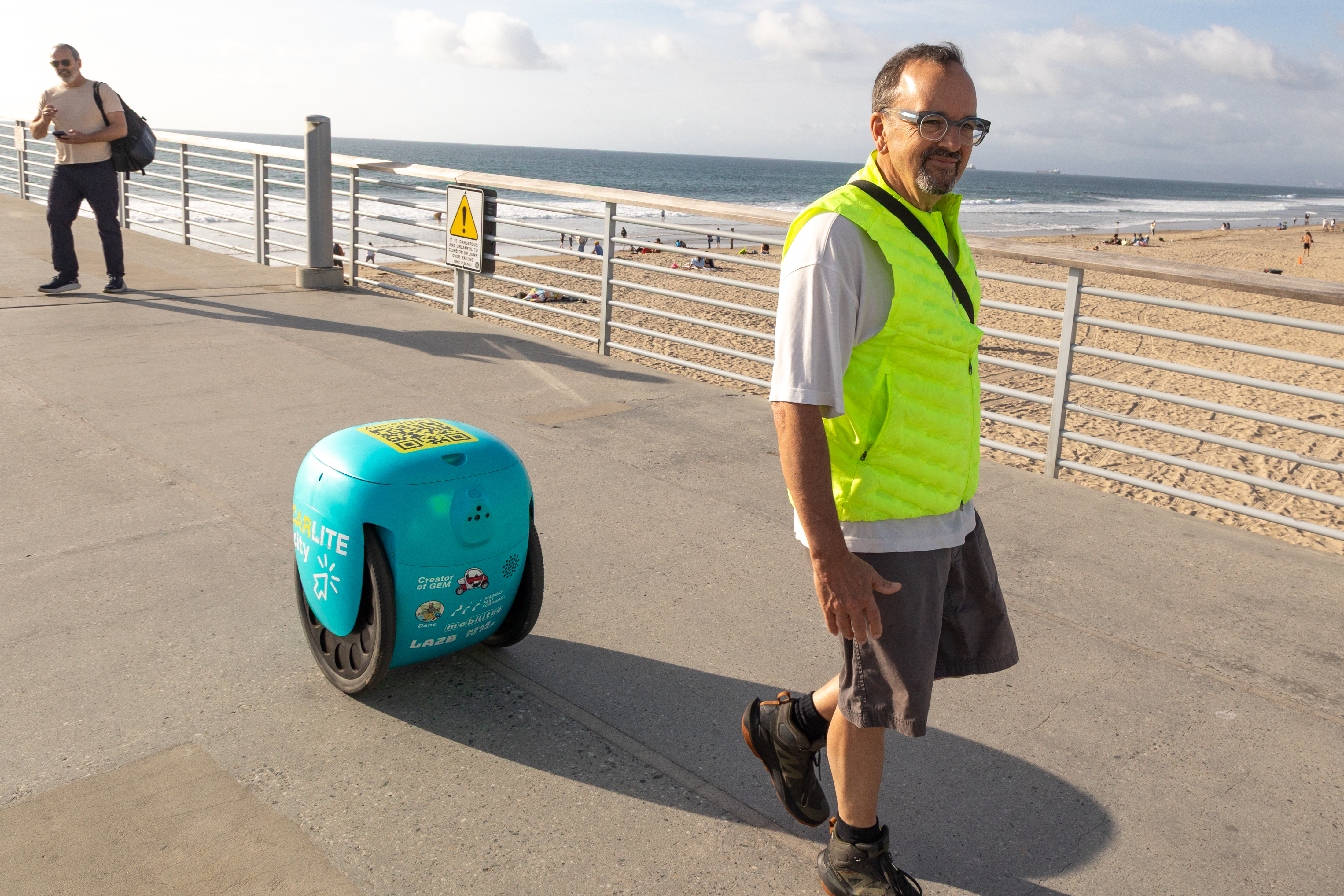
The designer and inventor is on his LA2B tour, an on-foot trek that will take him through all 88 cities of Los Angeles in eight weeks.
The name says it simply: a riff on getting from point A to point B, with an “L” added to plant the idea firmly in Los Angeles.
Sturges is promoting a “more connected, less car-dependent Los Angeles” as well as his latest book, “Near and Far,” while also interviewing city leaders, transportation experts and residents along the way.
Following closely behind is Sturge’s trusty steed, Gita, a cargo-carrying robot that can hold up to 50 pounds of his gear. The robot follows Sturges around like a duckling, using a camera to stay in sync with his movements. Gita is made by Piaggio, the same company that makes Italian Vespas.
Sturges began his LA2B journey on Catalina Island, where nearly all local travel relies on golf carts. He left Avalon by ferry, heading toward Long Beach on February 9.
“I’m a car designer that loves cars, but I love people more,” Sturges said. “As I started to slow down, I started to see how cool it was to see things, to see how people were living, to see their lives, seeing their house, seeing everything.”
While getting his degree in Art Center College of Design in Pasadena in 1983, Sturges thought of the first neighborhood electric vehicle.
“I began riding my scooter around because I couldn’t afford my car and I just thought, why doesn’t the Vespa scooter have a roof?” he said. “It got me thinking about these kinds of intermediate vehicles between a scooter and a car and that led me to start the first neighborhood electric vehicle.”
Sturges worked as a car designer for General Motors in 1986 before starting his own electric vehicle company in Torrance in 1988. It proved hard to compete with billion dollar businesses who later began the same electric approach.
“Some will say I was too early,” Sturges said. “It’s taken many years to see any kind of progress in that area because we’re such a car dependent society.”
As of 2025, roughly 92% of American households own at least one car, according to Hedges & Company, a marketing consultant firm.
Despite improvements in public transit and car sharing, Sturges observed an increase in car ownership over the past five years.
“It’s kind of my WTF moment,” he said. “When are we going to change? We have a climate crisis that’s pretty serious to me.”
A gallon of gas weighs roughly six pounds but burns 20 pounds of carbon dioxide that stays in the atmosphere for 2 centuries, according to Sturges.
“And we’re just doing this mindlessly,” he said.
But for Sturges, the Beach Cities are setting an example by implementing more short-distance vehicles for everyday use such as GEM, a Global Electric Motorcar.
GEM, based in Anaheim, creates electric utility vehicles that can be seen as a popular replacement vehicle for Beach City errands.
Sturges passed through Hermosa Beach on February 14, and noticed the “organic transition” in use of electric motorcars.
“I’d love to see your beach towns become more of a showcase for these kinds of vehicles.”
But the car designer can dream bigger and bolder. He wants to see more of Los Angeles take a crack at car-dependency issues, even utilizing ferries. He cites a scenario all Angelenos know too well; a last minute dinner invite from Pasadena is usually turned down due to LA traffic.
“Well, it shouldn’t be that way,” he said. “We put a person on the moon 50 years ago. We shouldn’t live in a region where we can’t get places.”
As for the 2028 LA Olympics? Sturges would like to see future events mitigated to more local, environmentally friendly watch parties at pop-up stadiums.
“I think the athletes need to come, their families,” he said. “But I don’t think we should be encouraging 12 million people to fly to LA in a climate crisis.”
Part of his tour will address these Olympic ideas to community leaders.
Sturges will be filming his journey for an upcoming online series, publishing encounters with GEM owners, Jay Leno and his car collection in Burbank and his final stop in Lancaster.
“We need to make LA a place where you don’t have to own a car to have a great life,” he said. “And we need to do that as soon as possible. ER