by Laura Garber
The Hermosa Beach City Council approved the city’s first fee update in nearly a decade Tuesday, but not without a fight from the business community.
The city’s first update since 2016 was a correction to years of under-pricing, Administrative Services Director Brandon Walker told the Council in his presentation.
Community Development currently recovers about 63 percent of its costs through, leaving a $1 million annual General Fund subsidy. Public Works recovers about 78 percent. Full implementation, effective July 1, would generate roughly $1 million in additional annual revenue.
Councilmember Ray Jackson said the status quo was no longer defensible.
“We are spending over a million dollars right now of taxpayer-subsidized dollars for these fees,” he said. “We can’t cut and waive and continue the giveaway and the subsidies. That approach is just no longer sustainable,” Jackson said.
Walker acknowledged the sticker shock. “I think when you wait nine years as we have, the amount of cost increases are a shock,” he said. “It’s a painful decision on Council, it’s a painful decision by staff, it’s painful for the community to consider these large increases. These are hidden subsidies.”
But he framed the increases as a path to better services as well as revenue.
“I think a good portion of being business-friendly is responsiveness,” Walker said. “It’s a quick turnaround with plans. A lot of that is making sure we have the consistent staff and the resources to be able to turn plans around quickly so residents and developers aren’t frustrated with long turnaround times.”
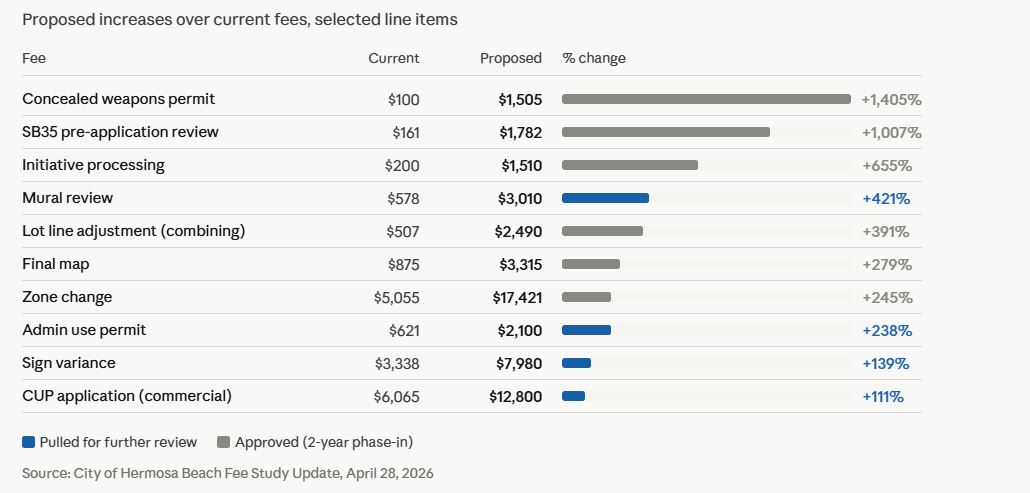
Among the most significant proposed increases: the conditional use permit application fee for commercial uses would rise from $6,065 to $12,800, a 111 percent increase. Administrative use permit fees would jump from $621 to $2,100, a 238 percent increase. Variance fees would nearly double, from $4,674 to $9,985.
Resident Maggie Bove-LaMonica, a trustee for the Hermosa Beach City School District Board of Education, said she supported the direction but wanted to be careful about the approach.
“The modernizing of the fee structure is the right approach,” she said. “I think it’s time for the city to take a hard look at how we do fees and pass it on to users,. But we should be taking a graduated approach.” She added that until the City has worked through its own internal efficiencies, “we shouldn’t be passing those fees along on to users, who are going to just be paying an additional burden for delays in the planning time.”
Resident Laura Pena said the fee study “was done in a way that doesn’t reflect who we are” and warned that doubling or tripling fees without examining internal processes could discourage investment. Resident John David cautioned against what he called a “spreadsheet trap,” raising fees on paper without accounting for the downstream effect on business activity and tax revenue. “CUPs, $6,000 to $12,000, it’s a killer,” he said. “We currently already scare away a lot of businesses.”
A new, $570 annual monitoring charge for businesses operating under a Conditional Use Permit, generated the sharpest Council discussion. Planning Manager Alexis Oropeza said the CUP monitoring process the fee will fud could be structured either proactively, with regular reviews of all CUP holders, or reactively, only in response to complaints.
Councilmember Michael Keegan drew on his own experience as a business owner.
“I had a CUP when I ran my business in Manhattan Beach for 34 years, and I’d be sure ticked off if I had to pay $500 a year to hold that,” he said. “Not one complaint in 34 years, and I don’t even think the city realizes [businesses] have a CUP.”
Resident Eric Horne warned that a complaint-based system could be abused.
“If I make a call on a business I don’t like, does that mean if a planning officer shows up, the business has to pay a fee?” he said.
Council voted 4-1, with Councilmember Rob Saemann dissenting, to approve most of the fee update on a two-year phase-in toward full cost recovery.
Nearly 20 fee items were pulled for further staff analysis, including the CUP application fee, the annual monitoring fee, the mural review fee, the administrative use permit and the appeal to City Council fee. Council members agreed to submit individual feedback to staff by Sunday for incorporation into a revised report at the May 12 meeting. ER