
DEVELOPMENT: Sally’s Tree is coming down, Tree removal permit issued
by Mark McDermott
The saga of Sally’s tree is coming to its end.
The City of Manhattan Beach this week issued tree removal permits for three protected trees at 1823 and 1827 9th Street — including the 50-year-old sweet gum tree planted by Sally Palm, a beloved Manhattan Beach community figure who lived at the address for more than 60 years before her death in 2024.
The decision came after the city took an unusual step: contracting an independent, third-party arborist to review the removal request — something that had not occurred during the year and a half of construction in which the trees’ roots were damaged. That arborist confirmed the findings of the developer’s own arborist, concluding that all three trees had been damaged through construction and posed significant risk to persons and property.
Associate Planner Johnathon Masi notified neighbor Gaston Moraga, who had fought for nearly two years to save the tree, in an email on April 6.
“The consulting arborist concluded the three trees were damaged through construction and require removal, as the trees pose significant risk to persons and property within close proximity to the trees,” Masi wrote. He added that the permits would not be executed before April 21, to allow time for any appeal through the city’s online permit portal. The appeal deadline is 5 p.m. on April 21.
In a previous statement, Thomas James Homes said “decisions involving changes to a neighborhood’s landscape and long-standing features are never taken lightly.”
Moraga, who will be traveling in Chile when the trees come down, said he and his wife Patricia plan to say their goodbyes before they leave on April 19.
“This news was a difficult one for us,” he wrote. “Very sad, and frustrating.”
Vicky Palm, one of Sally and Noel Palm’s five children, learned of the decision Tuesday morning.
“Can’t say I’m surprised, just very sad,” she wrote. “The city tree ordinances are wholly inadequate and ass-backwards. The new house was under construction for a year and a half if not longer. Developers should have to get tree inspections upon purchase of a property and regulations strictly followed. This definitely does not happen.”
“Once trees are hacked at, trimmed severely, not watered, etc., it’s almost inevitable that the city will deem them an insurance liability and [allow the developer to] take them out. Unless a developer decides they wish to save a tree, there is little chance it will happen.”
The three trees being removed include the sweet gum at 1827 9th Street — Sally’s Liquid Amber — an American Elm also on the property, and an Italian Stone Pine at the neighboring property at 1823 9th Street, whose roots were apparently also damaged during construction.
The case has drawn attention to what Mayor David Lesser called “limitations” in Manhattan Beach’s tree ordinance. Lesser, who was on the City Council when the ordinance was last strengthened, said he is “receptive to further modifications.” Community Development Director Masa Alkire, when asked whether the ordinance had enough teeth to deter a developer from simply absorbing the penalty and proceeding, called the question “fair enough.”
Manhattan Beach’s tree ordinance, first adopted in 1993, originally applied only to the Tree Section, where 9th Street is located. In 2003 it was expanded to cover all residential zones.The ordinance was strengthened again in 2006, with increased fines and replacement tree requirements, and revised once more in 2009 to provide greater flexibility while maintaining protections for healthy front yard trees meeting certain size thresholds. Under the current code, any tree with a trunk diameter of 12 inches or greater located in a required front yard qualifies as a protected tree — a threshold the sweet gum at 1827 9th Street, with its nearly 32-inch trunk, cleared by a wide margin.
Though Manhattan Beach’s ordinance defines which private property trees qualify for protection, other California cities place far greater emphasis on enforcement. Palo Alto, for example, imposes civil penalties of $10,000 per tree — or twice the replacement value, whichever is higher — for unauthorized removals, and requires stop work orders when violations occur during construction. Building plans must also show protected trees on neighboring properties within 30 feet, ensuring trees are accounted for before a shovel goes in the ground.
The financial consequence to the developer for the removal of Sally’s tree is a $600 after-the-fact permit fee — double the standard $300 — plus a requirement to plant replacement trees. Moraga suspects the developer must have calculated this as a relatively insignificant cost of doing business. “Those houses go for over five and a half million,” Moraga said.
Whether the appeal window will be used remains to be seen. No party has thus far indicated an intention to appeal.
Palm, writing from Seattle, offered a closing thought on what the tree’s fate says about the direction of her hometown.
“I would not want to be a tree in M.B., where there is a steady influx of cement, artificial turf, and mega buildings taking over the original small homes,” she wrote. “At least the beach survives — so far.”
“That city will just be cement and giant homes soon,” wrote Marsha Lubetkin, Vicky’s sister.
“What a joke their ‘tree saving’ law is.”
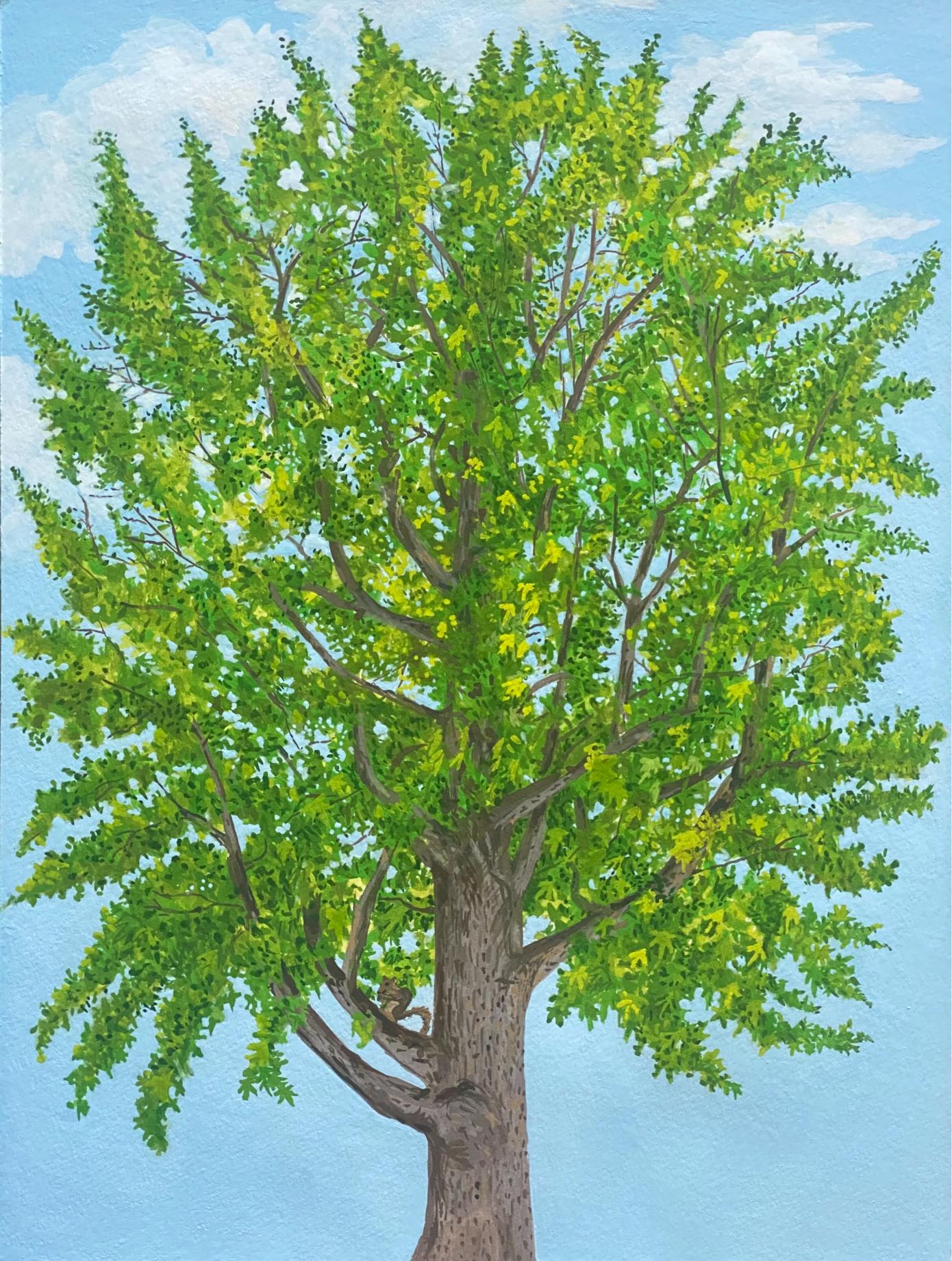
Moraga’s family moved into the neighborhood when the sweet gum was a sapling. He grew up alongside it, and when he realized it was in danger, he made a painting of it. He tirelessly attempted to protect the tree, despite the developer and the construction foreman both allegedly telling him it was doomed, and ultimately succeeded in persuading the City to grant it official protection and erect a fence around its base. It was all for naught. Construction work proceeded inside the protective fencing, severing major roots within feet of the tree’s trunk.
“I take long walks around my neighborhood, and see a lot of Liquid Amber trees, but almost none is as tall, impressive, and beautiful as Sally’s,” Moraga said. “It should have stood another hundred years or more — but strangers who have no connection to the neighborhood decided it was in their way. They came, they ignored what was inconvenient, and killed a tree that was not theirs to destroy. Sure, they would have had to alter their plans a little bit, put their thinking caps on, and find a way to keep ‘no ordinary tree.’ But I guess they had no interest apart from taking every square inch. What laziness, disrespect — and no vision.”
Lubetkin directed her last words on the matter not at the city or the developer, but for Moraga and the tree itself.
“Give it a good send off,” she wrote to Gaston, “and let it know how much the Palm family loved it for all these years.”
Moraga, for his part, had already composed his goodbye.
“I am sorry my dear friend, our tree,” he wrote. “We love who you are, and we will keep you in our thoughts, through photos, painting, and memories.” ER
Comments
Loading comments…