Independent thinkers at the Mall
by Richard Foss
Restaurants in malls used to have an almost parasitic relationship with the retail establishments that were their neighbors. Before online shopping became king, high-end stores like May Company, Sears, and Montgomery Ward attracted throngs of shoppers. Adjacent eateries thrived by feeding the ones who got hungry while walking the endless aisles of merchandise. That model has inverted in the last decade, businesses in the increasingly desolate shopping centers hope that diners will stroll by after they visit one of the restaurants that is their primary destination.
Mall owners have responded by taking their restaurant offerings upscale. Manhattan Village Mall is a good example. When they opened, the restaurant options were all family-oriented spots – Chili’s, Coco’s, and the Olive Garden. Chili’s and Olive Garden are still there, but overshadowed by restaurants where the tab will be triple the old school spots, and that’s if you don’t order the pricier bottles on the wine list. Or the high-end steaks – a ribeye at Boa will set you back $75, with sides and vegetables extra. Even so, those upscale spots at the mall are packed almost every evening.
A reader asked me why more local entrepreneurs aren’t cashing in on these mall-adjacent locations. They certainly haven’t been up to now – of the 19 restaurants in and adjacent to the Manhattan Mall, only one, the Tin Roof Bistro, is under local ownership. It’s also the only one that is not a franchise. There are two reasons there aren’t more like Tin Roof, one of which is that mall locations are generally much more expensive to build out. The first restaurateur in a space is presented with an empty concrete and glass box that takes a huge investment to develop, and consequently multiple years to pay off. They also have many more logistical challenges that are different from those faced by someone starting a restaurant in a location that was previously permitted as a restaurant.
Any restaurateurs who don’t have that development team to draw from must hire people with that expertise and pay them for years before the first appetizer comes out of that kitchen. It’s a big gamble, and few people have the deep pockets and the appetite for risk to take advantage of it. Tin Roof could do that because they are owned by the Simms Group, which also operates multiple mall locations of the Lazy Dog Café. Partner Mike Simms confirmed that mall developers may face pressure from banks to reject proposals from companies without a track record.
“Any proposal has to have very detailed analyses of return on investment, proof of capital to sustain the business during buildout period, and lots of other information that an individual operator probably won’t have. We have that because of the Lazy Dog Café locations that were started by my brother, but even so we faced skepticism in a similar situation, when we opened Lil’ Simmzy’s at The Pointe. The original Simmzy’s in Manhattan Beach was doing great business and we were experienced at mall restaurants, including Tin Roof right across the street, but we hadn’t done a Simmzy’s in a mall space before, so they had to think about it for a while.”
If you visited Tin Roof, would you see any clues that it is different from everything else on PCH between Marine and Rosecrans? The clues start on the beer menu, where two-thirds of the brews are from local breweries. That doesn’t happen at franchise operations that have contracts with the major breweries. The wines list ranges further to fit the Napa-inspired menu, but are all from smaller makers, another hallmark of independence.
The menu has changed considerably since they opened as successive chefs have brought their ideas, something else that sets them apart from places where focus groups make decisions. A few menu items have been there since the restaurant opened 17 years ago, in some cases despite Mike Simms deciding to change them. When he rotated those out, the outrage from customers who couldn’t get their favorites any more forced him to put them back on.
I used to get their Pig & Fig pizza or Indian-spiced spinach dip on just about every visit, but have gravitated to other items as they became available. Their fritto misto is a favorite, the classic of calamari and vegetables fried and served with lemon aioli. Their more innovative items are worth a look too – the roasted mushroom budino is very unusual, a smoky mushroom custard scented with rosemary that is polarizing – you’ll love it or wonder why it exists. Another innovative item is the beet and cheese salad, distinctive thanks to the use of both blood orange and tart Valencia orange.
Their pastas are made in-house and are sometimes departures from the traditional version. At a recent meal, the lamb Bolognese with pappardelle didn’t even resemble the item typically served under that name. Rather than pasta topped with thick red sauce that includes finely chopped meat, it’s a large portion of braised lamb in a delicious but thin red sauce, topped with fresh egg noodle pasta. When it arrived, I asked our server if it had been delivered to the right table. It was a daring expansion of the concept, but we might have actually enjoyed a more conventional version. Other entrees depart entirely from traditions, such as the roasted trout with cippolini onion, red pepper, corn, and olives in a saffron broth. I don’t know who invented this, but they knew what they were doing.
Tin Roof offers daily specials, and the St. Louis ribs make a case for dining there on Sunday. The large portion of seasoned and smoked meat is served with a Coca-Cola barbecue sauce that is tangy and refreshing, an excellent potato salad, pickles and a muffin. Get a salad or vegetable side and it’s a dinner for two, and an excellent one.
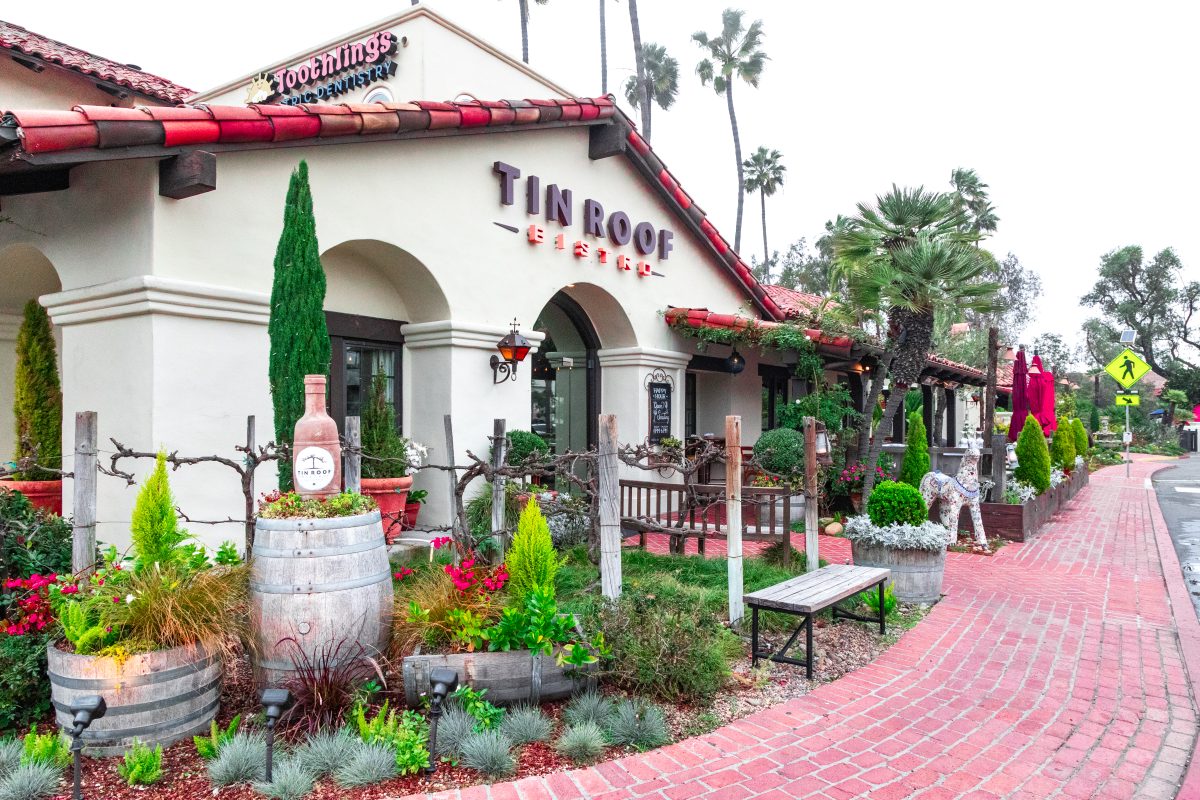
Tin Roof Bistro is different from most other restaurants by the mall because it’s separate from the mall itself and not restricted to the usual boxy architecture. The Olive Garden and Chili’s have this advantage too, but Tin Roof has made the most of it with two patios, one facing the road and parking structure and another in an enclosed courtyard. Both spaces are nicely landscaped, peaceful and quiet places for a leisurely meal. I enjoy them enough that it has to be very cold and windy for me to dine indoors.
Mike Simms mentioned that Tin Roof will soon open for breakfast and lunch. They won’t be the first upscale space at the Manhattan Village Mall to do this, and undoubtedly not the last.
Having observed the restaurant environment in and around malls and how it has changed, what might an expert predict for their future? When I talked with Mike Simms, he mentioned that some malls have turned to sports and entertainment, including bowling alleys that fit in the vacant department stores. Indeed, a bowling alley and bistro that also offers video games recently opened in the Promenade on the Peninsula. When I asked about another possibility, he sounded a bit puzzled.
“You would think malls and mall restaurants would be perfect places for live music because they don’t have any close neighbors. The main building closes too early for evening concerts, but the restaurants set their own hours and get their own permits. It does seem like something that might work, but nobody’s doing it.”
Public spaces have been repurposed since that concept first existed, and there are fads in this as there are with everything else. The one thing that won’t change is that entrepreneurs will serve food anywhere that people congregate, and the best among them will find it profitable to do so.
Tin Roof Bistro is at 3500 N. Sepulveda in Manhattan Beach. Open Sun. — Thurs. 4 to 10 p.m., Fri. 4 to 11 p.m., Sat. 10 a.m. – 3 p.m. and 4-11 p.m. Parking lot, full bar. Wheelchair access good, indoors loud, patios quiet. (310) 939-0900. TinRoofBistro.com. ER