

by Kevin Cody
“Incredible jiu jitsu guy. Incredible knock out. Nothing more needs to be said. Come on over here,” UFC (Ultimate Fighting Championship) president Dana White shouted to Hermosa Beach mixed martial arts fighter Jean-Paul Lebosnoyani.
Moments earlier, in the octagon at the UFC Apex in Las Vegas, Lebosnoyani had stopped welterweight (170 pound class) opponent Jack Congdon with a combination left jab to the jaw, left kick to the head, and overhand right to the jaw. Congdon went out on his feet. Though primarily a jiu jitsu fighter, the win was Lebosnoyani’s fifth professional win by knock out, or technical knockout.
The fight two weeks ago, on Wednesday, September 3, aired on ESPN’s Dana White Contender Series. White uses the series to scout UFC prospects.
Two days later, on Friday September 5, Lebosnoyani gathered with friends and family on the sidewalk in front of his father’s Nono’s martial arts studio on Pier Avenue, in downtown Hermosa Beach.
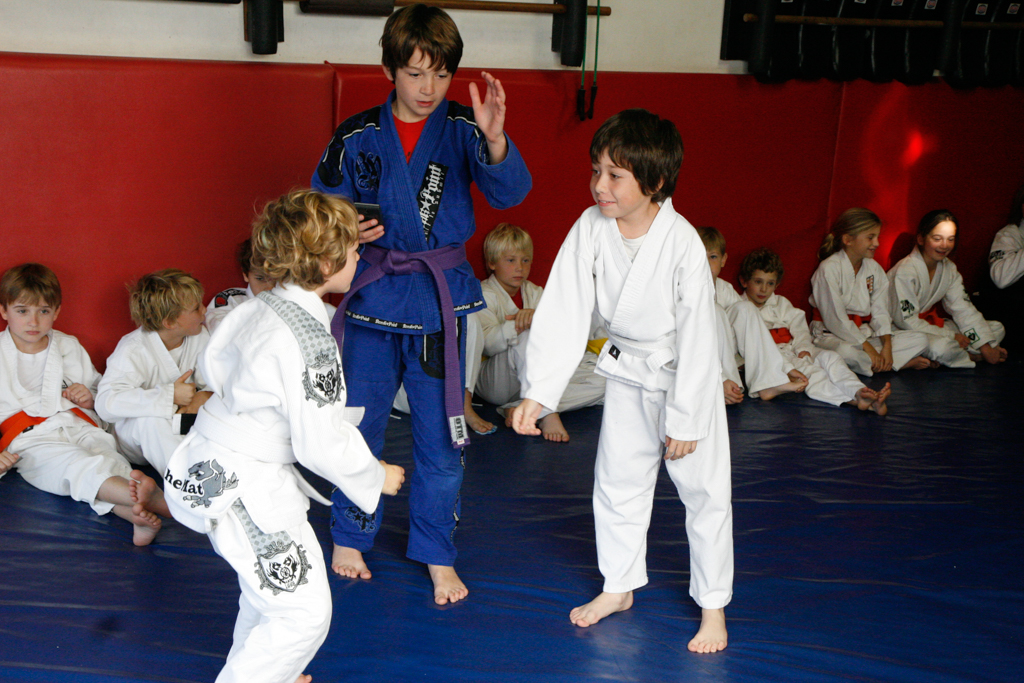
A gaggle of kids he trains hugged him as he thanked all the people who helped him reach the UFC, a goal he first wrote on his vision board when he was his young students’ age.
Lebosnoyani looked and spoke more like the Mira Costa High School wrestler and surfer his friends know him as than a professional MMA fighter. His hair was trimmed. His three tattoos were hidden by his button up shirt, and dress slacks. “Today is temporary,” is on his right thigh; “Mufasa” (King) is on his right bicep; and 13 small hashtags (Lucky 13) are on his chest.
Lebosnoyani beamed as he addressed the sidewalk crowd, and promised to prove himself worthy of their years of support.
Then his father joined him at his side, and he signed the ceremonial UFC contract he had been holding.
Professional athletes are common in the Beach Cities. This month, Lakers superstar Luka Doncic purchased retired tennis superstar Maria Sharapova’s $25 million Manhattan Beach home.
Last week, Mira Costa graduate and Colorado Rockies third baseman Kyle Karros returned home to Manhattan for a game against the Dodgers. On the morning of the game, he told 570 AM radio reporter Ed Cruz, he went downtown for coffee and ran into Dodger pitcher Clayton Kershaw. That afternoon, his dad, Dodger all-time home run leader Eric Karros, drove him to Dodger Stadium.
Retired NBA MVP Steve Nash plays doubles in the annual Manhattan Open Tennis Tournament.
So many Kings live in the Beach Cities that when they won the Stanley Cup in 2012 and again in 2014 they paraded the Cup down The Strand from Manhattan to Hermosa, and ended up at the North End bar, where they poured drinks for the regulars, from the Cup.
Now that the Chargers train at “The Bolt” in El Segundo, and play home games at Intuit Dome in Inglewood, the team, including kicker Cameron Dicker and coach Jim Harbaugh, is making a beachhead in the Beach Cities
Dicker was a celebrity cyclist at this summer’s 13th Annual Tour de Pier cancer fundraiser at the Manhattan Pier.
This past winter, Angel and former Dodger Chris Taylor held his second annual Polar Bear Plunge at the Manhattan Beach pier to benefit the Friendship Foundation, which helps local special needs students.
But of all the professional athletes living in the Beach Cities, Lebosnoyani is the only one to have reached the UFC.
The uniqueness of his achievement is underscored by the fact there are just 600 UFC fighters, about the same number as in other major sports. There are approximately 450 NBA players, 780 Major League Baseball players, 1,600 National Football League players, and 1,000 National Hockey League players. But those other sports are primarily played in the U.S. and Europe. Mixed martial arts is a global sport, which greatly expands the competition for admission to the UFC, the sports premier league.
It takes a village
During the UFC press conference following the awarding of his contract, Lebosnoyani credited his success to his father.
“As a kid, I wanted to play basketball and slack off, but my father was very strict, and brought me to where I am today. Of course, now it’s my own dream, but I’m proud to carry his last name,” he said.
Nono Lebosnoyani began training his son in martial arts before he could walk, or talk.
“Every time someone sees Jean-Paul in competition, they ask how long has he been training. My answer is always the same. Since he was three months old. While I taught, I carried him in a kangaroo pouch. I would whisper in his ear what I was teaching and tell him you will be doing this soon,” the father told an interviewer when his son was 10. Jean Paul began competing in jiu jitsu tournaments when he was 5.
Nono Lebosnoyani is from France and served in the French Foreign Legion, which led to special forces assignment with international law enforcement agencies, including Interpol and the U.S. Drug Enforcement Agency.
When he moved to the South Bay he trained in hapkido under Master Kwon, in Torrance, where he met Eddie Talbot, owner of ET Surf in Hermosa Beach.
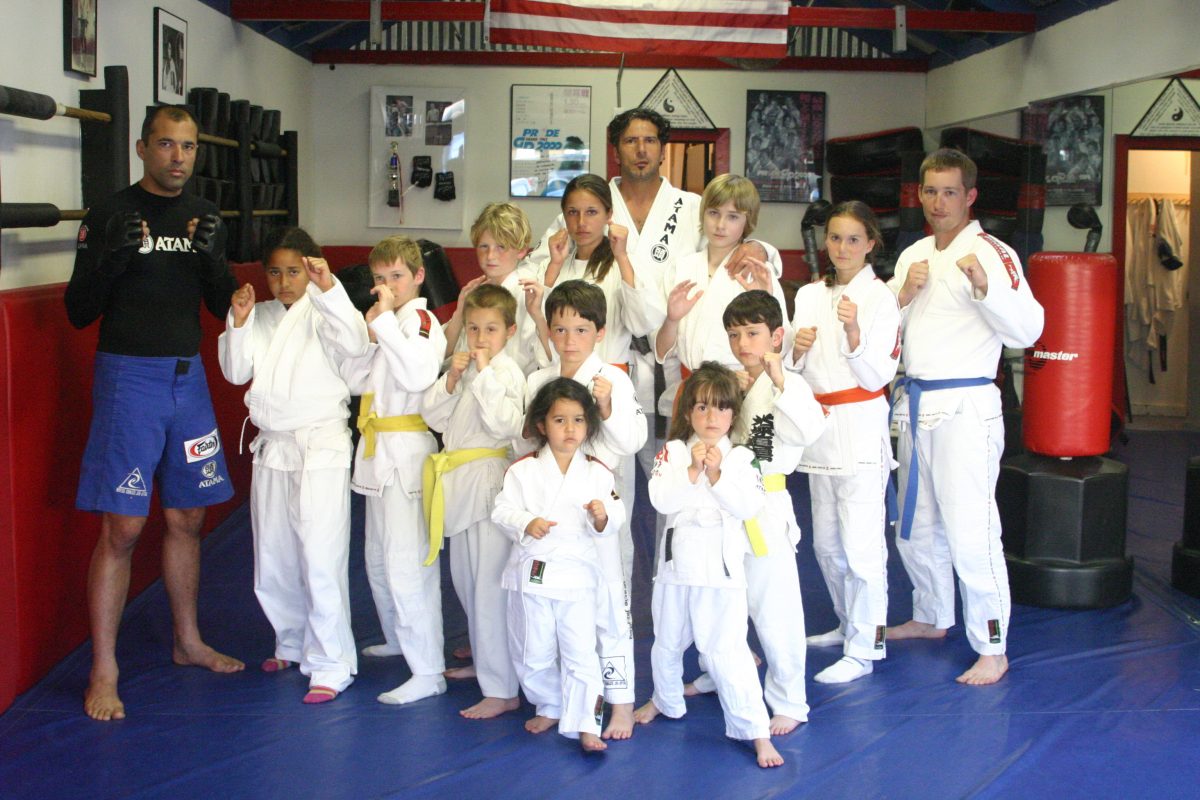
Talbot introduced Nono to Royce Gracie, and to Hermosa Beach, where, in 1987, he opened Nono’s One on One Hapkido in a small storefront between the Java Man coffee house and a dress shop. A speed bag and a few dummies and pads for kicking and punching are the only equipment. The walls are bare except for some of Jean-Paul’s trophies, an American flag, bars for stretching and a few framed photographs of martial arts masters. One is Master Kwon. Another is Gracie, with an inscription in Portuguese thanking Nono for introducing him to the world of stand-up fighting.
The Gracie family started the UFC in 1993, to demonstrate the superiority of Gracie Jiu-Jitsu, founded in Brazil by Royce’s father, Helio. The first UFC fight was held in Denver, the only state that would license the fight, which had no time limits, and whose only rule was no eye gouging.
Royce Gracie won three of the first four UFC championships.
His success was based on Gracie Jiu Jitsu ground fighting, where most fights, including street fights, end up. After taking his opponents to the ground, Gracie would choke them out, or apply joint locks that forced opponents to tap out or have their joints broken.
Following Gracie’s success, stand-up fighters, or strikers, trained in muay thai, taekwondo, karate and kick-boxing, realized they needed to learn what has become known as Brazilian Jiu Jitsu. Which led Gracie to ask Nono to teach him stand up fighting.
“I’m not going to exchange firepower with a larger opponent,” Gracie said in a 1993 Easy Reader interview. At 6-foot-1, 185 pounds, Gracie looked more like a runner than a fighter. “My game is grappling. But I need to know what my opponents can do and I knew of Nono’s background in hapkido.” Hapkido is a Korean discipline with an emphasis on kicking and punching.
When Jean-Paul was born a few years later, in 1999, Gracie became his godfather, and then, one of his jiu jitsu instructors.
Among the lessons impressed on Jean-Paul by his dad and Gracie was even though most fights end up on the ground, they begin standing up. To complement his jiu jitsu, his dad enlisted striking and boxing coaches. Among his boxing coaches was Freddie Roach, whose other students included boxing world title holders Oscar De La Hoya, and Manny Pacquiao.
(Another one of Lebosnoyani’s early coaches was newly appointed Hermosa Beach Police Chief Landon Phillips, who trained with his father, and today requires Hemosa officers to study mixed martial arts. The department has a training center at the police department.)
Though jiu jitsu has hundreds of submission holds, Nono taught his son, like he teaches all his students, to focus on just three maneuvers: the arm bar, the triangle choke and the double take-down, which puts the opponent in the guard when the fighters crash to the mat.
“He told us, ‘Don’t make it complicated. Don’t be a Jack of all trades and a master of none,’” Lebosnoyani said.
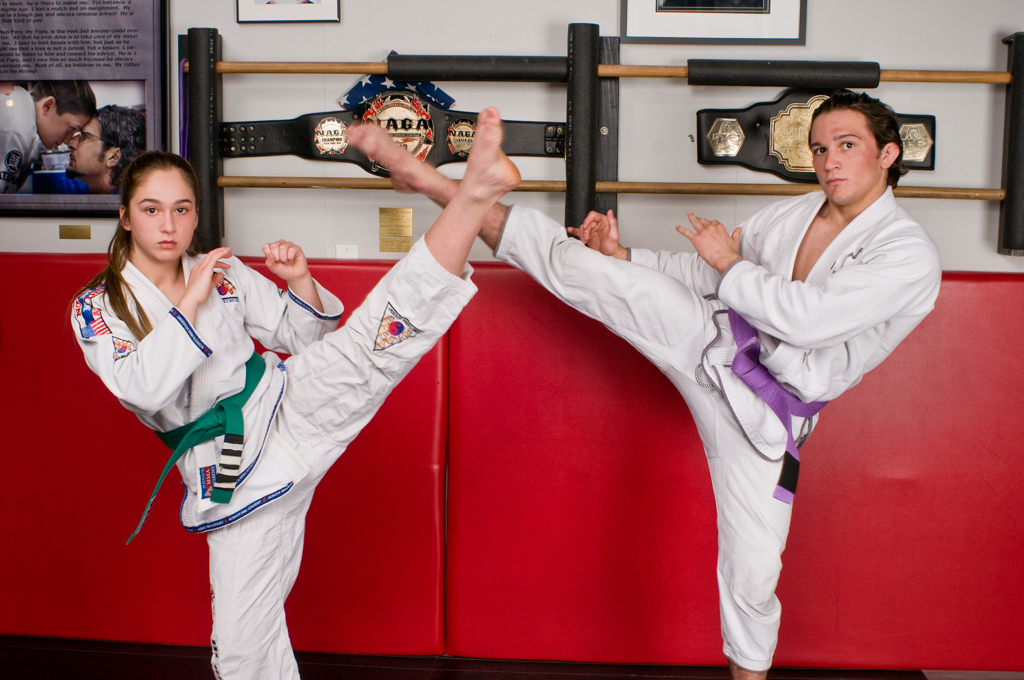
Nono also trains his students to be ambidextrous, and to do leg splits, which enable high kicks.
In 2010, the year Lebosnoyani entered fifth grade at Hermosa Middle School, he competed in eight jiu jitsu tournaments in the 11-year-old, 90 pound division, and won all of them. The competitions included the Canadian International Jiu Jitsu Open in Toronto, the Abu Dhabi Jiu Jitsu Championships, the California State Championships at Long Beach State, and the Pan Am Kids Jiu Jitsu Championships at Cal State Dominguez Hills.
When he entered Mira Costa High his father insisted he join the wrestling team.
“I opposed it for a month. I saw wrestling as jiu jitsu with handcuffs on,” Lebosnoyani recalled.
Mira Costa coach Jimmy Chaney changed that attitude.
“Coach Chaney instilled in me the basics of wrestling. He made me a more rounded fighter,” LeBosnoyani said.
“Wrestling is the art of getting someone to the ground and holding them there. Jiu jitsu is forcing your opponent to submit. Wrestling is like a knife. Jiu Jitsu is like a Swiss Army knife. Together, they are the ultimate weapon,” he said.
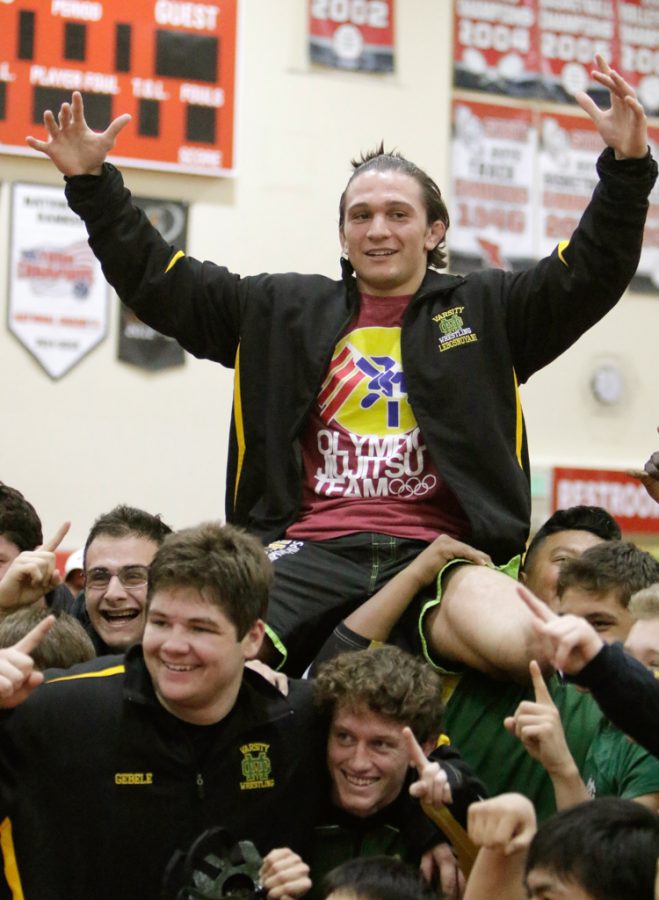
In 2017, his senior year, Lebosnoyani was ranked fifth in the State in the 170 pound division, and helped lead Mira Costa to the CIF Southern Division Wrestling Championship.
While at Mira Costa, he also competed in martial arts tournaments. In 2016, he won the North American Brazilian Jiu-Jitsu Federation (NABJJF) World Championship. In his senior year, he ventured into mixed martial arts competitions and won the four he entered, all by submission.
“My dad taught me to win by submission or knockout. Don’t leave the decision of who won up to the judges,” Lebosnoyani said.
He began fighting professionally the year after graduating, in the LFA (Legacy Fighting Alliance), a stepping stone to the UFC.
In 2023, with his LFA record at 4-0, he was given a fight for the vacant LFA lightweight (155 pound) title. A win meant a UFC contract.
The fight at the Gila River Casino in Chandler, Arizona, was against Jacobi Jones, a former Colorado State University All American wrestler.
Lebosnoyani’s “walk around” weight was 185 pounds. In the weeks before the fight, he “cut” 20 pounds by eliminating protein from his diet. In the days before the fight he “cut” another 10 pounds through dehydration.
“Fighters never enter fights at full strength because we’re always trying to make weight,” he said before the fight.
Despite both fighters being ground fighters, the fight was a stand-up slugfest.
“I’ve seen 25 minute fights with less action than this one. They’re trying to finish each other,” the excited announcer said during the first round.
In the second round Jones cut Lebosnoyani above the left eye with an elbow punch, followed by a knee. Blood spurted out, covering Lebosnoyni’s face and the octagon mat.
“Oh no. Come on ref,” the announcer exclaimed when the referee stopped the fight.
The blinding blood hadn’t slowed Bosnoyani’s furious attack, the announcer argued.
The loss was a reality check for Lebosnoyani.
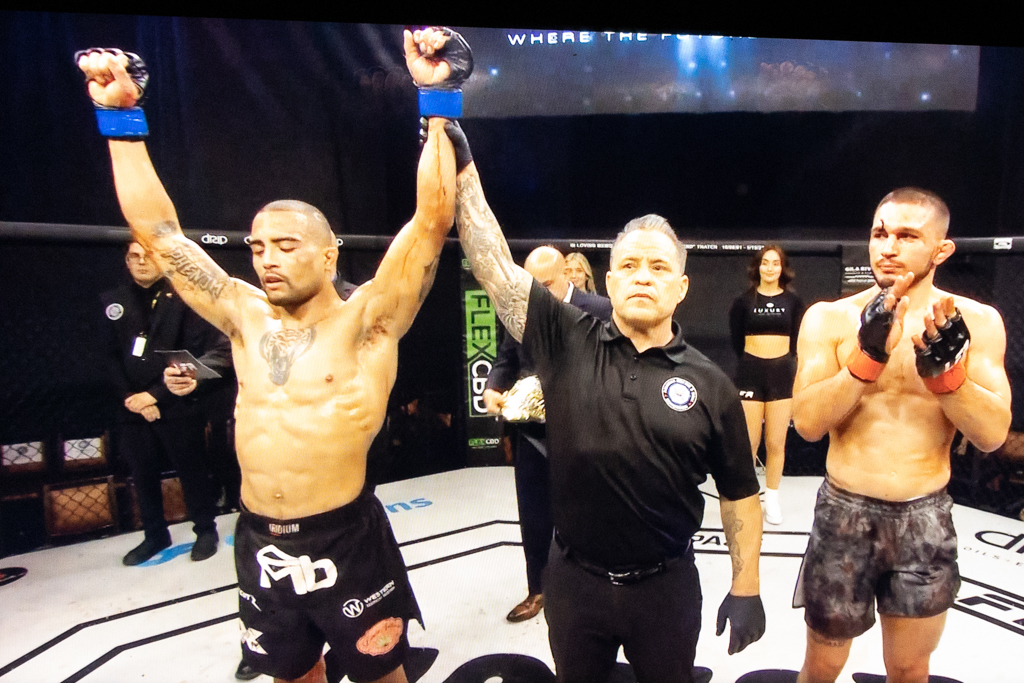
“I thought I’d never lose, that I’d get to the top scar free. But life has a way of throwing curve balls at you,” he said after the fight.
One realization was 30 pounds is too much weight to cut.
And more importantly, he said, “I didn’t have a game plan. I relied on pure aggression. In fighting at this level, you need a strategy, the same as you do in basketball or football. You need to review your opponent’s footage, identify his weaknesses, and study how to exploit them.”
Lebosnoyani moved up to the welterweight division (175 pounds), and won his next three LFA fights. That earned him a second chance at a UFC ticket, on the Dana White Contender Series.
“I knew my opponent was a very skilled striker, a taekwondo fighter. And I knew he would be guarding against a take-down because he knew I’m a ground fighter,” Lebosnoyani said after the fight.
“I used level changes, going up and down to feint take-downs until he became so focused on guarding against a take-down that he left an opening.”
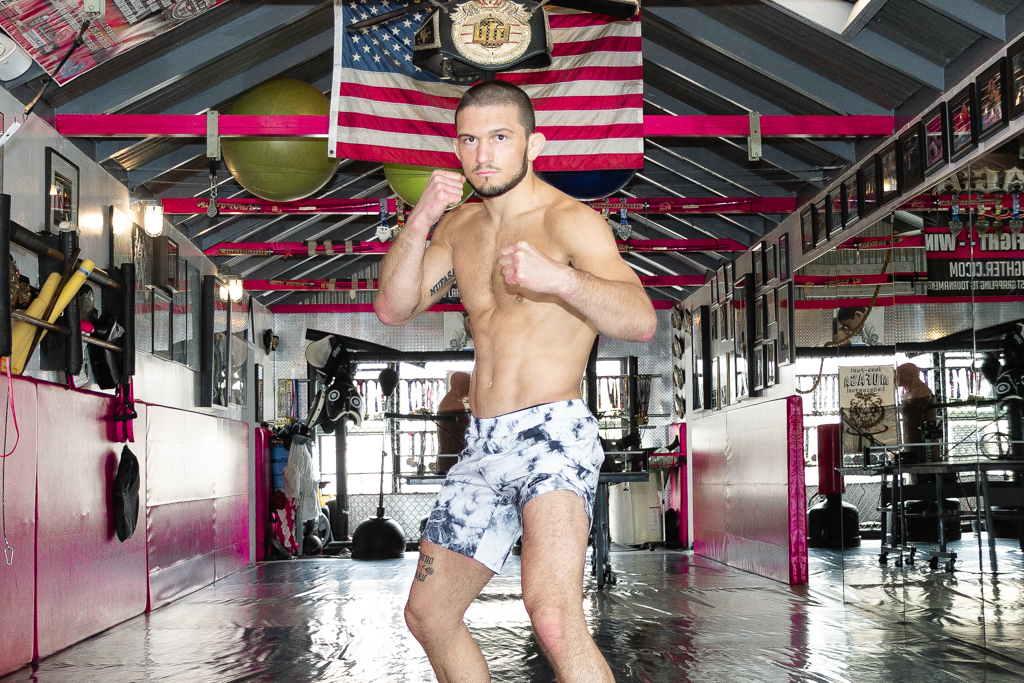
His strategy traced back to his earliest training at his father’s Pier Avenue studio.
“I constantly find myself falling back on the lessons I learned from my dad as a kid. The main one being don’t rush anything. You want to make sure you have position before you move in for the submission.”
“You’re trying to see several moves ahead, and then wait for the opportunity,” Lesbonoyani said. “If you’re hyper focused on the finish, you’ll be blind to everything else. So, my dad taught me to focus on the process. When you do that, the opportunity for a submission, or knockout will present itself to you.”
The decisive high kick traced back to doing leg splits. At 6-foot-2, Congdon was three inches taller than Lebosnoyani.
The left jab that hid the kick, and the right overhand that followed came from his ambidextrous training.
Not depending on ground fighting skills, he learned from watching his father teach kicks and punches to Royce Gracie, arguably the greatest ground fighter in UFC history.
Lebosnoyani doesn’t know when his first UFC fight will be. The UFC does not have a season, so he trains year round.
“The day will come like a thief in the night,” he said paraphrasing his father, and the Bible.
During the week he trains with four MMA teammates from the South Bay, known as the Cobra Team, at the UFC Performance Institute in Las Vegas.
On weekends, he returns to Hermosa to bodysurf at the pier, practice yoga at Soho Yoga, and teach jiu jitsu at his father’s studio.
“There is nothing to compare to the raw primality of being locked in a cage and doing everything possible with your body to inflict pain on your opponent,” he said in a 2023 Easy Reader interview, days prior to the fight the ref stopped because he was spurting blood.”
“I need Hermosa to balance out. It’s necessary for my soul,” he said while in town this week. ER



Spectacular – Congratulations, Jean-Paul!