By Garth Meyer
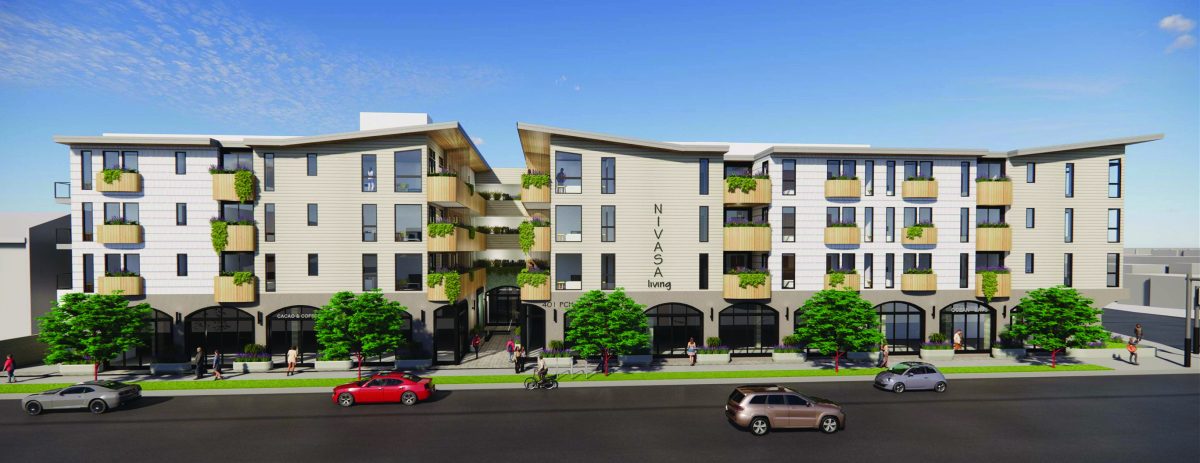
A 49-unit residential building was approved for Pacific Coast Highway and Pearl Street Tuesday night by the Redondo Beach city council.
The project, with commercial space on the ground floor, was denied by the city’s planning commission in December. The original proposal lacked a parking study, commissioners said in their decision, and neighbors maintained that it could impede response times from nearby Fire Station One.
The developers then submitted a traffic study with their appeal to the city council, and got an indirect boost from the Redondo Beach Fire Department, which issued no opinion whether any added traffic would affect its work.
The city council mainly cited tied-hands in its unanimous approval of the project.
“My interpretation of the (current state law) is, with residential, we don’t have a say anymore,” Mayor Jim Light said.
“Sacramento is forcing our hands here. That is where my vote is coming from,” said Councilman Brad Waller, whose constituents formed the bulk of public comment against the development.
“Previously, a city could use subjective design standards (to deny a project), such as neighborhood compatibility,” said Marc Wiener, city development director. “Now these standards have to be objective.”
Weiner first gave a rundown to the council Feb. 17 about three state laws that set the stage for the matter (SB330, AB2011, State Density Bonus Law).
After the planning commission’s rejection of the proposed 49-unit building, Redondo Beach received a letter from the Coastal Commission, advising the city that potential findings of limited public access did not apply. The state Housing and Community Development department wrote to say that a denial of the project would be against the law (AB2011).
The developers, Redondo Seaside Living, LLC, after the planning commission’s vote, modified the four-story structure with an expanded garage, making for a total of 68 commercial parking spaces and 61 residential.
Developer Banarsi L. Agarwal, a Redondo Beach resident, made the case to the council, along with his daughter and business partner, Seema Dhir, and their land use attorney, and the project’s architect.
“It’s very important to keep the project community-oriented,” Agarwal said.
Previous works of his in Redondo Beach include Aviation Villas, 27 units at Catalina Avenue and Francesca Avenue, and more than 100 single-family residences.
The new building will be called “Nivasa Living.” In Sanskrit, “Nivasa” means a dwelling, a home, or a place of belonging.
“We’re not trying to force a project in Redondo Beach… we want this to be something the city can be proud of,” Agarwal said.
Attorney Elisa Paster told the city council that the parking study found that the modified garage was sufficient. The building’s residential units, a mix of one, two, and three bedrooms, would be for sale, she said, except for the eight affordable ones, also in a mix of sizes.
“This project is what this city needs to meet its RHNA numbers (state required housing)… HCD (Department of Housing and Community Development) is going to be watching that,” Paster said. “… Not only does the law compel you to approve this, it is a good project… We could’ve done a stucco box.”
Mayor Light said he disliked Paster’s “veiled threat,” but the adjusted parking for commercial lessened his concern. He then cited the Eddy Redondo, a 115-unit building which opened last July on PCH in Redondo Beach. It has 50 units available at present and two of its 11 commercial spaces are occupied.
“I’m all for affordable units, it’s the market rate (that I’m concerned about),” the mayor said. “We are devoid of affordable units in the Coastal Zone.”
Answering questions from the council, Paster said that the developers would be happy to target its marketing to young professionals who work in Redondo Beach, such as teachers, nurses and firefighters, who cannot afford to live here today.
City Attorney Joy Ford told the council that a court could order it to approve the project, and deem the city liable for fees.
City Councilmember Paige Kaluderovic expressed concern about maintaining and tracking affordable units long-term, and asked how the developers planned to make the commercial space attractive to businesses.
“It is the center of the project, the heartbeat, we really want to get it right,” Dhir said as part of her answer.
In public comment, a neighbor noted, “You’ve got strip malls down the street all empty,” adding that, “a few years ago, I spent a half million for my ocean view. This (building) will now be my view. It’s mostly all two stories in this area. This is grossly oversized. If nothing else, make it all residential, just right-size it.”
A local physician who said he grew up in poverty and finally got a chance to live in Redondo Beach, told the council, “This is luxury living. It’s not an answer to the housing crisis. Safety is a really big gray area that we should consider.”
Another neighbor said take out the commercial space.
“You don’t have control over density and height, but you do have control over safety,” said another. “It’s too big, it’s too tall, it’s not safe.”
“Safety is non-negotiable,” said a Pearl Street neighbor.
“A ‘carmageddon’ incident is going to happen on Pearl Street,” said another resident.
“The elevation just seems enormous, and off-putting,” said another. “Something should be put there, (and) I will lose all of my ocean view. If it happens with a three-story building in code, I would understand that.”
“Ask them, would it pencil out if they got rid of the commercial,” said north Redondo resident Holly Osborne. “… And then you’ll have enough parking.”
Resident Alex Fineman spoke in favor of the project. Wayne Craig, head of the planning commission, said the parking study was very misleading because it was done in January, the lightest-traffic time of the year.
“I think it’s a better project than what we had, thankfully,” Craig said, of what went before the planning commission. “It’s still not going to be enough parking.”
An older gentleman spoke.
“All I ask is that you do your best to not let this become another Manhattan Beach,” he said.
“There is literally no proven harm,” said a caller.
Could the commercial be taken out, asked Mayor Light.
“That commercial revenue is a central tenet of providing for the affordable units,” Paster said.
“(Residential) towers are the future if you don’t do anything about state government,” Councilman Zein Obagi, Jr., said to the crowd.
He made a motion to approve the project. Councilmember Kaluderovic gave it a second. Councilman Scott Behrendt agreed.
“These laws are well-intentioned but they certainly can have difficult consequences,” Behrendt said.
“You’ve got to vote for the right people at the state level, because they’ve tied our hands on this,” Light said.
As for the fire department, “We have no expertise or oversight on traffic flow,” said Jason May, RBFD deputy chief, Wednesday morning. “Our expertise is in responding quickly and providing top-level care to members of the community. We will be able to work around any project, and respond quickly to anywhere in the city.” ER
Q&A
Easy Reader spoke with Seema Dhir, a partner on the “Navisi Living” project approved Feb. 17 by the Redondo Beach city council.
What was your reaction to the council’s vote?
We’re really pleased that they agreed to what we’re legally entitled to… We’re at a crossroads, we are trying our best to meet the needs of now and also the future.
Do you have any concern about the status of Eddy Redondo and other empty commercial space, storefronts in the area?
We’re listening and watching with our eyes open. We feel like the commercial spaces available now are not built to suit. We’re hoping to identify businesses early and build out what they need.
She noted a desired “synergy” to the project.
A city-like feel to the building.
How do you decide whether to build two floors, three, four, five, etc.?
If it were three floors, we would have gone 45 feet, with higher ceilings. We were allowed 45 feet. (It’s) the economics of market rate units in order to be a successful project.
So the building’s units will be all for sale except the eight affordable units?
“We have the ability to sell. We have to see what the market is dictating. We’re hoping to sell them, that’s our goal.”
When might the project be built?
We’re hoping to move quickly. That’s all I have for you now. ER