The Manhattan Beach Unified School District held a standing-room-only budget workshop last Thursday morning. The rain pouring down outside did nothing to discourage a crowd of parents, teachers and community members who packed the boardroom to hear what they feared most: the district’s financial crisis has grown significantly worse since last summer.
“It’s been bleak, and getting bleaker,” board trustee Wysh Weinstein said last June when the district adopted a budget requiring 31 employee layoffs and a dangerous dip into emergency reserves.
Nine months later, the district’s financial situation has only gotten bleaker. The board is now considering almost twice as many position reductions as they made last June, and at this point is preparing to send over 58 pink slips to employees whose jobs may be cut in final budget deliberations this June. Deputy Superintendent and Chief Business Officer Dawnalyn Murakawa-Leopard gave a dire budget presentation that included projections showing that without significant additional cuts, MBUSD will be $6.77 million in the red by next year and $14.35 million in the red the year after.
“The budget situation that we find ourselves in now is not a new situation,” Murakawa-Leopard said at the outset, clicking to a slide that displayed excerpts from three successive district budget narratives — 2015-16, 2020-21, and 2025-26 — each one warning of a structural deficit and the need for ongoing expenditure reductions.
“We have been talking about ongoing deficit spending, a structural issue and the need to make expenditure reductions for many years.”
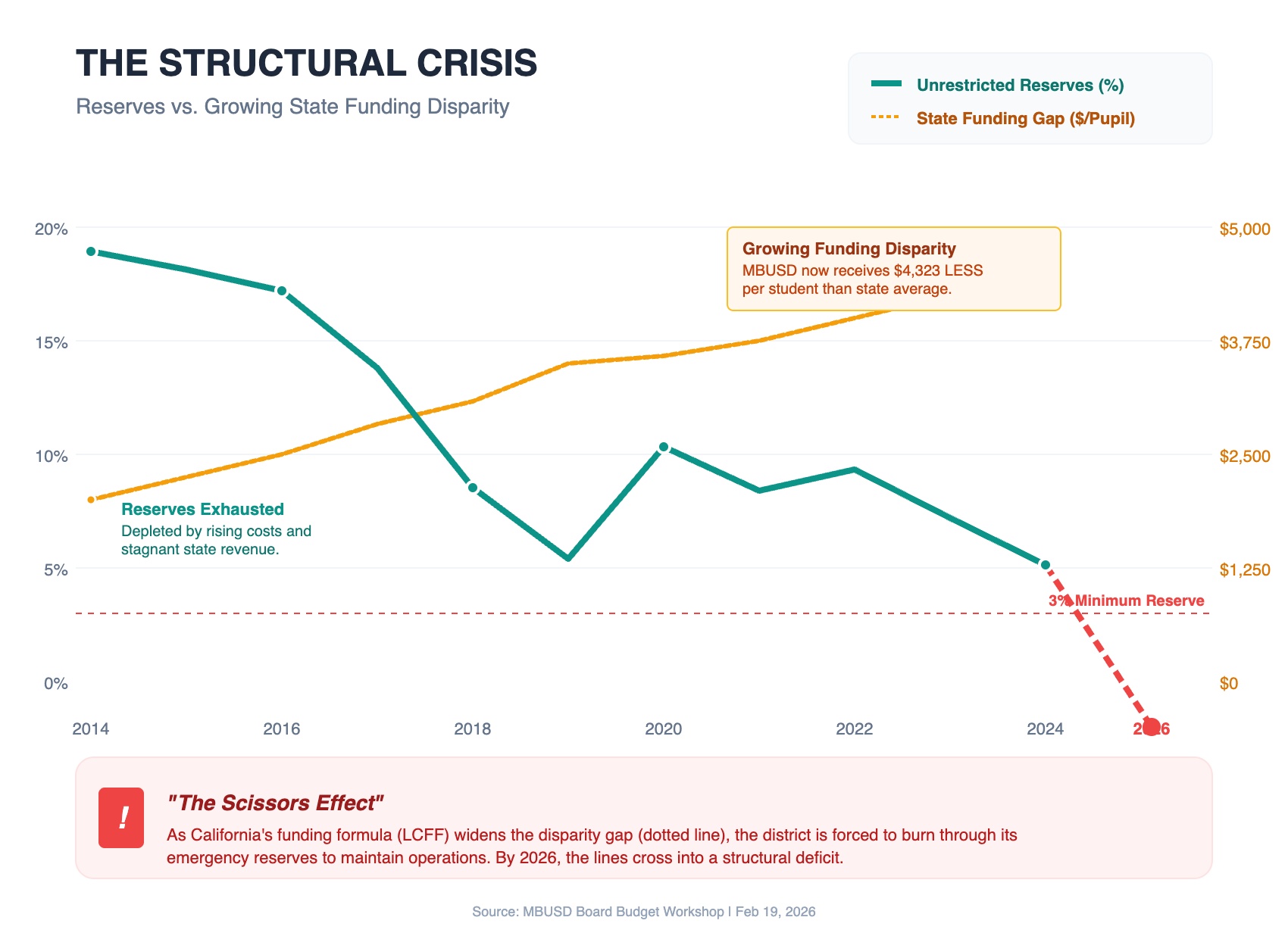
What is new is the scale. The district’s unrestricted reserve, which stood at nearly 20 percent of expenditures a decade ago, has fallen to roughly 7 percent — dangerously close to the state-mandated minimum of 3 percent. And the trajectory is sharply downward.
The root cause, as Murakawa-Leopard has explained many times before, is California’s Local Control Funding Formula, the state education funding mechanism adopted in 2014 to prioritize districts with large populations of high-need students. MBUSD has the second-lowest percentage of such students — English learners, foster youth, and socioeconomically disadvantaged pupils — among the state’s 345 unified school districts. Only 6.31 percent of MBUSD students fall into that “unduplicated” category, compared to a statewide average of 61 percent.
The consequences are stark. MBUSD receives $11,657 per student in total LCFF funding, compared to a state median of $14,421 and a county median of $13,610. The highest-funded district in Los Angeles County receives $16,578. When all revenue sources are counted, the statewide average for unified districts is $22,125 per pupil; MBUSD receives $17,802 — a gap of more than $4,300 per student.
“I do want to add that the LCFF is structured this way intentionally, because the idea is that the structure provides equity,” Murakawa-Leopard told the audience. “The students who are falling into the unduplicated pupil count come to school with greater needs. So this is not to criticize the structure. It is simply to point out that it creates vast funding disparities.”
Making matters worse, the gap has been widening. Over the past decade, LCFF revenue grew 44 percent — but the district’s fixed costs, those it has little or no ability to control, grew 112 percent, an increase of $23.7 million. Pension obligations alone rose $11.9 million over that period. The district’s mandatory contribution to special education grew $7.3 million. Health and welfare costs rose $3 million. Some utility costs have increased nearly 200 percent; some liability insurance costs have risen 700 percent.
Murakawa-Leopard said the overall problem has been growing for a decade — ever since the Local Control Funding Formula was enacted — but was masked by emergency funds received during the pandemic.
“Pre-pandemic we were in a place where our reserves had been depleted and we were making really difficult reductions in our expenses,” she said. “Then the pandemic happened, and a lot of resources came into the district. There were, at the height of it, 24 new sources of one-time funding. The reason we haven’t continually had to have really difficult budget situations is because of that one-time revenue.”
The district has long relied on the Manhattan Beach Education Foundation and local parcel taxes to partially bridge the gap. MBEF contributes approximately $7 million annually, while the Measure MB parcel tax provides another $2.5 million. Together with other local sources, 16 percent of MBUSD’s budget comes from local contributions — far above the state average. But those sources are not elastic.
“These funding sources have sustained this district in many foundational ways for many years,” Murakawa-Leopard said. “But they don’t just grow because we need more money.”
As an example, she noted that Measure MB originally funded more than 20 teaching positions. Today, at mid-teens and shrinking, the same dollars buy less every year. By the end of the measure’s term, it may fund closer to 10 positions.
The crisis deepened sharply between the June budget adoption and the First Interim report in December. Special education costs — legally mandated services the district must provide regardless of funding — surged from $3.74 million to $5.26 million in outside contractor and consultant costs alone, a $1.5 million jump. Much of that increase came from staffing agencies filling vacancies the district couldn’t fill with its own employees, a phenomenon Murakawa-Leopard described as a budget shift rather than purely new spending: positions budgeted as personnel costs became services costs when they couldn’t be filled in-house.
“We have vacancies that we know about in June, and we build our budget on the assumption that we will be able to fill every vacancy by the time we get to the start of school,” she said. “When we have vacancies that we aren’t able to fill, then we sometimes need to turn to outside companies that provide us with temporary people.”
Special education now represents 15.6 percent of district enrollment, a figure that has been rising, tracking a national trend. The services are federally mandated under the Individuals with Disabilities Education Act, meaning the district has no authority to reduce them.
“We are legally required to provide those services,” said Irene Gonzalez-Castillo, the district’s special education director. “This is a federal mandate, and that’s why we’re required to do that, and it’s the right thing to do for students who have this level of need.”
But MBUSD Board President Tina Shivpuri said that funding has not kept up with the special education mandate.
“As a Special Ed parent with a kid who has dyslexia, she needs certain accommodations in order to basically just access her education that other students don’t need,” she said. “It is the right and legal thing to do. But those costs are an underfunded mandate — it’s given some funding, but not the entire funding that it costs.”
MBEF Executive Director Hilary Mahan praised the district’s transparency in hosting the workshop but expressed frustration at what she called a failure to act sooner — and a failure to fight harder when the opportunity presented itself.
In 2022, a citizen-led campaign called MB Citizens for Schools placed Measure A on the June ballot. The initiative would have imposed a $1,095 annual parcel tax — roughly $12 million a year — intended to bring MBUSD’s per-pupil funding closer to the state average. It was defeated by a landslide, 68.8 percent to 31.2 percent, amid an aggressive and partly anonymous opposition campaign.
City Councilmember Joe Franklin, who led the formal opposition, had argued the tax was too large and too long, though he acknowledged a funding problem existed and promised to work toward a “right-sized” solution. That solution ended up being Measure MB, which continued the existing parcel tax at the same level rather than increasing its amount in order to account for the district’s chronic underfunding and what Murakawa-Leopard repeatedly described as an oncoming “financial cliff.”
Mahan, who had warned at the time that the defeat would accelerate cuts and program losses, said Thursday that the district’s own role in Measure A’s failure still troubles her.
“I, along with trustee Weinstein [who was Measure A co-chair, but not yet a board trustee], wholeheartedly worked on Measure A because we knew it was essential,” Mahan said. “But that partnership from the district — and I will say this — was lacking in terms of expressing why we needed it. How did we come to a point where we are not working together to make something positive happen for the future?”
Three years later, with the financial cliff that had been warned about now fully arrived, Mahan said the pattern of deferred action had to end.
“We have failed to look back strategically as to how we could have prevented this,” she said. “Yes, we can look back and say we presented three years ago that we were going to hit a financial cliff. Where was the work then? We’re smart enough to stop this.”
Mahan said that MBEF would try once again to rise to the occasion to help. She noted that only 55 percent of the MBUSD community participates in MBEF’s annual appeal.
“If we got 100 percent, we would be raising well over $15 million in our community to support our schools,” she said. “There are ways in which we can work together to bring this message.”
Aaron Kofahl, a teacher and president of the Manhattan Beach Unified Teachers Association, focused on the human and educational cost of annual layoff cycles — not just that people will lose their jobs, but that MBUSD develops young teachers and then lays them off, a cycle that has created chronic turnover at the expense of that development.
“We hire phenomenal first and second year teachers, and then every few years we lay them off, losing that investment, losing people who have come to genuinely care about their students, your kids, this community and its families,” Kofahl said. “We’ve come to celebrate with these families, victories, and sometimes we mourn with these families, and when we have this kind of turnover, we lose that chain of growth. We have great first and second year teachers and as soon as we hit year three, four, and five, we have a world class teaching staff — if we can keep them that long. And I feel we need to be prioritizing keeping our staff that long.”
Pacific Elementary parent Ashley Pickett pressed district officials for more granular financial data, arguing that the community couldn’t meaningfully engage with decisions it couldn’t fully see.
“We need the actual underlying data,” Pickett said. “We are here with you, to partner with you. We understand the constraints that you have, but this is a frustrating process when it feels like we’re not given transparent data so we can be making these decisions together.”
The immediate steps the district has taken include freezing new travel and conference expenditures, requiring cabinet-level approval for any purchase over $500, reviewing open purchase orders, and renegotiating a staffing services contract to secure a $20,000 credit and a 10-to-15 percent rate reduction. The board will consider a Supplemental Early Retirement Plan at its Feb. 25 meeting, which could reduce costs by encouraging higher-paid employees to retire voluntarily.
The situation is so dire that one question submitted in a community Q & A section of the meeting asked about closing one of MBUSD’s elementary schools. Superintendent John Bowes said that solution would most likely create yet another problem.
“With an empty campus, those become available for charter schools to apply under state law,” Bowes said. “We have been successful in maintaining pretty steady enrollment during a period of decreasing enrollment statewide and here in the South Bay. Closing a campus and opening it up to a potential charter school would exacerbate a declining enrollment trend in our community.”
The board is also exploring a new parcel tax. Polling is currently underway, with results expected at the Feb. 25 meeting.
A group including board members, MBEF, and PTA representatives is also planning a trip to Sacramento to advocate for changes to the state funding formula, particularly around special education funding. The district supports distributing a proposed one-time $2.9 billion state block grant through the base grant rather than on a needs-weighted basis, which would direct more money to districts like MBUSD.
Longer-term, Murakawa-Leopard offered some hope in the form of basic aid status — the point at which local property tax revenue exceeds what the LCFF formula would provide, giving the district more autonomy over its funds. She estimated that milestone is six to 10 years away, depending on property value growth and enrollment trends.
The March 15 preliminary layoff notice deadline is three weeks away. The Second Interim budget report comes to the board March 11. The district must adopt a 2026-27 budget by June 17, likely before the state finalizes its own budget. The MBUSD Board of Education will consider issuing pink slips at its meeting Wednesday night.
Weinstein closed the workshop by putting the crisis in historical context.
“This has been a problem for 50 years,” she said. “This is Prop 13 in 1979. We are still dealing with the unintended consequences of that. This community has been incredible since the early 80s. When we come together, we can continue to solve this problem. This is where we are. This is the reality that we all face.”