
Brad’s Corner: How a man approaching the end of his life galvanized the anti-Trump protests in Manhattan Beach
by Mark McDermott
Brad Graverson had several reasons why he was not likely to ever participate in, much less lead, any kind of a political protest.
Graverson spent 40 years as a photojournalist, the last 37 of those years shooting for the Daily Breeze. He covered many protests, documenting them with his camera. But whatever political convictions he personally held didn’t matter, because his journalistic ethics meant he was an observer, not a participant. Graverson was a supremely gifted observer — arguably the finest photojournalist in the South Bay over the last three decades, inarguably its most stalwart, ever-present photographer.
But as a citizen, he kept his thoughts about whatever he was observing to himself. This didn’t mean Graverson didn’t care, or have thoughts about things of a political nature. It just meant he had a job to do.
“I’m sure I photographed hundreds of protests,” he said. “But reporters, photographers, people who work for newspapers — you are impartial, so to speak. Newsroom ethics are that you don’t participate in politics. I could never put a bumper sticker on my car or wear a shirt that had Obama on it, or whatever. That was just not done.”
Graverson retired from the Daily Breeze in 2017. He wasn’t one of those guys who was worried about what he was going to do in retirement. He liked to travel, to backpack, to fish, and spend time with family. And of course, he continued to photograph, but now strictly for his own sense of art. He had a lot to do and plenty to look forward to.
But things didn’t go according to plan.
Five years into his retirement, he began to feel that something just wasn’t right with his body. After a year of tests, in November 2023, Graverson was diagnosed with ALS, better known as Lou Gehrig’s disease. Every plan he’d had was gone at that point.
“If I was retired without ALS, I’d have a million things I want to do,” he said. “I have a house in Oregon where I went fishing and hiking and cycling all summer. I can’t do that anymore.”
ALS (Amyotrophic Lateral Sclerosis) is a progressive neurodegenerative disease that attacks nerve cells in the brain and spinal cord that control voluntary muscle movement. Progressive, means the disease moves slowly but surely, taking away function after function. There is no cure. ALS is a terminal diagnosis.
Graverson is matter-of-fact about what his future holds.
“It’s a long, slow, agonizing thing,” he said.
His legs were the first thing to go. Which meant, among other things, he could no longer photograph. If you ever saw Graverson shooting, you saw a man in motion, athletically so — moving around to find the best angle for a shot.
“I can’t take the pictures I would like to take, so I took that off my list,” Graverson said.
But something happened in early 2024 that moved Graverson in a different way. On February 28, Ukrainian President Volodymyr Zelenskyy visited the White House, and on live television received a dressing down from President Donald Trump and Vice President JD Vance.
“You’re in big trouble… you’re not winning this,” Trump told Zelenskyy, referring to its ongoing war with Russia, which he said Ukraine would have lost in “two weeks…or maybe less” were it not for U.S. support.
“Have you said thank you once?” Vance asked.
At one point, Trump said, “This is great TV.”
Watching from his home in Manhattan Beach, Graverson was aghast. Something about the exchange deeply upset him.
“That pretty much felt like the trigger for me,” he said.
Graverson made a protest sign and went to a protest organized statewide that locally occurred in front of Manhattan Beach City Hall. It was a very small gathering, but the first protest he’d ever participated in. When he went back home, Graverson knew this was only the beginning, for him.
“Then I said, I’ve got to keep doing this, and the best corner to do it is right by my house, because it’s got so much traffic going past the mall,” he said. “So I just went out there with my sign.”
So here he was, a man who knew the number of days he had left in this world were growing diminishingly finite. Yet he rolled up the hill to Sepulveda Boulevard, and started his very own one-man protest.
The nature of his condition, rather than providing another reason not to participate, made doing so feel more imperative to Graverson.
“When you have a terminal diagnosis with ALS like I have, you’re thinking in different directions,” he said. “It’s not so much about owning certain things, or a rush to do this or do that. It makes you more introspective about how your life is going, and what you want to say to people. I have limited time to do that.”
“A terminal diagnosis from a doctor, it kind of sets your head spinning a little bit, and you realize your time is limited,” Graverson said. “It slaps you in the face. You start looking around and going, ‘What’s important in my life?’”
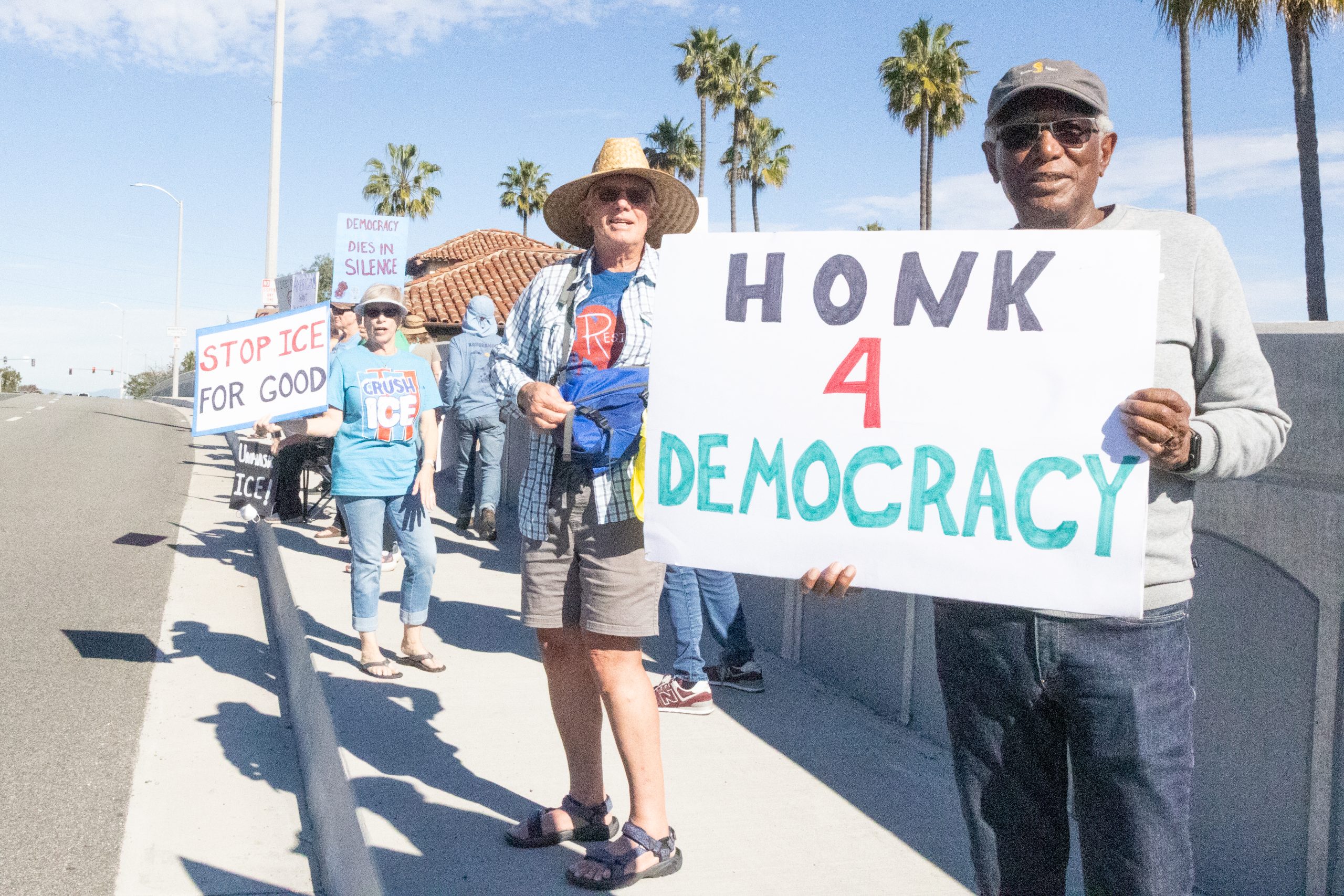
Mickey McRae, of Hermosa Beach.
From one to many
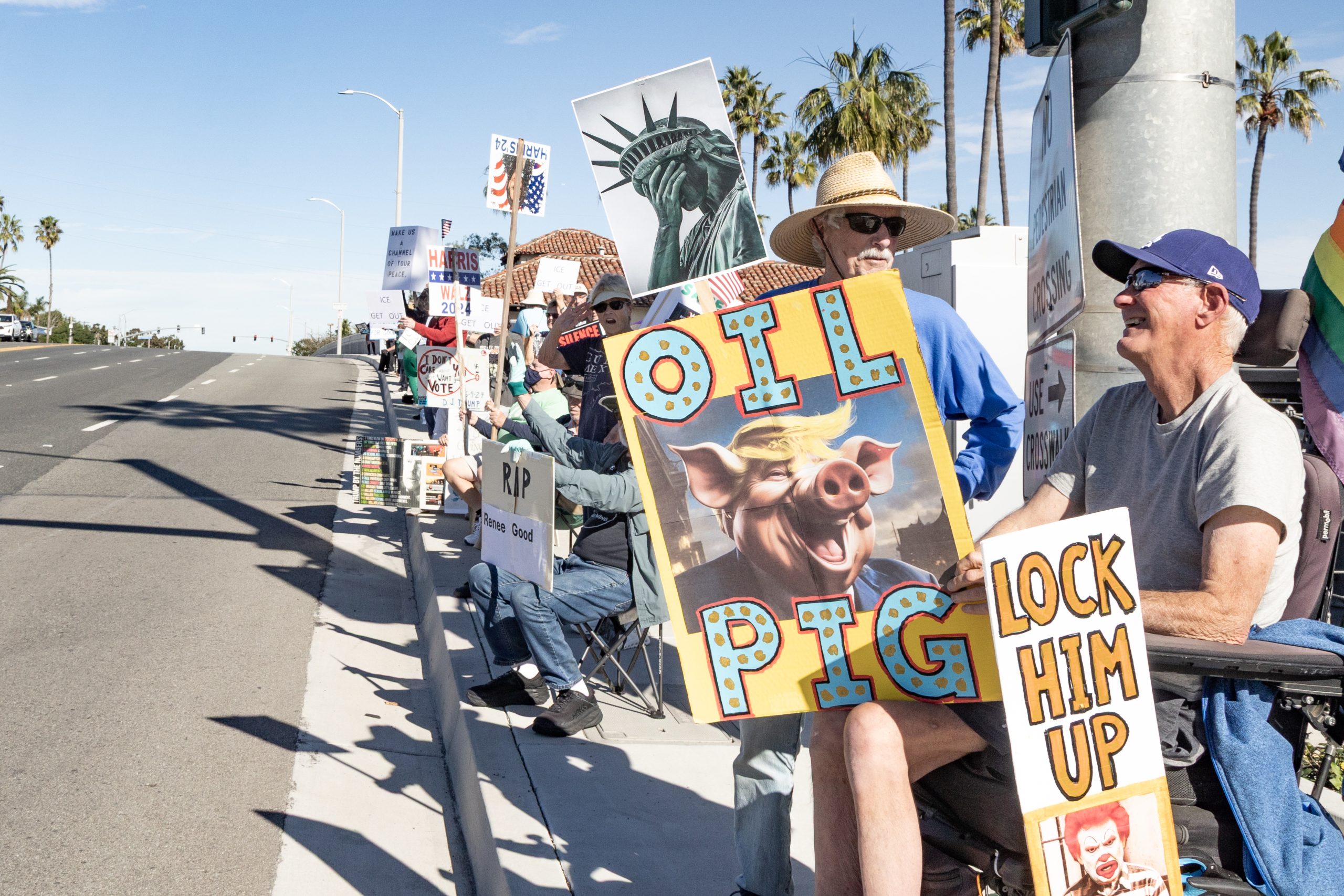
For the first few weeks, Graverson protested alone at the corner of 33rd Street and Sepulveda Boulevard, right by the Manhattan Village mall. He’d wheel his chair out there about three days a week, holding signs he’d made himself. Drawing on his years as a visual artist, he’d scour the internet for interesting images and create what he calls “weird juxtapositions of words and type.”
One early sign read “Dump Trump / Orange Lies Matter.” He later changed it to “Epstein Files Matter.” He also hung a small Trump effigy from his wheelchair — “Like a little voodoo doll,” he said, “but I don’t stick pins in it,” — and flew a Pride flag.
There was something else driving Graverson beyond the Zelenskyy incident. As a self-described “old white guy” in Manhattan Beach, he wanted to make clear to everyone who saw him exactly where he stood.
“I really didn’t want anybody looking at me and thinking that I might have voted for Trump,” he said. “The nannies that walk by… I’m out there with my dog. They’re looking at me, and I don’t want them thinking that I might have voted for this guy. I’m just going to tell people who I am, what I think. I’m not going to be Mr. Anonymous photojournalist anymore.”
After about a month of solo protesting, Graverson admitted it “got a little boring.” He was getting responses from passing cars — both supportive horn honks and the occasional middle finger or worse. Some people spit at him from their cars. One passenger shot him with a Nerf water gun.
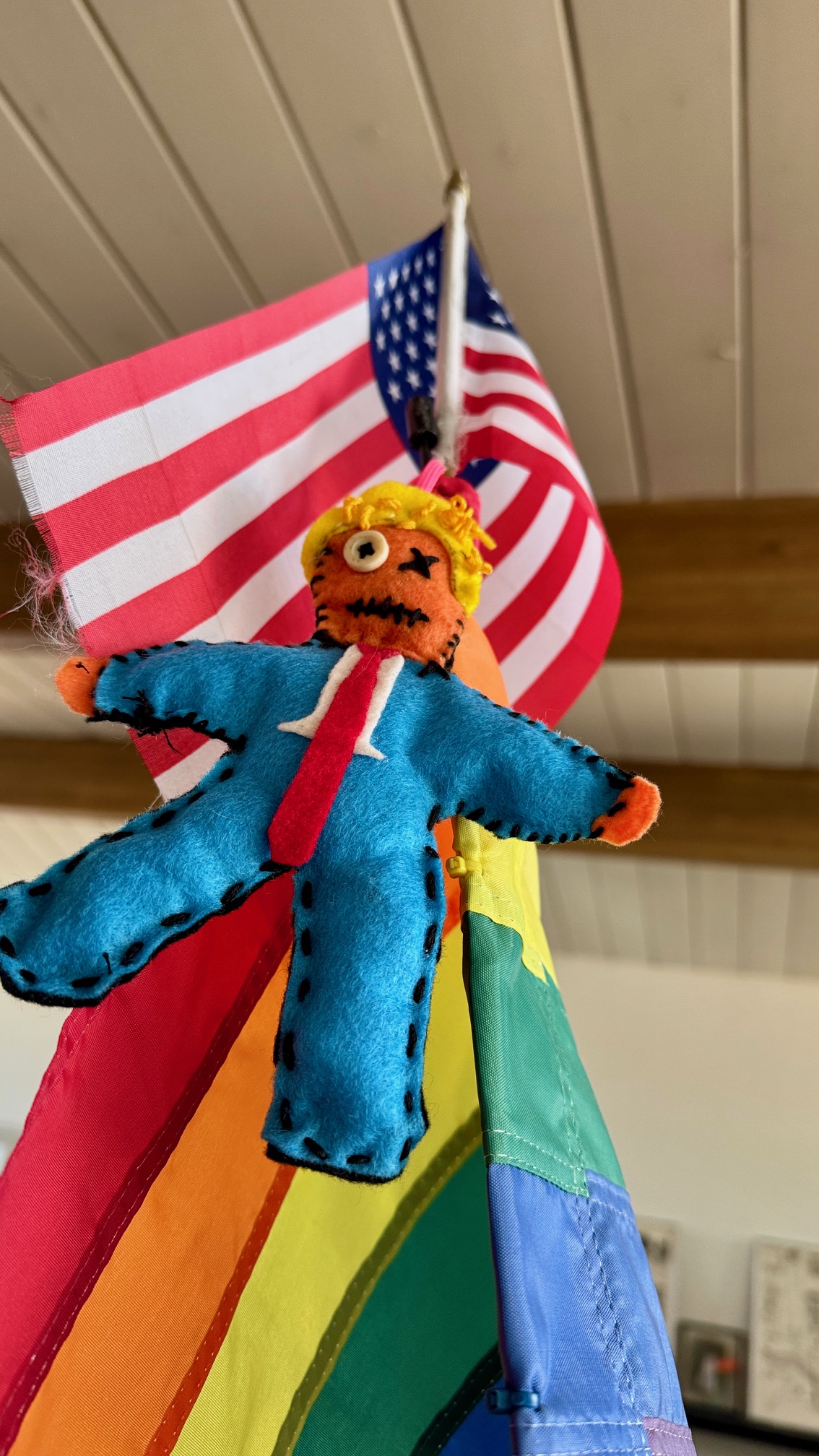
Brad Graverson’s Trump effigy, which hangs from his wheelchair. Courtesy of Brad Graverson
Then one day, a woman stopped her car and approached him. She said she wanted to protest with him. The woman was part of a group called the Manhattan Beach Huddle, and she asked if she could bring some friends.
“I said, of course,” Graverson recalled. “And it just really snowballed from there.”
The Manhattan Beach Huddle has been operating largely under the radar since 2017, formed in the wake of the Women’s March that occurred in Washington D.C. the day after Trump’s first inauguration. Penny Markey, one of the group’s founding members and its postcard coordinator, explained that after the march, organizers told participants not to go home and think they were done.
“They said, ‘Stay with your groups. Create groups in your community and call them huddles, like huddles in football,'” Markey said. “Get together and figure out something to do.”
What the MB Huddle figured out to do was ambitious and sustained. Since 2017, the group has sent out more than 110,000 postcards supporting political candidates and get-out-the-vote efforts, both locally and nationally.
“We are self-funded,” Markey said. “Every once in a while we get a grant or donation, but mostly we throw in cash. We make the postcards themselves available, the addresses, the script, and we make stamps available if people want them. We do not turn anybody away from postcarding.”
The group has about 150 members, with 60 people who postcard regularly. When their postcard efforts first started, stamps cost 34 cents. Now they’re 61 cents.
Beyond postcarding, the Huddle holds regular meetings, bringing in speakers on various issues — banned books, environmental concerns, healthcare, whatever interests their members. The goal, Markey said, was to be active rather than just sitting around complaining.
When one of the group’s members saw Brad Graverson sitting alone at 33rd and Sepulveda, she saw an opportunity for the Huddle to do something more visible. The group began joining him on Sundays, and what became known as “Brad’s Corner” grew to a regular gathering of about 30 people every Sunday morning from 10:30 to noon.
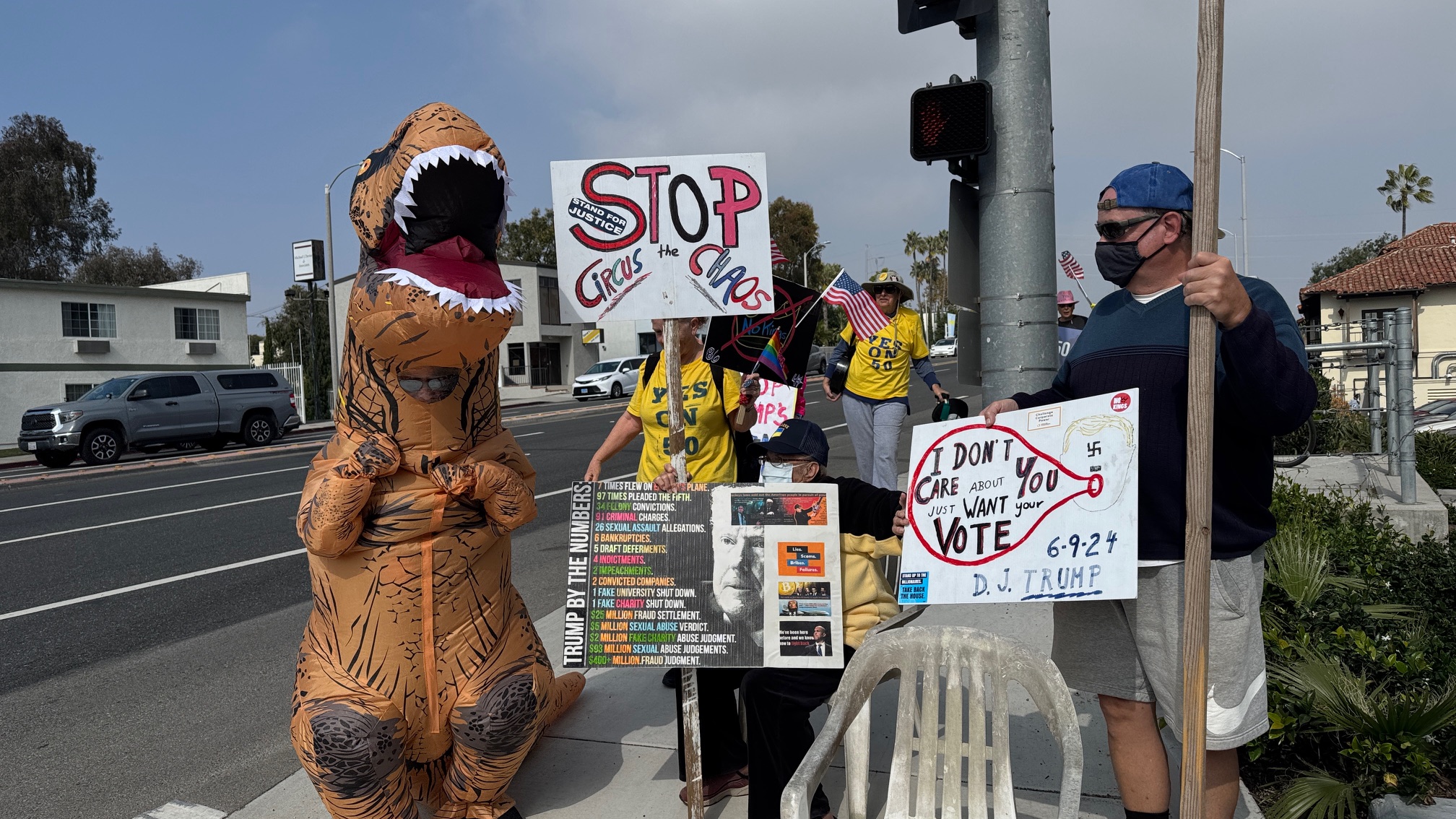
Brad’s Corner attracts an assortment of activists. Courtesy of Brad Graverson
“We have a frog, we have a lobster, we have unicorns, we have a T-Rex who joins us,” Markey said, describing the costumes some protesters wear. “We have music. We all have our signs. We are peaceful. We are nonviolent. We have our share of whistles and bells, and we stand on that corner every Sunday morning, at which point we fold up our tents and we all go home with plans to come back the next week. That is what we do.”
Markey noted that the group is meticulous about leaving no trace behind. “There is never a scrap of trash on the street when we leave,” she said. “We don’t leave anything behind, including scraps of paper or candy bar wrappers or anything.”
For Graverson, the weekly gatherings changed his world in unexpected ways.
“It’s opened my life up to a whole different group of people whom I would never talk to,” he said. “I’m not a super outgoing, vocal kind of guy. I’m just kind of hanging to myself a lot. But people just walk up and talk, and I’m happy to talk to them.”
The recognition extends beyond Sunday mornings. People now approach Graverson when he’s at the library or on the Manhattan Beach pier.
“They see my wheelchair and they say, ‘Are you the guy on the street corner with the flag, with the protesters?'” he said. “Everyone thanks me for what I’m doing. And usually there’s a little discussion about it, and they say, ‘I want to come out with my daughter next week.’ And I say, ‘Sure, come on down.’ And it’s good, because it’s every Sunday.”
The protests have even opened doors for difficult conversations. “Some good friends who voted for Trump… they know what I’m doing.” Graverson said. “This is opening the door for some conversation.”
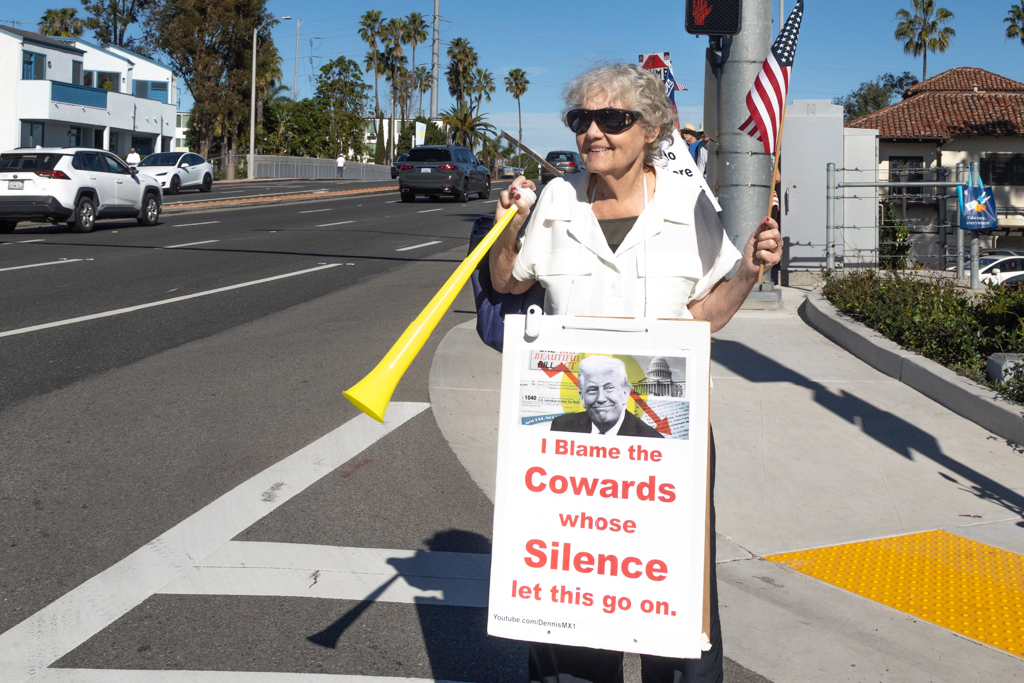
Melanie Mosher, of El Segundo.
Minneapolis changes everything
On the morning of January 7, Renée Good, a 37-year-old American citizen, was fatally shot in Minneapolis by Immigration and Customs Enforcement agent Jonathan Ross. Good and her partner had just dropped their six-year-old son off at the elementary school he attended in their neighborhood. ICE protests were occurring just down the street. Good pulled her vehicle out in the middle of the street, blocking the ICE vehicles. When ICE agents got out of their vehicles and approached, Good attempted to drive slowly away. Ross fired three shots, killing her — one through the windshield, then two through the open driver’s side window. In video footage, he could be heard calling Good a “f***ing b***h” immediately after killing her. He then drove away from the scene. The Trump Administration has been adamant that Ross was acting in self-defense — that Good had “weaponized” her vehicle — though most analyses of the various footage taken of the shooting undermines that claim.
The shooting galvanized protests across the country. Indivisible, a national progressive organization with which the Manhattan Beach Huddle is affiliated, put out a call.
“The response that came through from MoveOn and Indivisible and many of these partnering coalitions said, ‘Okay, you’ve got to get people out on the street,'” Markey said.
She and fellow Huddle member Joanne Hadley posted information about their Sunday protest on Indivisible and MoveOn websites. The response was immediate and overwhelming.
“I personally received over 100 RSVPs in the two days before the event,” Marky said. “I was starting to get really nervous.”
On Sunday, January 11, 177 people showed up at Brad’s Corner — nearly six times the usual crowd. For the first time, the protest stretched all the way up Sepulveda from 33rd Street to Rosecrans Avenue, a goal the group had never quite reached before.
“It was pretty wild,” Graverson said. “I was very impressed, although a little worried.”
The concern is that violence against the protesters is not, at this juncture, out of the realm of possibility. But so far, the response to the protests, in the wake of Minneapolis, have been overwhelmingly positive.
The horn honking the Sunday immediately after the shooting was continuous.
“From the minute we crossed the street to the spot where we picket, the horns started, and they went straight through completely until we left at noon,” Markey said.
Graverson has been tracking the responses he gets from passing cars, trying to gauge what percentage honk in support versus what percentage flip him off. The latter, he said, is now “very rare… rarer than it was before.”
The shift in demographics has been notable. In the early months, support came mostly from women honking and waving. Then more men started showing up and honking. More recently, even people in pickup trucks — “talking about demographics, who drives pickup trucks, mostly younger guys,” Markey noted — have been showing support.
What occurred in Minneapolis has become a flashpoint, but ICE’s presence has also been felt acutely in Southern California. ICE has conducted raids at car washes in Manhattan Beach — reportedly three raids of the Red Carpet car wash on Sepulveda — as well as in Redondo Beach. Home Depot locations, where day laborers congregate, have been targeted. The fear is palpable throughout the South Bay’s immigrant community.
Manhattan Beach City Councilperson Nina Tarnay, who as a child was herself an immigrant, one of the Vietnamese refugees known as “boat people” who were forced to flee during and immediately after the Vietnam War when the Communist regime took over, sees the impact within her affluent beach community.
“When you look across our city, who’s working in our homes, who’s working in our yards, who’s building our homes, it’s all immigrant labor,” Tarnay said. “I grew up as one of those. My mom was a manicurist — the service industry, that’s what immigrants do, right? Provide the labor that drives this economy, that drives this country. As Americans, we were more than happy to take advantage of that cheap labor. But when people start stoking up racism, fear of others — then you’re not even seeing those people anymore.”
“We are such a privileged community that benefits so greatly from the labor of immigrants, from our childcare, to our gardening, to restaurant services, to construction—none of that would get done without the labor of immigrants. Beyond the raids on immigrants, I’m worried about our Constitutional rights. Like all attorneys, I took Constitutional Law and understand the importance of abiding by our laws. The Constitution is not optional or situational. It is the shared safeguard that protects all of our rights. The deprivation of due process of anyone on U.S. soil should worry us all, because once the government decides only some people’s rights matter, none of our rights are secure.”
Markey knows the fear rippling across the immigrant community intimately through people in her own life. Her housekeeper of many years takes the bus from East LA every Tuesday.
“She’s scared to death, and I’m scared to death for her,” Markey said. “She’s a member of our family. She has her papers, whatever she needs. But that doesn’t keep a brown woman on the bus from getting harassed, or from getting picked up.”
Her gardener, who lives in Inglewood and is also a legal immigrant, tells her he can’t find workers anymore. “Nobody is willing to come out and work for him anymore from the Hispanic community,” she said. “And we talk about it, and he says it is scary to walk down the street if you’re a brown person or a black person in Inglewood.”
Markey’s response was deeply personal. “You know what I did one day? I apologized,” she said. “I apologized for our country that would do that to them. These are members of my family. I know them well. And my heart breaks.”
The protests aren’t limited to Manhattan Beach. In Torrance, at Hawthorne and Sepulveda, a protest that didn’t exist before Minneapolis drew 1,000 people over two days. Similar gatherings have emerged in El Segundo, Westchester, and Culver City.
For Markey, the urgency is both political and personal. She’s Jewish, and her grandparents came to America while their parents and other family members “disappeared in Europe at World War Two.”
“One of the things I have always had as a question in my mind, in my head, in my heart, is: How long do you stay? What do you do if you’re in a situation like they were in Europe?” she said. “And here we are. We can’t let it happen to us. We have to stand up for what we believe in.”
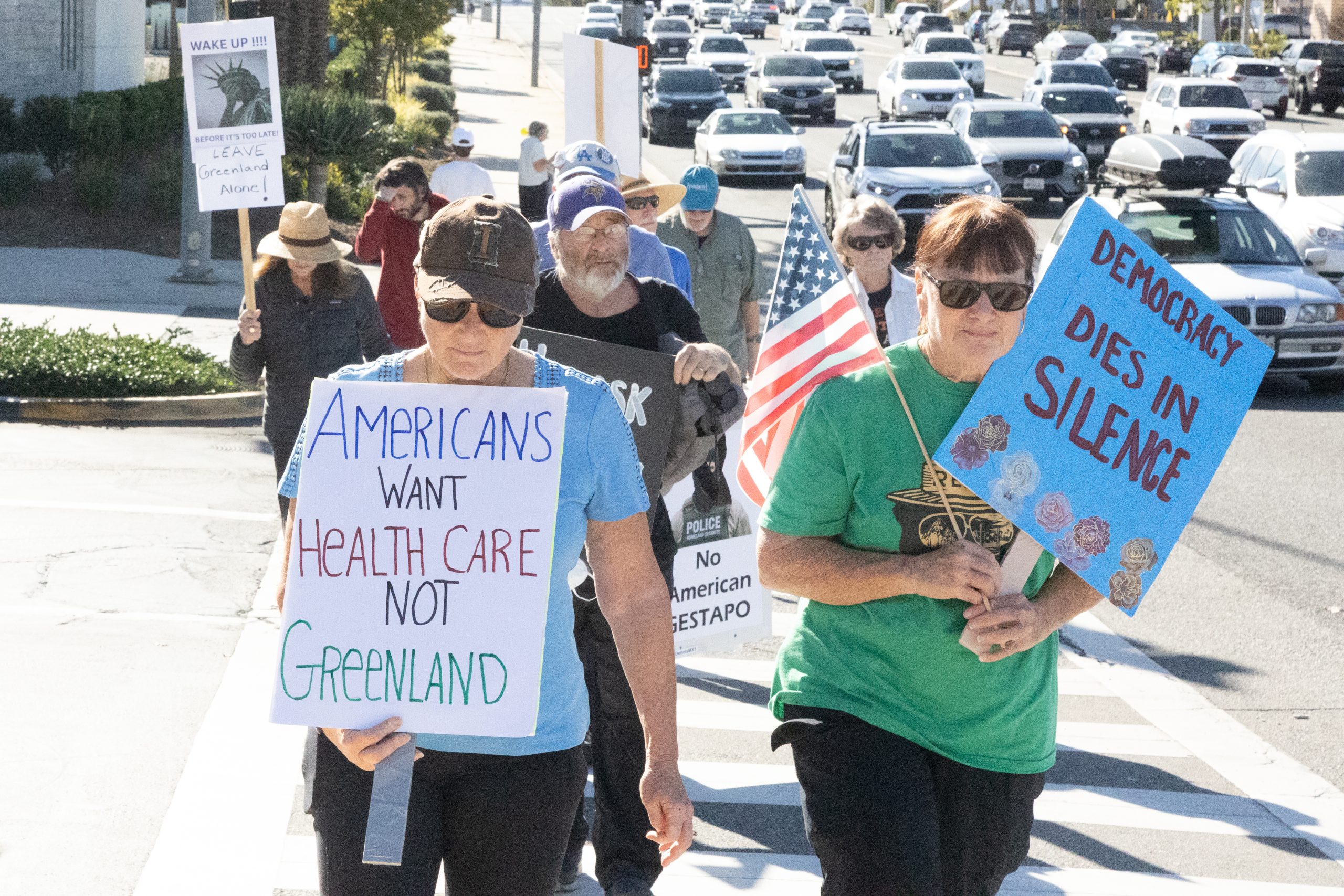
Brad’s Corner ICE Protest on Sepulveda Boulevard in Manhattan Beach. Photo by Kevin Cody
“While I still have a voice”
For Brad Graverson, the protest has become more than just a weekly act of resistance. It’s become a source of unexpected joy and purpose at a time when both seemed to be slipping away.
“This has really been an uplifting thing for me,” he said. “Something I look forward to every week.”
There’s an element of creative expression to it as well. Making the signs, choosing the images, finding the right words — it has filled a void left by his inability to do the photography work he loved.
“There’s a little bit of theater of the absurd, making signs and stuff,” he said. “I scour the internet for interesting images and weird juxtapositions of words and type. That’s the creative outlet part of it.”
Tarnay praised what Graverson has done to raise not only awareness, but action, in the community.
“Brad is a complete hero,” she said. “Because it’s all about visibility. The fact that the protest grew so big last weekend — it takes a lot for people to show up, right? And to see that he’s really brought visibility to the South Bay, I’m just so in awe of that.”
“Brad reminds us that one person’s courage can awaken an entire community,” Tarnay said. “He’s shown us what it is to be civic minded. He’s not only fighting for his rights but the rights of others.”
Tarnay emphasized she was not speaking as an elected official, but as an attorney who values the rule of law and a parent concerned for the future of the country. “I’m just a mom who cares about the Constitution, and my kids’ future,” she said.
Graverson likewise said his urge to protest is about the country his own daughter will live in long after he is gone.
“This isn’t just a one-item protest,” he said. “This involves our entire country and the future of our country, and the future of my kid. My god. I just can’t see a world that has Donald Trump leading us into chaos.”
Graverson acknowledges there’s a risk in being so public.
“There’s a lot of risk here, because my name is right there… it’s going to be right there in your story, and it’s right there on the internet, and it’s out there in social media,” he said. “I don’t think they’re going to come after me. But Manhattan Beach is kind of an isolated little soft spot in Los Angeles.”
What concerns him more is the broader climate of fear and the behavior of ICE agents.
“I don’t know who’s training these ICE agents,” Graverson said. “They’re just going way beyond the law, stuff that no police officer would ever do. Pulling innocent people from their cars? No investigations, no crime scene, no nothing. Just pull them off, and shoot them, or whatever? It’s scary. And it should be scary for everybody.”
He’s aware of what the protest has given him personally — community he didn’t have before, conversations he wouldn’t have had, a sense that he’s making his voice heard while he still can.
“It has galvanized a lot of people,” he said. “I never was a participant in this kind of stuff, I was always just the observer. But now I am a participant. You’ve got to raise your voice. I spent my life practicing the First Amendment. Now I am defending it.”
When the ALS diagnosis came, it forced Graverson to recalibrate everything about how he thought about his remaining time. Most of what he loved to do is no longer possible, but the meaning and connection he has found in protesting have given him an unexpected new sense of purpose.
“This kind of popped up, but it seems to be a path I’m taking, with protesting,” he said. “I am really happy to do it, and the rewards are pretty substantial.”
But Graverson still thinks like a photographer. His wheelchair, he has realized, has helped bring attention to the protests.
“If I didn’t have ALS, I probably would go to some of the protests as a solo guy,” he said. “But to put myself out there in a wheelchair — it’s got some visual impact in its own, and I think that’s probably what drew a few people towards me.”
He tries to encourage other retired journalists to join him at Brad’s Corner, though he understands the resistance.
“You get so used to not being a participant,” he said.
As for how long he’ll keep showing up every Sunday, Graverson is clear about his intentions.
“I’ll do it until they drag me out of my wheelchair,” he said.
His ALS is progressing. His lower body is gone. His lungs and throat “are kind of going.” He knows what’s coming.
“I really haven’t got to the agonizing part yet,” he said. “That’s coming.”
But for now, every Sunday morning at 10:30, Brad Graverson wheels his chair to the corner of 33rd and Sepulveda, hangs his Trump effigy, flies his Pride flag, and holds up his sign. And now, more and more people are standing with him.
“While I still have a voice and ability to hold a sign,” he said, “I will.”
For more information, reach out to ManhattanBeachHuddle@gmail.com. ER
Comments
Loading comments…