
Democratic Senate candidates face off at Kiwanis Club
by Laura Garber
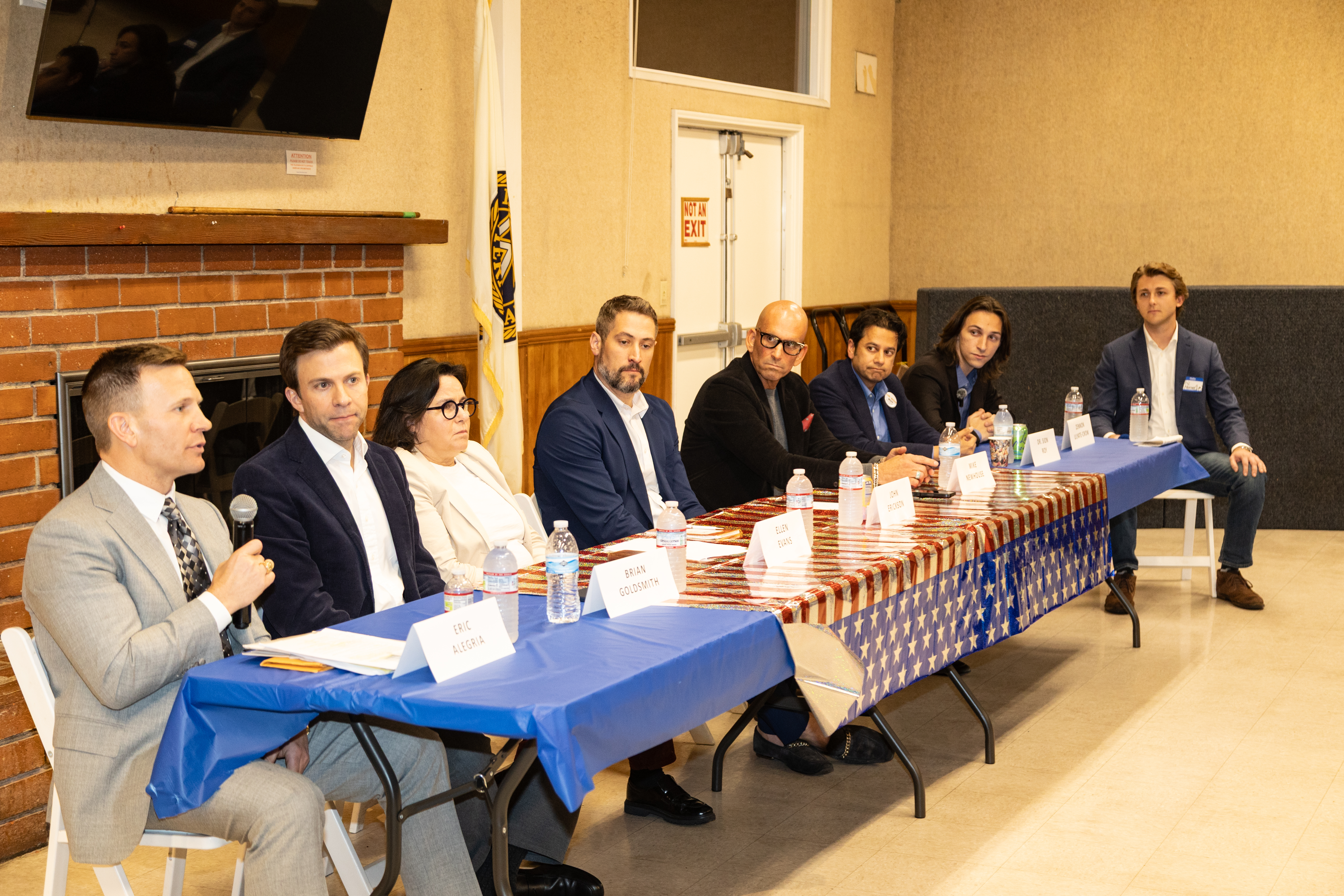
Seven Democratic candidates vying to represent California’s 24th State Senate District gathered at the Hermosa Beach Kiwanis Club on February 25 for a Beach Cities Democrats forum that gave South Bay residents an up close look at what has become one of the most competitive legislative races in the state.
The forum, moderated by Beach Cities Democrats Vice President Eric Horne, opened by framing the stakes.
“It’s been 12 years since we’ve had an open seat without an incumbent for the state senate,” Horne said to the audience. “We have an incredible opportunity that very rarely presents itself.”
Current Senator Ben Allen, a Democrat from Santa Monica, was first elected in 2014 but is now termed-out and running for California Insurance Commissioner.
Allen’s departure has triggered an intense succession battle, drawing candidates from the South Bay all the way to Beverly Hills.
The June 2 primary will send the top two, regardless of party, to the November ballot. The 24th district stretches from the Santa Monica Mountains to L.A.’s Westside and Hollywood area and down to the South Bay.
Horne posed the first major policy question of the night, centering it squarely on South Bay concerns; how candidates would approach state housing mandates, local control and SB 79, the state’s zoning bill that mandates high-density or mixed-use development near major transit stops. The bill has generated significant pushback from cities across the district, including Hermosa Beach.
Housing dominated the evening, with candidates offering sharply different views on how much Sacramento should be able to override local planning decisions.
Hermosa Beach Councilmember Ray Jackson, who was in the audience, pressed the candidates on affordability.
“Unless affordability is mandated, nothing’s going to be affordable,” Jackson said. “Pick a number, 10,000 units. They’re not going to be affordable. Trickle-down economics doesn’t work, and trickle-down housing doesn’t work.”
Redondo Beach Councilmember Paige Kaluderovic, who is also a board member of the Executive Committee for Regional Homeless Alignment, asked the candidates to define what they saw as the state’s specific role in the homelessness system, noting that cities in the South Bay have done significant work but struggle with coordination.
Byung Cho, a board member of the Redondo Beach Unified School District, asked about public school funding formulas and how candidates would fix what many in the room viewed as a shortfall.
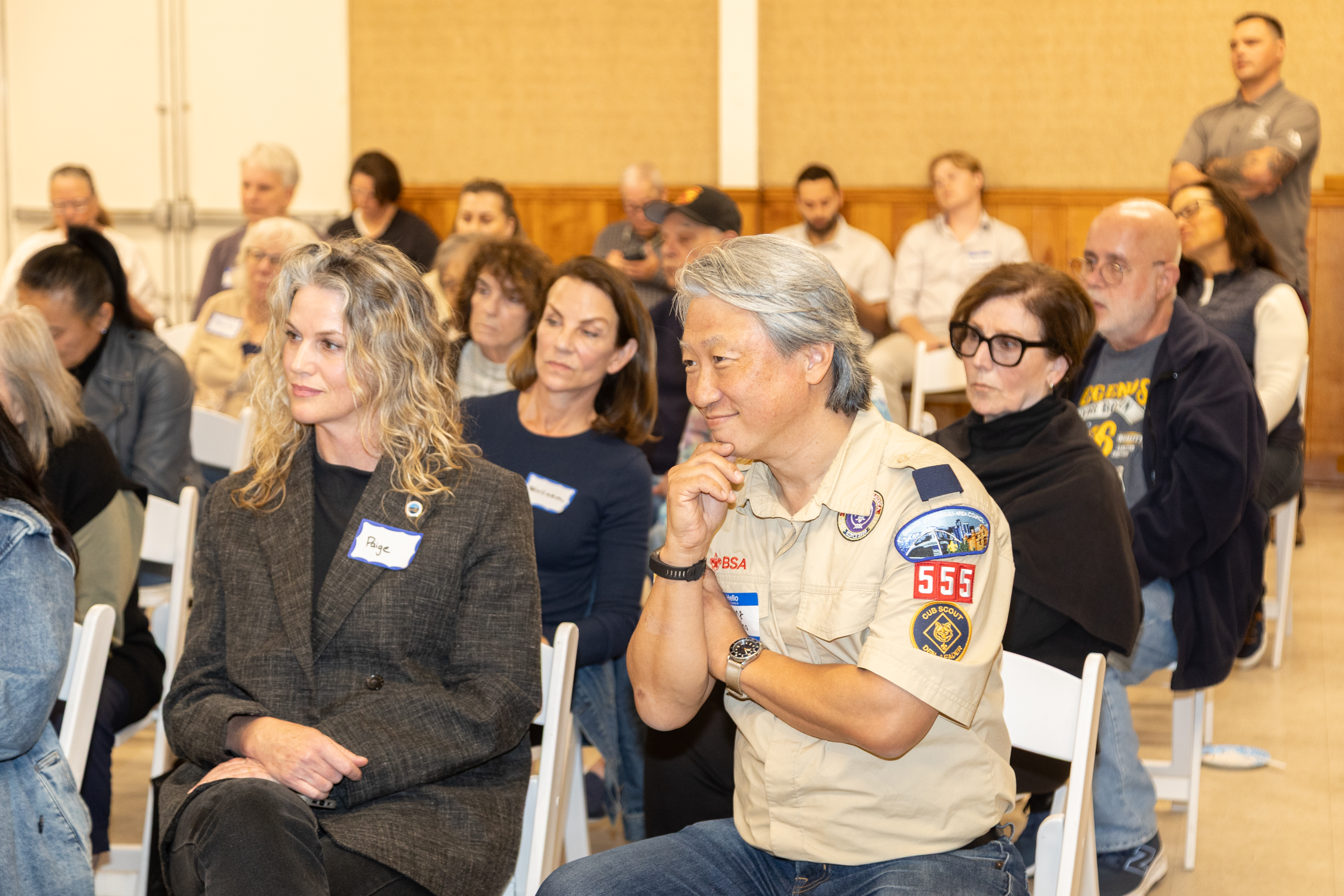
Redondo Beach Unified School District board member Byung Cho and Redondo Beach City Councilmember Paige Kaluderovic listen as candidates respond to Cho’s question about public school funding formulas.
The seven Democratic candidates who appeared were:
Zennon Ulyate-Crow, 23, a Topanga native and recent UC Santa Cruz graduate, is running to be the first Gen Z member of the California Legislature. He founded the Student HOMES Coalition, co-authored four bills in Sacramento focused on student housing and tenant protections and served as the youngest commissioner in Santa Cruz history. He still lives at home, a fact he offered as evidence that the affordability crisis is not abstract for him.
“I still could not make enough money to move out of my parents’ house,” he said. “In fact, I still live there today. These are the issues that are facing our generation.”
At the forum he argued that decades of local control have produced the current housing shortage and that Sacramento needs to step in.
“That zero-sum thinking is exactly what leads us to the crisis of today,” he said. “That thinking is exactly why Sacramento’s not working.”
On homelessness, he called for the state to stop routing money through nonprofits and instead deliver services directly through accountable local city providers.
“The state gives money to nonprofits to then do these things,” he said. “That’s how we see money go into some ether and then we find out two years later it was spent on executive compensation.”
He was also one of the few candidates to explicitly support the proposed state billionaire’s tax, calling it well-structured and necessary.
“It is actually the perfect response,” he said, “As we see untold amounts of wealth being generated in this country right now.”
Dr. Sion Roy is a cardiologist at Harbor UCLA Medical Center in Torrance and vice chair of the Santa Monica College Board of Trustees, where he has championed healthcare workforce programs and led on student housing initiatives.
Roy lost his home in the Palisades fire and has built his campaign around Medi-Cal stability, wildfire recovery and fire insurance reform. He warned at the forum that the healthcare system, which is already overburdened, would be strained by federal cuts that trickle down to the state level.
“We need people who come from the system, come from the safety net, to help navigate the next decade as we face this healthcare crisis,” Roy said.
On housing, he cautioned against one-size-fits-all solutions for a geographically complex district.
“It is very difficult to legislate a district like this from Sacramento,” he said, noting that the needs of fire-devastated Palisades communities, rent-stabilized Santa Monica neighborhoods and South Bay coastal cities are fundamentally different from one another.
On affordable housing specifically, he focused on financing mechanisms and building community support project by project.
“Doing that, city by city, project by project, is really important in our district, which is so unique,” he said.
Roy has received an endorsement from Attorney General Rob Bonta, the California Medical Association and has the backing of the California Democratic Party.
Mike Newhouse is a Venice-based attorney and Los Angeles city planning commissioner who ranks second in fundraising in the race, with more than $419,000 raised through the end of 2025.
Newhouse has spent 30 years practicing environmental and land use law and was appointed to the L.A. Planning Commission by both Mayor Garcetti and Mayor Bass.
At the forum he was the most forceful critic of SB 79, arguing that its fatal flaw is stripping away local control without building in meaningful affordability requirements.
“SB 79 is 90% right. The goals are laudable,” Newhouse said. “The problem is you are stripping away the actual mechanism to make a difference. And the worst part of it is, there is no affordability requirement.”
Newhouse called instead for adaptive reuse of vacant commercial and office buildings and fast-tracked entitlements for 100% affordable projects.
“We are not gonna solve this problem by eviscerating local control,” he said. “It’s not going to fix the problem.”
He proposed a state version of L.A.’s Executive Directive 1 as his first bill in Sacramento, a measure that would put 100% affordable projects on a 60-day entitlement timeline.
“That’s how we’re going to actually give us a carrot to develop,” Newhouse said, “as opposed to a stick.”
Newhouse has endorsements from Redondo Beach Police Officers’ Association and California State Assembly member Josh Lowenthal.
John Erickson is a West Hollywood city councilmember and former mayor who currently serves as chief of staff at Alliance for a Better Community, focusing on Latino community advocacy across LA County.
Under his leadership as mayor, West Hollywood amassed a $31 million budget surplus while expanding city services.
His endorsements include LA County Supervisors Lindsey Horvath, Janice Hahn, Hilda Solis, the Los Angeles County Lifeguard Association and the California Teachers Association.
At the forum, Erickson argued that bureaucratic delay is the central driver of the housing crisis and cited a specific case from his time overseeing West Hollywood’s permitting process, where a single 200-unit application sat on a planner’s desk for two years at a cost of $1.6 million to the developer.
“That’s the way that you disinvest in your communities,” he said.
On homelessness, he argued against across-the-board budget cuts.
“You can’t help those problems by cutting off all of the state-funded mechanisms to help those people and expect those problems are going to get better,” Erickson said.
On education, he called for holding charter schools to the same standards as public schools. “We are seeing charter schools get away with literally our tax dollars while not being held to the standard that public schools have to face,” he said.
Ellen Evans is a neighborhood organizer and LGBTQ rights activist who spent years building coalitions and working directly with city departments before running for office.
Evans has been endorsed by the California Women’s Legislative Caucus and California Legislative Jewish Caucus.
Her central argument at the forum was that California’s problem is not its values but its ability to follow through on them.
“California doesn’t have a values problem. We have an execution problem,” she said. “Too often, bureaucracy delays what needs to be done, or sidelines programs altogether. And that problem doesn’t fix itself.”
Evans described her organizing background; building a neighborhood association, taking problems directly to city departments and persisting until she got real answers.
“That’s not glamorous work,” she said. “That’s the work that makes governments deliver and function.”
On housing, she emphasized removing barriers that prevent approved projects from being built, and on education called for funding streams that smooth out the state’s notoriously volatile budget cycles.
“We need to figure out how to fund education with a smoother budget cycle,” Evans said.
Brian Goldsmith is a Beverly Hills-based journalist and Democratic consultant who spent more than a decade as a political columnist and commentator with Yahoo News, The Atlantic, CBS News, CNN and served as lead political producer with Katie Couric Media.
A graduate of Harvard College and Stanford Law School, Goldsmith also founded two California technology startups. Goldsmith has emerged as the race’s top fundraiser, amassing more than $1 million and is endorsed by former House Speaker Nancy Pelosi, former Senator Barbara Boxer and former Transportation Secretary Pete Buttigieg.
Goldsmith says two things changed his view on running for Senate; the 2024 election, “not just the outcome, but the way that California became exhibit A in the Republicans case against our party,” he said. “If [democrats] are being honest with ourselves, some of these arguments are lies and distortions, but it is too hard for the middle class in California. It is too challenging and expensive for small businesses.”
He also cited the 2025 fires in the Palisades as a reason for his campaign.
“We now know that these fires were preventable. They were mismanaged at every stage before, during and after,” Goldsmith said, adding that he wanted the State to not just give promises, but results.
At the forum he challenged Sacramento’s spending record and demanded accountability for outcomes.
“Somehow there’s no money, but we’re spending $140 billion a year more than we did just seven years ago,” he said. “Are our outcomes dramatically better? Is life easier? Are schools dramatically better for our kids?”
On homelessness, he said flatly: “There is nothing progressive about anybody sleeping on the streets. Ever.”
He noted that LA Unified reports 17,000 children in the system are considered functionally homeless, calling it “an outrage that should not be allowed to happen.”
On the proposed billionaire’s tax, Goldsmith expressed skepticism, arguing instead for sustainable revenue reform paired with new spending oversight.
“I am for an ongoing tax reform where we’re producing new revenue in a sustainable way over time,” Goldsmith said. “New taxes should be combined with spending reform.”
Eric Alegria is a former two-term city councilmember and mayor of Rancho Palos Verdes, a current Palos Verdes Peninsula Unified school board member and has more than 17 years of South Bay public service. He also brings a background as chief operating officer of a public health company.
The most locally rooted candidate at the forum, Alegria called for regional cooperation among South Bay cities over top-down state mandates and said he opposed SB 79 for overriding local planning processes.
“Our local leaders know best what’s right for their community,” Alegria said.
On homelessness, he pointed to the work being done in Redondo Beach as a model, emphasizing that trust between service providers and unhoused residents is the central challenge.
“Trust is the ultimate challenge,” he said. “Getting them to believe and trust in the system.”
On the state’s overall fiscal approach, he argued for economic development before new taxes. “Additional revenue means first prioritizing economic development,” he said.
Alegria has secured endorsements from former state Treasurer John Chiang, former Assembly Speaker Anthony Rendon and Redondo Beach city Councilmember Kaluderovic.
The evening also covered public school funding formulas and Prop 13.
On schools, nearly every candidate called for more funding but differed sharply on how to generate it, with some pointing to Prop 13 reform, others to closing corporate loopholes and others to economic development.
On Prop 13, the field was divided, with Newhouse opposing any changes and Ulyate-Crow arguing that the law has inflated property values by $250,000 per home in LA County and that reform, with clear protections for seniors, is unavoidable.
Horne closed the forum by noting what the moment represents.
“We’re running more than 250 years into our republic,” he told the crowd, “and nothing symbolizes that better than having you all here, sharing with us in an open primary. This is not a predestined race. Any of you could be our next state senator.”
The June 2 primary is now less than three months away. The Kiwanis Club forum was among the first to bring nearly half the senate candidates to the South Bay, giving residents a direct look into a race that will shape the region’s representation in Sacramento for years to come. ER
Comments
Loading comments…