A common adage in the making of public agency budgets is that each adopted budget is only a snapshot in time, given the complexity and fluidity of the revenue sources. But for public schools in California, that snapshot is a blurry polaroid at best, more commonly a botched and largely illegible overexposure.
School districts must budget while flying largely blind.
The reason for this is every school district is forced to make guesses regarding how much revenue they will receive. It’s an issue of timing. Per education code, they are required to adopt a budget by July 1. In order to meet that deadline most districts adopt a budget at a board meeting in early or mid-June, based on the Governor’s so-called “May Revise,” rather than the final state budget, since the state’s process runs concurrently. The Governor rarely signs off on a budget until July 1, and the already unwieldy process often bleeds into July.
Additionally, school districts are required to issue preliminary layoff notices on March 15 and final layoff notices by May 15. The result is thousands of employees receive layoff notices that may or may not be later rescinded, while state negotiations continue.
The upshot is school districts are forced to enact a painful drama year after year in which people’s lives are upended by the issuance of layoff notices, which may be rescinded.
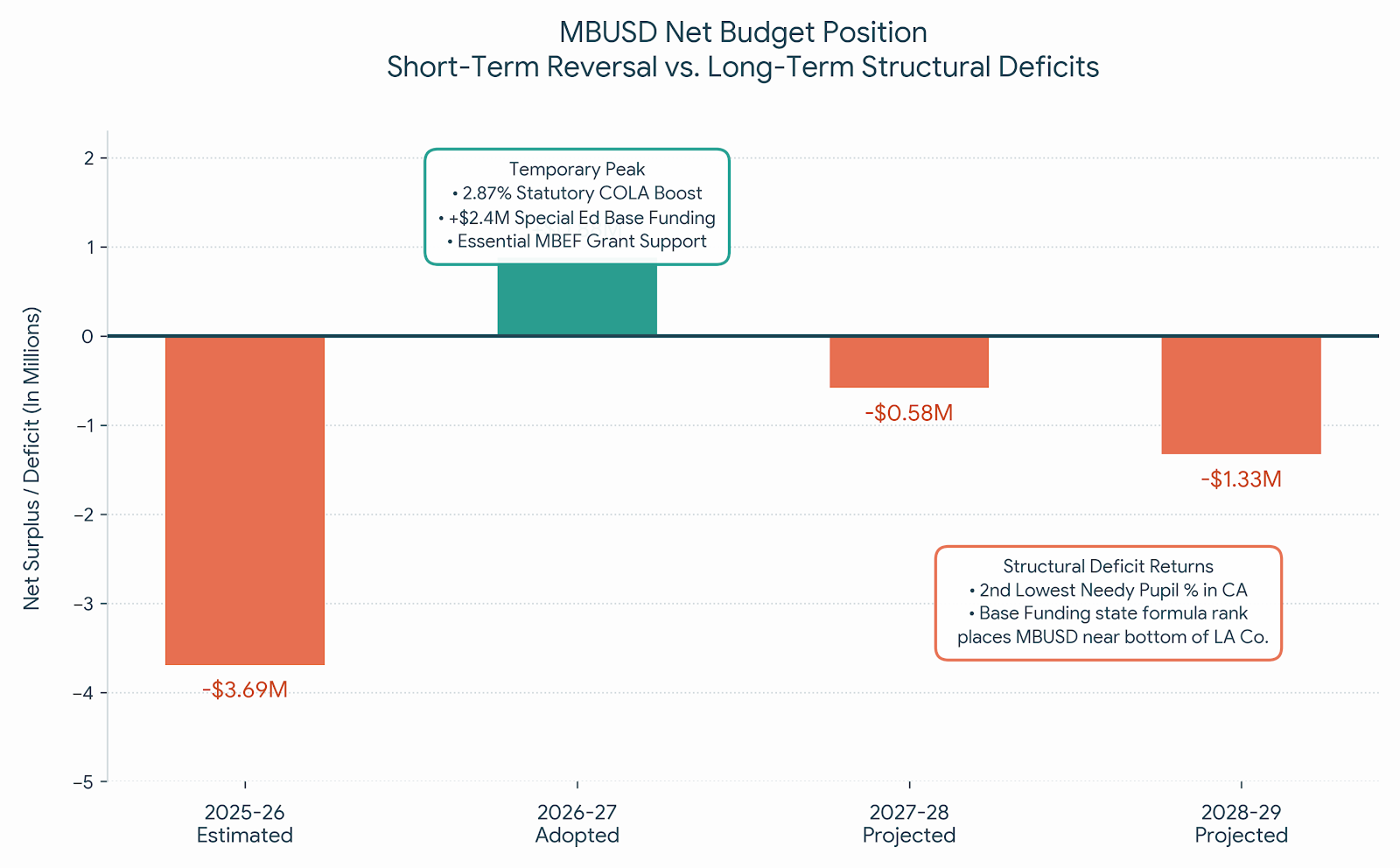
The Manhattan Beach Unified School District Board of Education voted unanimously at a brief special meeting the morning of June 18 to adopt a 2026-27 budget that projects an $878,887 surplus — a dramatic reversal from January, when the district was contemplating more than $7 million in cuts and the Board preliminarily authorized the reduction of up to 58.85 full-time positions.
By May 15, when final layoff notices are required to be issued, that number had dropped to 26.235 FTE — 17.6 certificated and 5.635 classified positions. The reduction came from a combination of early retirements through the district’s Supplemental Employee Retirement Plan (SERP), class size reduction grants from the Manhattan Beach Education Foundation (MBEF), and additional anticipated state funding. Thirty-five employees opted into the SERP — 16 certificated and 19 classified — which both reduces the layoff need and allows the district to replace more senior, higher-paid retirees with newer hires at a lower step on the salary schedule. The retirements alone do not reduce class size, but MBEF’s record grant for next year does.
The district has continued to rescind notices since the May 15 deadline. The board has reached consensus on lowering the district’s Reserve for Economic Uncertainty to 4 percent — a roughly $1 million reduction from the previous 5 percent target that frees up operating money to bring more positions back. Final state revenue figures will be known when Governor Gavin Newsom signs the adopted state budget at the end of June.
“We’re not done rescinding yet,” Trustee Jen Dohner said.
At the regular board meeting the night of June 17, Deputy Superintendent and Chief Business Officer Dawnalyn Murakawa-Leopard presented the adopted budget to trustees and was direct about what the surplus does and doesn’t mean.
“It’s good news for now, but it is not a solution to our long-term problems,” Murakawa-Leopard said.
The district’s own multi-year projection shows deficit spending returning in 2027-28 at $582,786, and growing to $1,328,078 by 2028-29.
The reversal from January was driven primarily by three changes at the state level, two of which Murakawa-Leopard chose to include in the adopted budget. The first was the statutory 2.87 percent cost-of-living adjustment, which all three Sacramento parties — Governor, Assembly, and Senate — had agreed to. The second, more significant, was a $2.4 million ongoing increase in special education funding, a result of the state raising its base per-pupil grant from under $1,000 to $1,340. That change also has consensus support.
A number of other revenue items remain unresolved. A possible 1.44 percent LCFF (Local Control Funding Formula) augmentation would bring MBUSD an additional $968,000. A discretionary block grant could deliver as much as $5.3 million in one-time funding. The restoration of the learning recovery emergency block grant would mean $76,000 more. None of those are included in the adopted budget because final terms remain under negotiation. The Legislature passed its version of the state budget June 15 — meeting the constitutional deadline that triggers loss of legislator pay — but Newsom has until June 30 to sign a final bill, and significant differences remain.
Murakawa-Leopard told trustees she chose to include in the budget only items where there was clear agreement among all three Sacramento parties. Los Angeles County did not provide directive guidance to districts on what to include this year, she said, leaving the call to each district.
“I appreciate that,” Trustee Cathey Graves told her at the meeting. “We do have a lot of confidence that these numbers will come true.”
Proposition 98, the 1988 ballot measure that has set the floor for California school funding for nearly four decades, requires roughly 40 percent of the state’s general fund revenue to flow to K-12 schools and community colleges each year. Chief among the unresolved Sacramento questions is the Governor’s proposal to withhold $3.9 billion from the 2025-26 Proposition 98 minimum guarantee — down from $5.6 billion as proposed in January, but still amounting to what would be roughly $654 per ADA if those dollars flowed to districts. Newsom calls it a “settle-up.” Murakawa-Leopard, in her presentation to the board, called it what it functionally is.
“It is a workaround that does not honor Proposition 98,” she said. “It’s a decision that he’s making without going through the Proposition 98 suspension process. The Legislature can, by law, vote to suspend Prop 98 and fund schools at less than what the Constitution requires. That’s not what’s being proposed here. It is simply an underfunding.”
The simplest way to describe the difference: a Prop. 98 suspension is the legal, public way for the state to fund schools below what the Constitution requires. It requires a two-thirds vote of the Legislature, and the state’s IOU to schools grows each year to keep pace with inflation and student enrollment until it’s repaid on a schedule set in the Constitution. A settle-up, by contrast, requires no legislative vote and comes with none of those protections. The Director of Finance decides when and how the money gets repaid, and the IOU does not grow over time to reflect rising costs. Education groups including the California Teachers Association and the California School Boards Association have characterized the withholding as a manipulation of the funding guarantee and are threatening to sue. The Legislature’s budget appears to acquiesce to the withholding while pushing for what it called “a reliable schedule” for repayment.
If settle-up funding does eventually reach MBUSD, the district estimates the amount at roughly $3.7 million. That, too, is not included in the adopted budget.
Beneath these state-level fights sits MBUSD’s persistent structural problem. The district ranks second-lowest in unduplicated pupil (needy) percentage among the 345 unified school districts in California — the measure that drives weighted LCFF funding for low-income, English learner, and foster youth students. As a result, MBUSD receives $11,548 per ADA in Base, Supplemental, and Concentration Grant funding — the LCFF stream designed to address equity — placing the district second-lowest in Los Angeles County on that measure, just above $11,402 and well below the county median of $13,356 and state median of $14,043. When total LCFF dollars are counted, MBUSD comes in at $11,657 per ADA, compared to a county median of $13,610, a state median of $14,421, and a county high of $16,578.
That gap is why MBUSD has been forced into difficult cuts earlier than many other districts. It is also why MBEF and Measure MB have become structurally essential rather than supplemental. MBEF’s record $7.636 million commitment for 2026-27 was extended this spring as the foundation’s annual appeal continued to gather contributions, pushing the foundation’s total grant for next year to roughly $8 million. The MBEF board has voted to hold the additional $400,000 raised through the extension until the state’s final budget is settled. If MBUSD receives sufficient state funding to address class size, the foundation will direct its surplus toward enrichment programs rather than gap-filling.
Measure MB, the parcel tax, contributes another $2.5 million annually.
“Local support is essential, but it does not eliminate the district’s structural funding challenge,” Murakawa-Leopard’s budget presentation noted.
Trustees expressed frustration with the cycle that has defined recent years — issuing preliminary layoff notices in March, then rescinding them through the spring as additional revenue and one-time funds materialize.
“I sunset in December, but I would love to see a scenario where the board is not constantly doing this merry-go-round of pink slips, [then] pulling them back,” said Trustee Jen Fenton, whose term ends this year. “I’d love to not continue deficit spending, and I’d love to figure out a way to do that. I know it’s a pie in the sky dream.”
Dohner had a name for the cycle.
“I call it the lather, rinse, repeat cycle that I’d love to break,” she said.
Trustee Wysh Weinstein agreed: “I’d love to break that as well.”
The district will likely return to the board with a budget revision in August once Sacramento finalizes the state budget by June 30. If the differences are material, Murakawa-Leopard told trustees, the local picture will be revised to reflect them.
Board President Tina Shivpuri described the strategy that the board’s budget strategy group has settled on as three words: educate the community on how the district arrived here, advocate in Sacramento, and innovate locally.
“We do need to do things maybe differently, or just reintroduce some things that we haven’t seen for a while,” Shivpuri said. “We’ll continue to push on those three levers and see where that takes us into the future for our 3, 5, or 10-year outlook for the district.” ER