
by Garth Meyer
“Have you talked about blowing it up?” Planning Commissioner Gail Hazeltine asked Stuart Miller, a representative of the new owners of the South Bay Galleria at the August 21 Redondo Beach Planning Commission meeting.
Miller, who also represented the previous two owners, said they had considered it, and other options such as taking off the roof, before settling on a proposal to add 350 more residential units outside.
Miller has worked on the “South Bay Social District” project now for more than 10 years, first for former owners QIC (Brisbane, Australia), then L Catterton and now Kennedy Wilson.
“I’m a firm believer in retail as a way for people to congregate,” he said. “Online definitely made an impact, but what it did was force owners to reinvent properties to become a real third place where people want to hang out.”
After a four-hour discussion, the planning commission approved Kennedy Wilson’s request, despite lamenting that their hands were tied by new state housing laws.
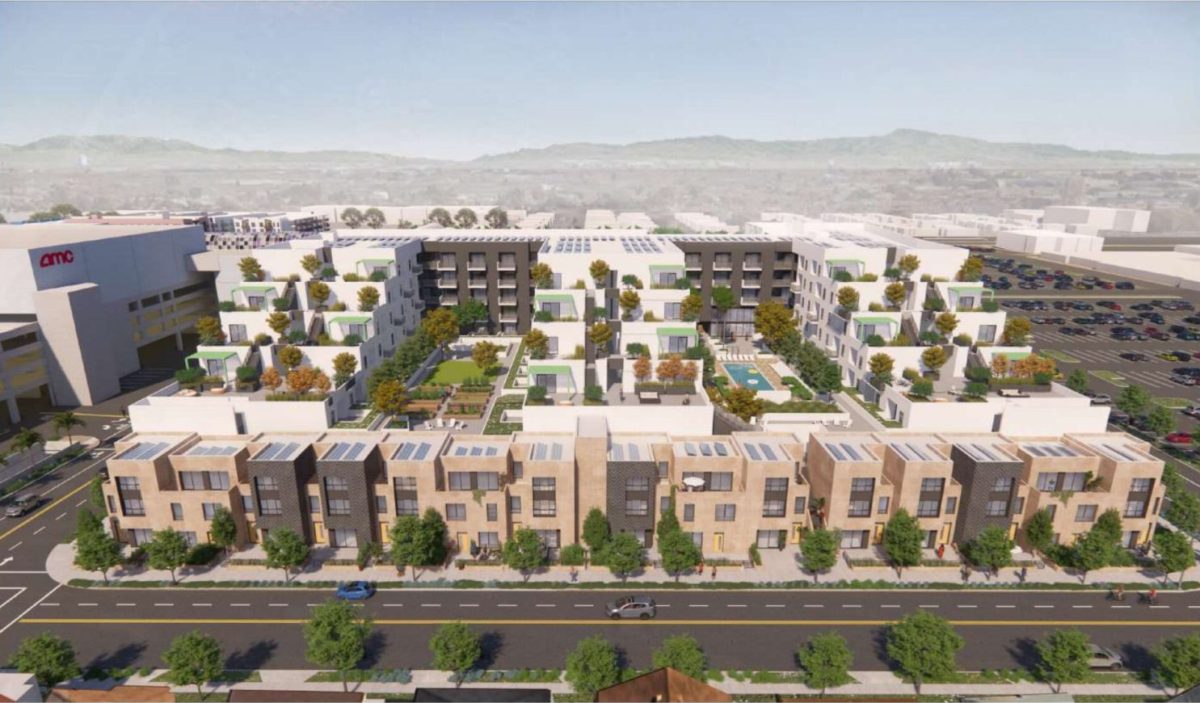
Commissioner Doug Boswell voted against the proposal, known as Phase Two of the “South Bay Social District” plan. It is to include 8,300 square feet of commercial space, 15 townhouses and 335 apartments, ranging from three to eight stories, with up to 845 parking spaces, and pedestrian plazas. Thirty-five of the units would be “very low” income.
Phase One has already been approved, for 300 residential units in the mall’s opposite parking lot.
In 2022, the Redondo Beach city council included the Galleria 350 potential housing units in its master housing plan, known as a “Housing Element,” which was later certified by the state.
“How did we even allow this to get this far?” Commissioner Boswell said. “To put (the units) here does nothing more than create more traffic. All of the intersections around there are a mess, and this makes it more unmitigatable.”
“These developments are trying to claw back what (the owner) gave up,” he continued, referring to the 650 units initially allowed under an Environmental Impact Report in 2018, though the developers kept the project to 300.
“It’s not the planning commission’s job to make decisions based on if somebody on city council is going to go home crying,” Boswell said. “We should demand that new housing be spread out over the whole city.”
“That’s not really what we’re discussing today, unfortunately,” said Commission Chair Wayne Craig.
“The city is pretty limited on what it can impose on the project,” Redondo Beach community Development Director Marc Wiener said.
“I want the public to know just how limited we are in our ability to make this project more (acceptable),” said Commissioner Rob Gaddis, who is also treasurer for “Our Neighborhood Voices,” a grass-roots group seeking a State Constitutional amendment to give cities more control over zoning. “What is and what is not mandatory here?”
The developers, Kennedy Wilson, of Beverly Hills, obtained the property this spring in foreclosure. They asked the city to allow four waivers, including one that would increase the Redondo Beach height limit from 60 to 89 feet. The other waivers regard decks, patios and storage space for units.
“You do have the option to deny projects, you just need to make the appropriate findings,” Assistant City attorney Cheryl Park said.
“Adverse public health and safety impacts is the standard,” Wiener said. “It’s a bit subjective and the standard is high in making that finding.”
“It was the city that threw the people who live here under the bus,” Boswell said during his questioning of Miller.
“There’s no doubt more mixed-use became the obvious solution,” Miller said.
Boswell, and other commissioners, called for a different use.
“For the city’s interest, it would be best as a giant car lot,” he said. “The residential option is the most destructive thing you can do on that corner… We have other places that this can go. Imagine 650 residents all leaving for work at 7:30 in the morning, it’s Armageddon. Why can’t you do something else with that property to make it feasible?”
“We think the project is appropriate for that site,” Miller answered, noting it was close to public transportation, and the 405 Freeway. “The idea is that it becomes the economic engine it once was for the city.”
Miller then commented about the development becoming a “third place.”
“A measure of success would be if people came here and didn’t spend money,” he said.
He gave, as an example, a family at the skate park. “Don’t spend anything that day, maybe come back the next day and spend some money.”
“The people of Redondo Beach have been sucker-punched for 50 years. You are aware we used to have a downtown?” Boswell said. “Now it’s all condos.”
Commissioner Hazeltine then asked about tearing down the mall.
Miller said it was considered, “But we have loyal tenants, with very long leases,” he said.
Gazeltine doubted the success of any kind of retail mall inclusion in the once and future project.
“It’s dead, it’s not something any community is doing anymore. It would have been wonderful for the community but it’s not going to work,” Hazeltine said. “…. We don’t live in a snow community where we’re going there to exercise.”
Miller said that taking the roof off and waterproofing the Galleria would be cost-prohibitive.
“First of all, let’s see if there is a way to adaptively re-use the concrete,” he said to Hazeltine’s query about destruction. “The project is adaptive re-use; not one hundred apparel stores, but different uses during the day and night,” he said.
“What is the vacancy rate at Americana at Brand (in Glendale)?” Commissioner Gaddis asked.
“Great question,” Miller said. “I don’t know the answer. I would guess two percent, if any.”
“Americana at Brand is a great example of what can happen here,” Miller continued. “Retail used to be the place we hung out, gathered in the ‘80s. The only place that has that now is Americana… It’s been way too long with this project, we feel a responsibility.”
He told of parties interested in leases at the Social District, including a co-work facility that would use space inside the existing mall, and a “large-format fitness operation – wellness in general is a huge category.” He said owners had secured “some great restaurants” and a “very cool, retro bowling alley; not Lucky Strike.”
Joshua Gottheim, a land-use attorney for the applicant, spoke and Boswell questioned him about whether elements of the proposed project could be sold individually.
Public input followed.
“Decrease the commercial,” said longtime resident Holly Osborne.
“It’s not Phase Two, it’s an entirely new project,” said a man named Tom, a Kingsdale Avenue resident. “Crime, backed-up streets, density.,.”
“The subdivision request is before you,” Wiener said to the planning commission. “My recommendation is to approve the subdivision request.”
“Burden’s on us,” said Commissioner Roger Light. “We have to prove adverse effects.”
Hazeltine zeroed in on vegetation, to make sure what is shown in drawings will be reality. Then she made a motion to approve “with the proposed conditions added tonight.”
Commissioner Jason Conroy gave a second.
“I wish I knew what I was voting on,” Boswell said, before saying “No.”
The commission did ask for, and got three concessions; to capture more water for plants by using semi-permeable surfaces; the second was that if a spot is not available inside the underground parking garage, then a resident may park in the commercial lot; and the third was Hazeltine’s effort to improve the tree canopy, based on the City of Pasadena’s tree ordinance.
Commissioner Conroy suggested making Kingsdale Avenue a dead end where it intersects with Grant Avenue.
“That’s going to make for a lot less traffic, I imagine,” he said.
The commission, and Miller, seemed to think it was a good idea, though it would take an action by the city council and Public Works to do so.
The commission’s approval allows Kennedy Wilson to ask for a building permit, unless the proposal is appealed to the City Council.
Pre-pandemic, construction appeared imminent, but since then, inflation rose, followed by interest rates, and financiers started to prefer housing over retail/commercial space.
So L Catterton made the Redondo Beach venture smaller, and more outdoor-oriented, and they gained further interest from financiers, Miller told a crowd in March 2024 at a public meeting at the Galleria.
A lease had then been signed for 20,000 square feet in the old Nordstrom store – now World of Dinosaurs – by Industrious. The company now plans to offer co-working office space.
Phase Two’s 350 units would be built in the Galleria’s southwest parking lot, across from AMC Theater on Kingsdale Avenue.
The Social District would include a redesign of the current mall’s interior, with a mix of office and retail. The building’s doors will be removed to make for an indoor/outdoor experience.
Chair view
Commissioner Craig explained how things were before the new state housing laws, in an interview with Easy Reader Monday.
“Before, we could have said, ‘cut it to 200 units,’” he said. “Two parking spots per unit.”
As for the commission’s vote last week, he said their paths to oppose the project were few.
“There was no direct, verifiable, prove-able health and safety issue we could cite,” he said.
Craig said SB330 and other bills “tied our hands the most.”
If a project has 10 percent affordable housing, developers may ask for waivers.
“The principal reason to ask for the height was we wanted to design a project that paid more respect to Kingsdale Avenue, to tier back the project with the townhomes…” Miller said.
What is the planning commission’s biggest concern about this project if it gets built?
“Traffic impact and parking,” Craig said. “It’s the hand we’re dealt, and we dealt with it the best way we could. The Artesia corridor is long overdue to have something happen there. The Galleria component is
going to be critical to that at some point.”
The building permit for the first phase of 300 units at the Galleria is already issued.
Miller said the 10 years he has worked on the project is not out of the ordinary. He said a project in one in Australia he worked on began in 2004 and opened in 2020.
The 300 units at the front of the Galleria will be “fairly-similar in makeup,” Miller said, to the 350 by AMC, not tiered “but both aspirational in design, not homogenous.”
“We’re excited about this approval, it provides the opportunity to deliver a residential neighborhood to North Redondo, rather than a retail mall with some residential,” he said.
Stuart Miller: desire to congregate not outdated, just the term “the mall”
On Tuesday, Easy Reader spoke with Stuart Miller, who has now represented three different owners in the quest to revamp South Bay Galleria.
“I thought the planning commission played their role well to ensure the community has the best outcome,” he said of the Aug. 21 meeting.
He said that owners Kennedy Wilson are seeking financing for the entire project, not just the newly-approved 350 housing units.
“The ownership focus is to deliver on the original 30-acre master plan, but most likely in phases,” he said.
Seeking leases is on pause, but the mall remains open.
What do you think of malls in general?
“It’s another out-of-home community asset, (they) have been an integral part of American culture, as is the beach, a park, church. It’s not the aspiration of wanting to congregate or hang out that has changed, what is outdated is the term ‘the mall.’ What we’re providing is a sense of place.”
Were malls overbuilt in the ‘70s and ‘80s; now it’s only the strongest survive?
“They were overbuilt. Food and beverage, retail, outdoor experience, residential, those mixed-use environments will (succeed) and be embraced by the community.”
Do you include The Grove (Los Angeles) in your assessment of Americana at Brand as having a congregating quality?
“Absolutely. Same owners. Create great design, great placemaking. The Grove has residential directly across and adjacent, and the Farmer’s Market, so you do get a smaller, mixed-use outcome. We want (our project) to be an asset to the community, a revitalized North Redondo Beach neighborhood, like visiting the beach, or riding on the Strand.” ER




The property is entitled for 650 units. Planning Commission, “approval” was just a formality.