
San Pedro artist Peggy Reavey b/w “Are You Seeing What I’m Seeing?”
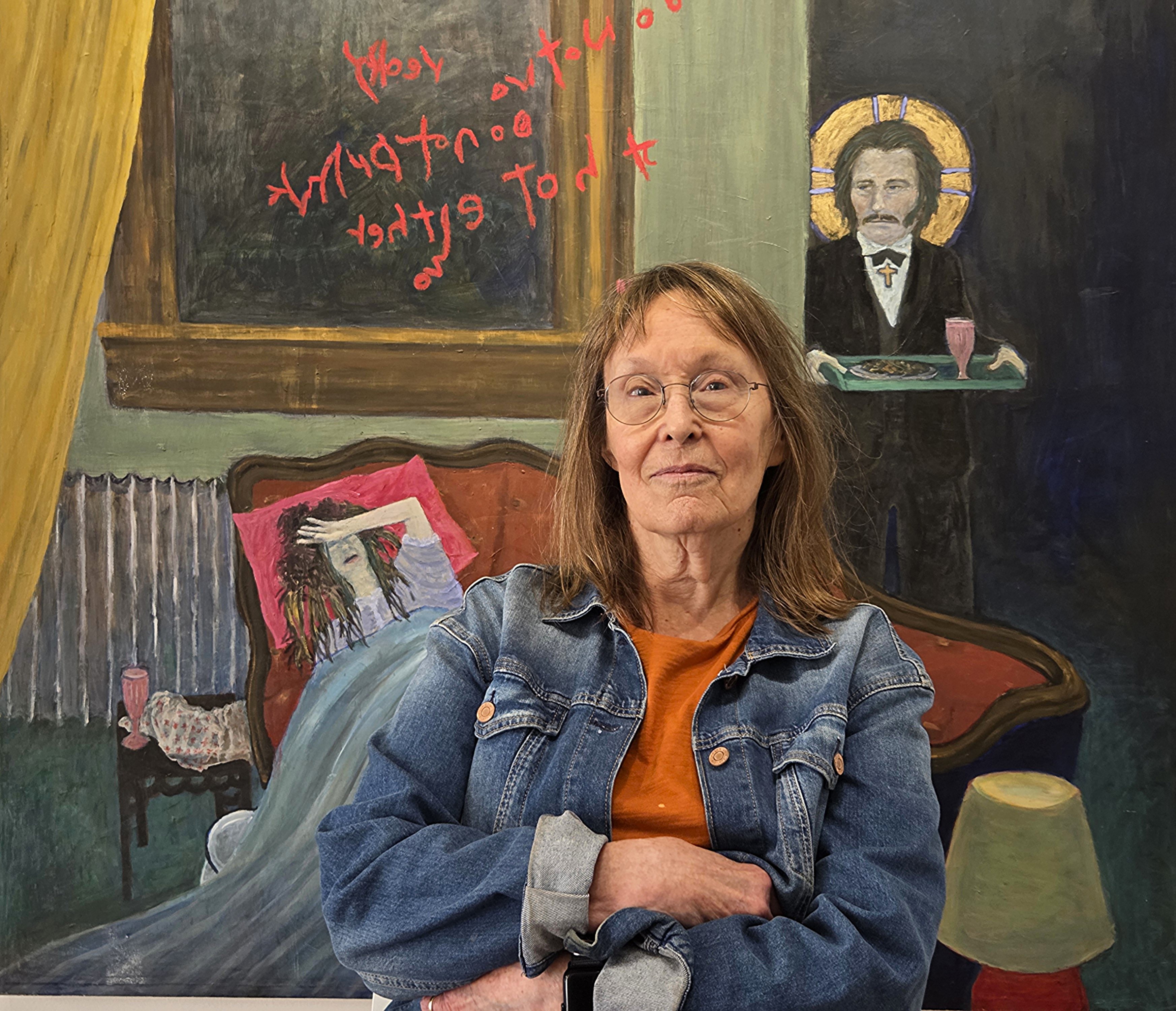
The poisoned wife, and the mechanical bull
The courage to create art and the courage to display it
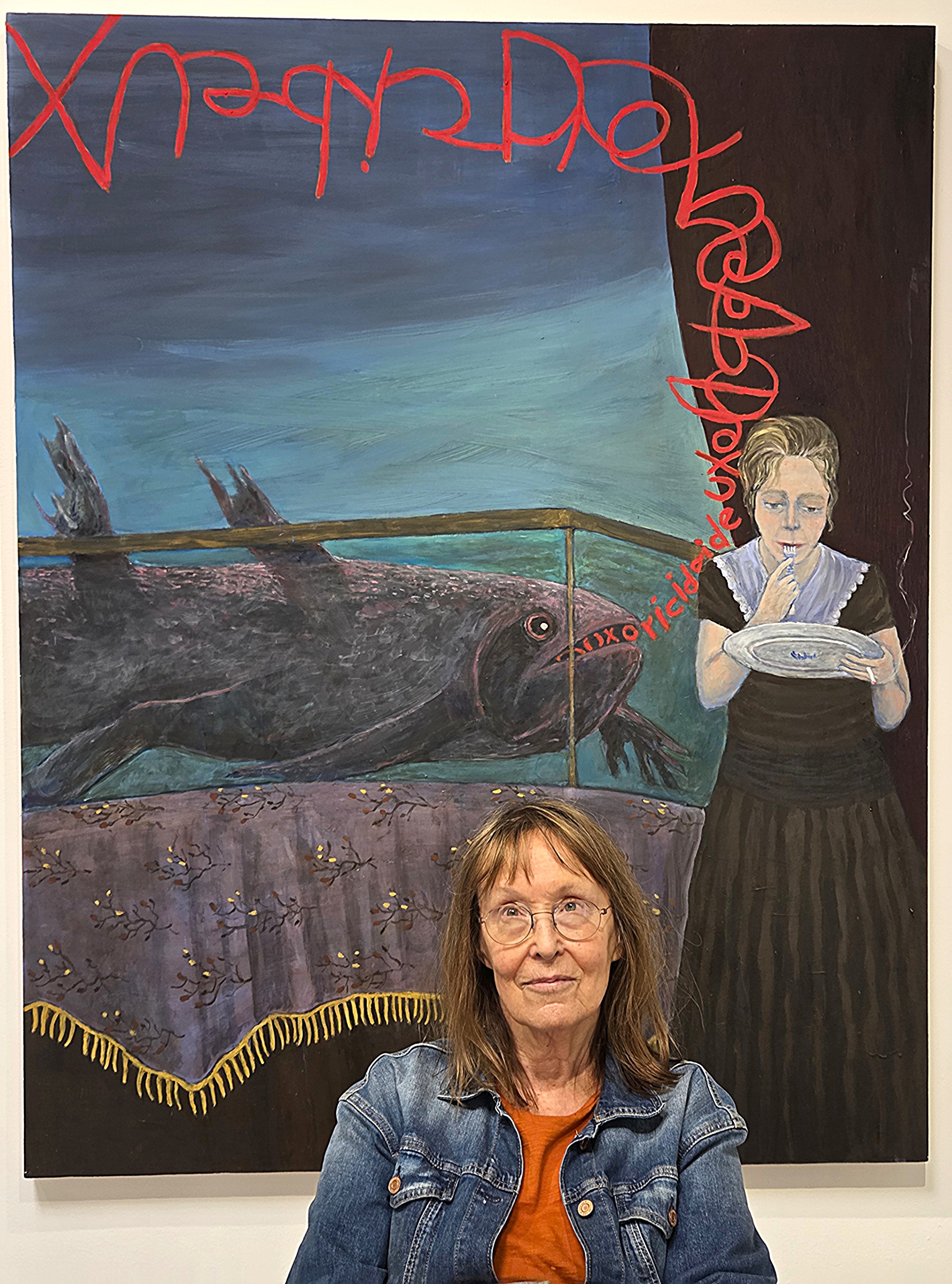
Peggy Reavey with “Uxoricidel”. Photo by Bondo Wyszpolski
Sure, there are artists I admire, but San Pedro-based Peggy Reavey is, let’s just say, in the upper echelon of my favorites. Her latest exhibition was held at Solo, an art gallery on 7th Street, and just before the show came down Peggy and I sat down to chat.
It was a singular body of work, combining an abiding interest in religion, humor, and the mysteries of life that dance around us. Ron Linden has recently described it as “idiosyncratic painting” while emphasizing Peggy’s “daring compositional inventiveness.” It may also appear, at first glance, as primitive or childlike, words that could be applied to the pictures of another San Pedro artist, the late Harold Plople, and also to outsider artist poster boy Henry Darger.
Years ago, when Peggy was asked about her artistic statement she hesitated but then said, “Oh, it’s a marriage between William Blake and Ann Landers.”
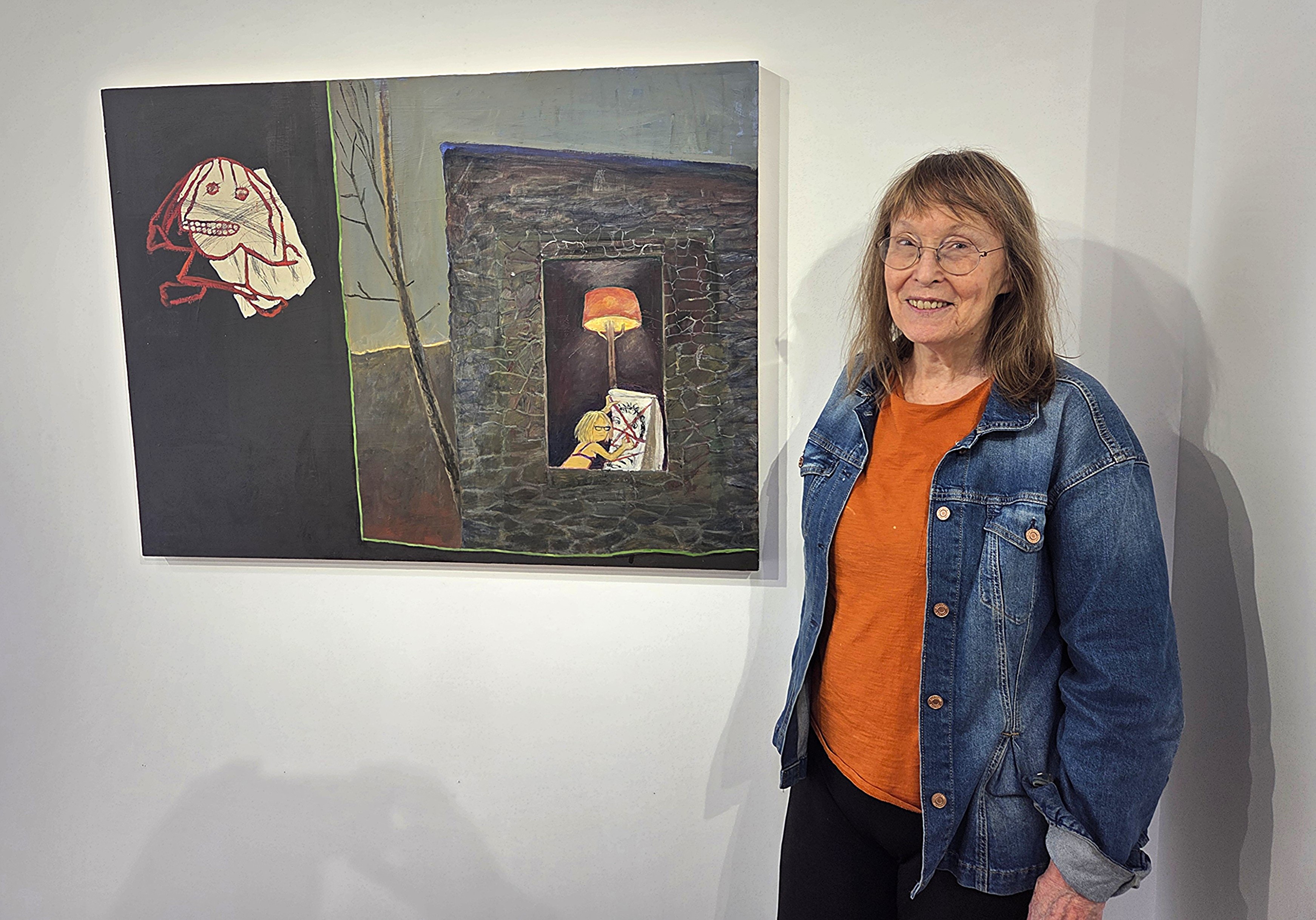
Peggy Reavey with “Cross the bad gyrle out” (2022). But you can’t: She’ll pop up again somewhere else. Photo by Bondo Wyszpolski
(Halos are a dime a dozen; you don’t have to be a saint in order to wear one)
Personally, I think “Do not eat that!” (2022) is an exceptional work, which now opens another line of thought: An artist isn’t just someone who paints pretty pictures. He or she has convictions and presumably an idea or a story that needs to be shared. I’m eliminating from the conversation all pictures of the pier, sunsets and flowers, family pets, and commissioned portraits. Beauty, as such, is in the expression and composition and not necessarily in the subject matter. Art shouldn’t have to be conciliatory or apologetic. If you go into a gallery or a museum and you don’t care for what you see, then keep walking or just leave. Stay home. Some art’s for you and some isn’t.
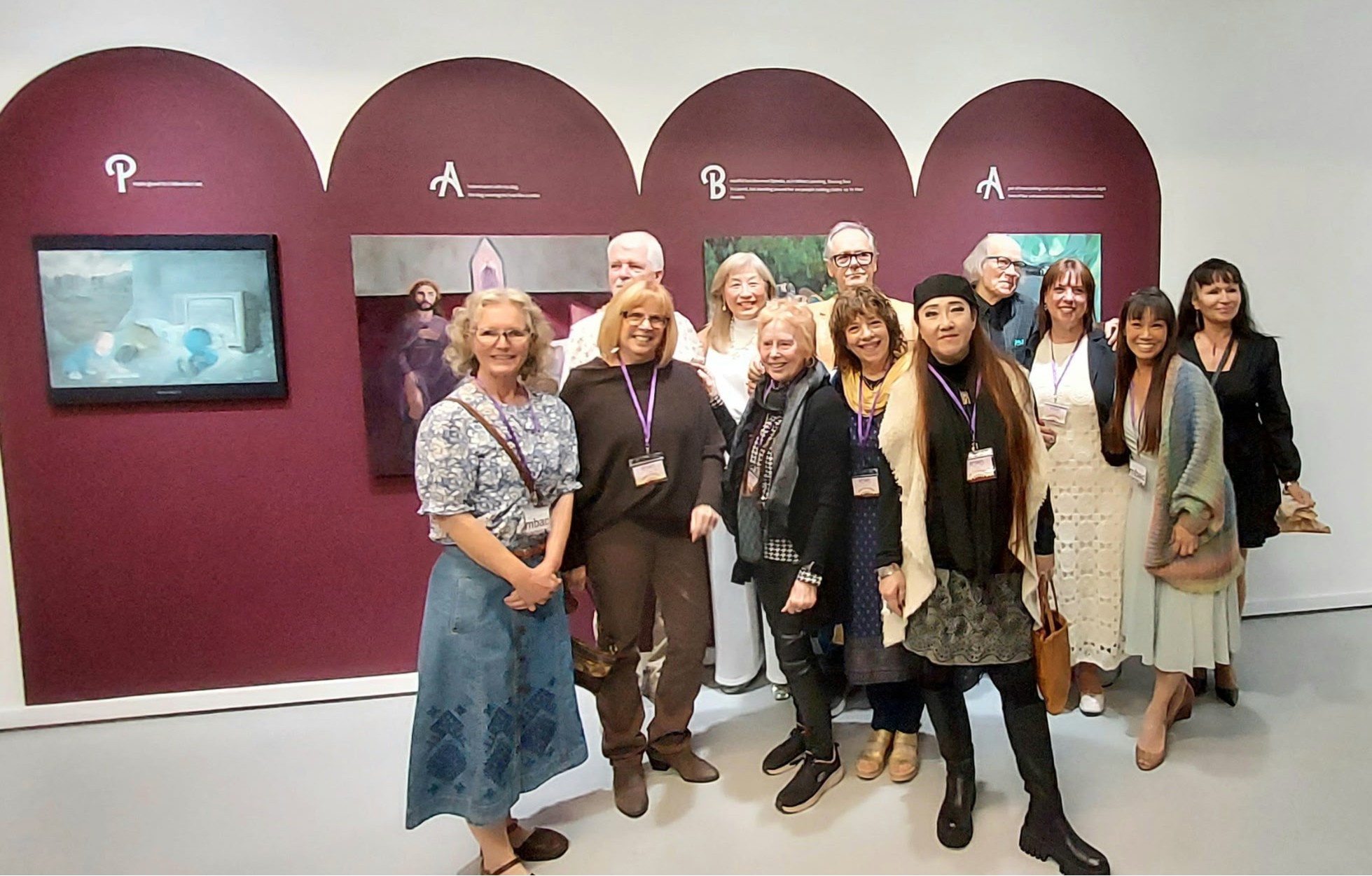
Opening night at the Manhattan Beach Art Center on Jan. 16 for “Are You Seeing What I’m Seeing? – a logical successor to “Are You Thinking What I’m Thinking?” The show ends soon, on March 29.
Our approach involved titles (or headings) inserted into fortune cookies that were then attached to a wheel of fortune. In turn, each artist stepped up and spun the wheel, and their “winning number” was of course the cookie with the title of the picture they’d have to paint.
I’m not sure what results Buñuel and Giacometti were after, but the idea behind “Are You Thinking What I’m Thinking?” was to urge artists to think outside the box. That also underlines the purpose of “Are You Seeing What I’m Seeing?” on view at the Manhattan Beach Art Center through March 29.The name of the show is phrased as a question, which asks for a response and perhaps initiates a dialogue.
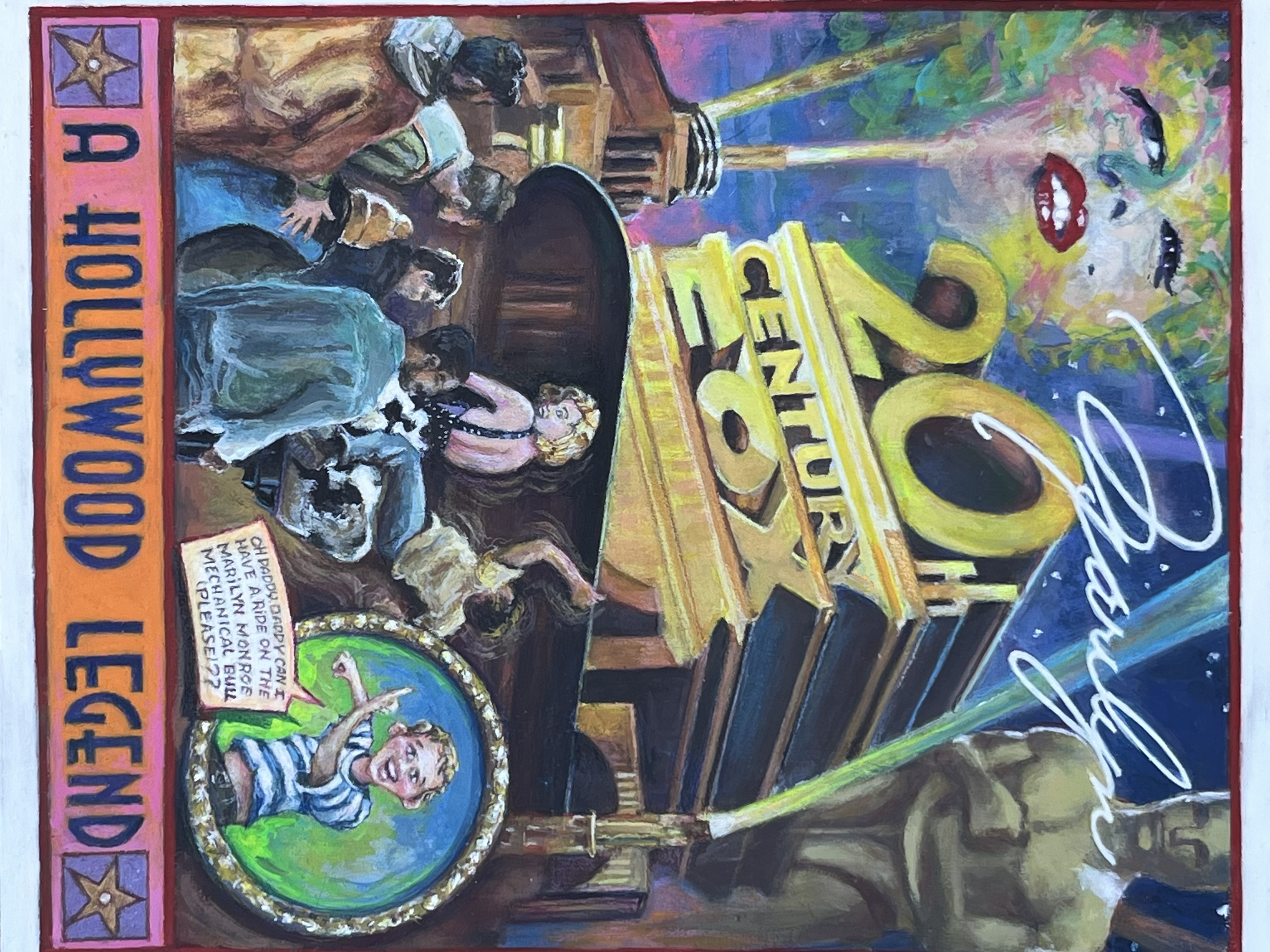
“Waiting to Ride the Bull,” by Mark Fenton, original, unaltered version.
Now, the idea of that image was mine, and one morning it simply popped into my head: an odd juxtaposition the Surrealists might have approved, like Man Ray’s flatiron with a row of tacks down its center, Dalí’s telephone with a lobster for a receiver, and Meret Oppenheim’s fur-lined teacup, saucer, and spoon. It’s a prompt that might also appeal to someone who’d say their influences are a mix of William Blake and Ann Landers. However, the reason given for the removal from view of Fenton’s painting was that “The language was overtly sexual and suggestive, and the imagery involves a child.”
The reference, I believe, was to both the prompt and the painting itself, which resembles a frame from a comic strip. We’re not talking photorealism.
Apart from being the son of a successful Hollywood screenwriter, Mark Fenton is a professional artist who has created work for the movie industry. When he was five he even met Miss Monroe on the set of one of her films.
The picture that resulted was adeptly composed, a visual non sequitur that, again, did not seem to go overboard even in this age of intensive moral scrutiny. However, in a sort of word bubble, a young boy is exclaiming, “Oh daddy daddy can I have a ride on the Marilyn Monroe mechanical bull (please)??”
As it turned out, only one person complained, out of the hundreds who had already seen the piece, and it was on the basis of this one complaint that the work was removed. Now, if I had wanted to imply a sexual undercurrent to the prompt I could have written “Joe DiMaggio and Arthur Miller, plus John and Robert Kennedy, are lining up to ride the Marilyn mechanical bull.” That would have made a darker reading more probable, but I hadn’t thought along those lines at all.
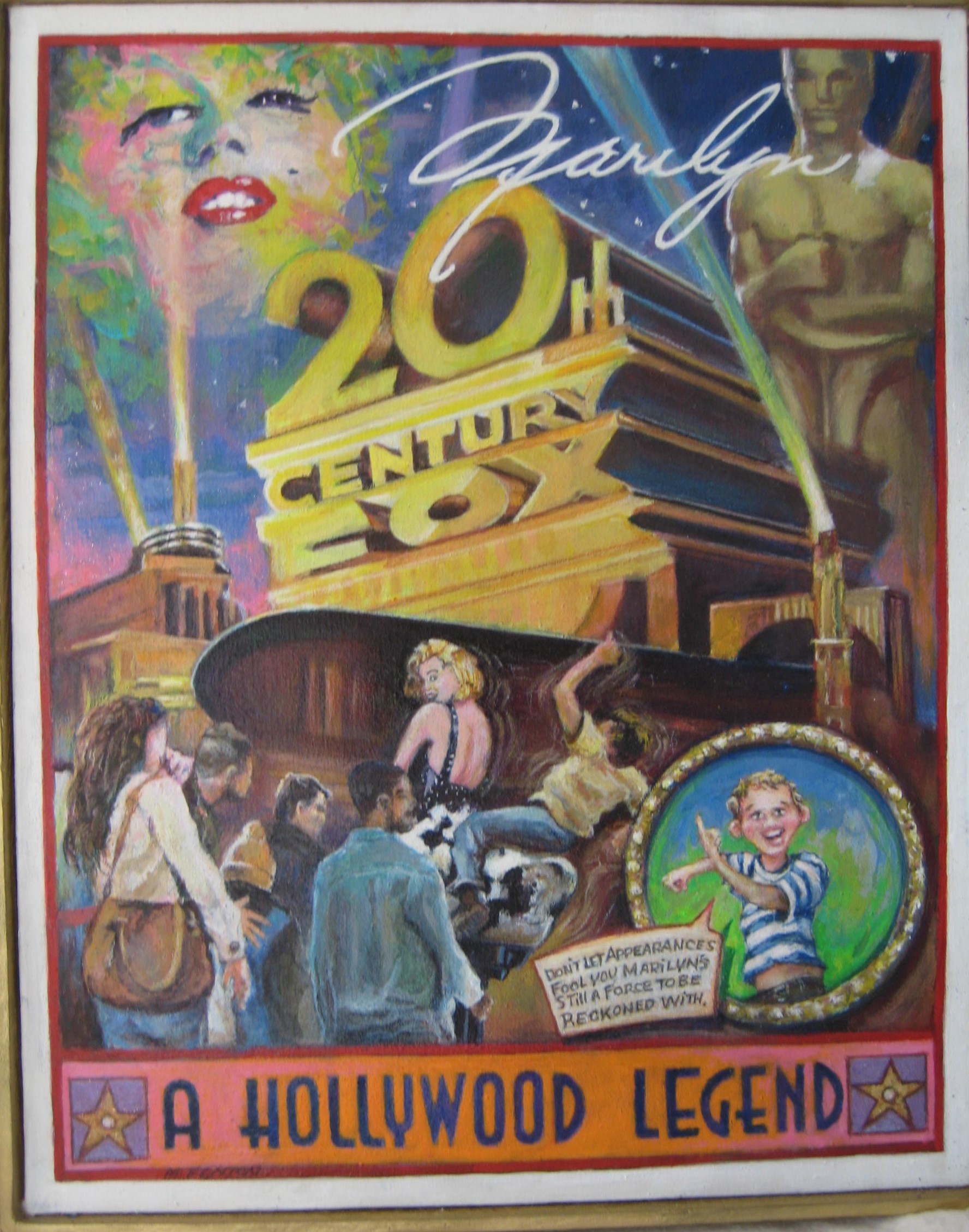
“Waiting to Ride the Bull,” by Mark Fenton – the revised and now acceptable version.
From what I know, the person who cried foul lacks credentials as a critic or judge of art, but was still able to create such a stir, and to do so without the artist or organizer of the show being consulted, only to be informed after the fact. That crucial dialogue should have taken place first.
Art venues reserve the right to reject and remove whatever work they deem unsuitable for display. A gallery needs to have and to adhere to standards. But don’t set the bar so low that people won’t take you seriously.
This is a time when artistic expression should be encouraged and imagination celebrated. We must not allow the opinions of just one or two biased individuals to dictate what the rest of us are allowed to see and think. As it is, too many artists already self-censor themselves. Instead, we should be open to and learn from the visions of artists like Peggy Reavey and Mark Fenton, because they explore new realms of possibility and encourage diverse points of view, which generate discussions. From its inception, this was what “Are You Seeing What I’m Seeing?” set out to accomplish. PEN
Comments
Loading comments…