
by Garth Meyer
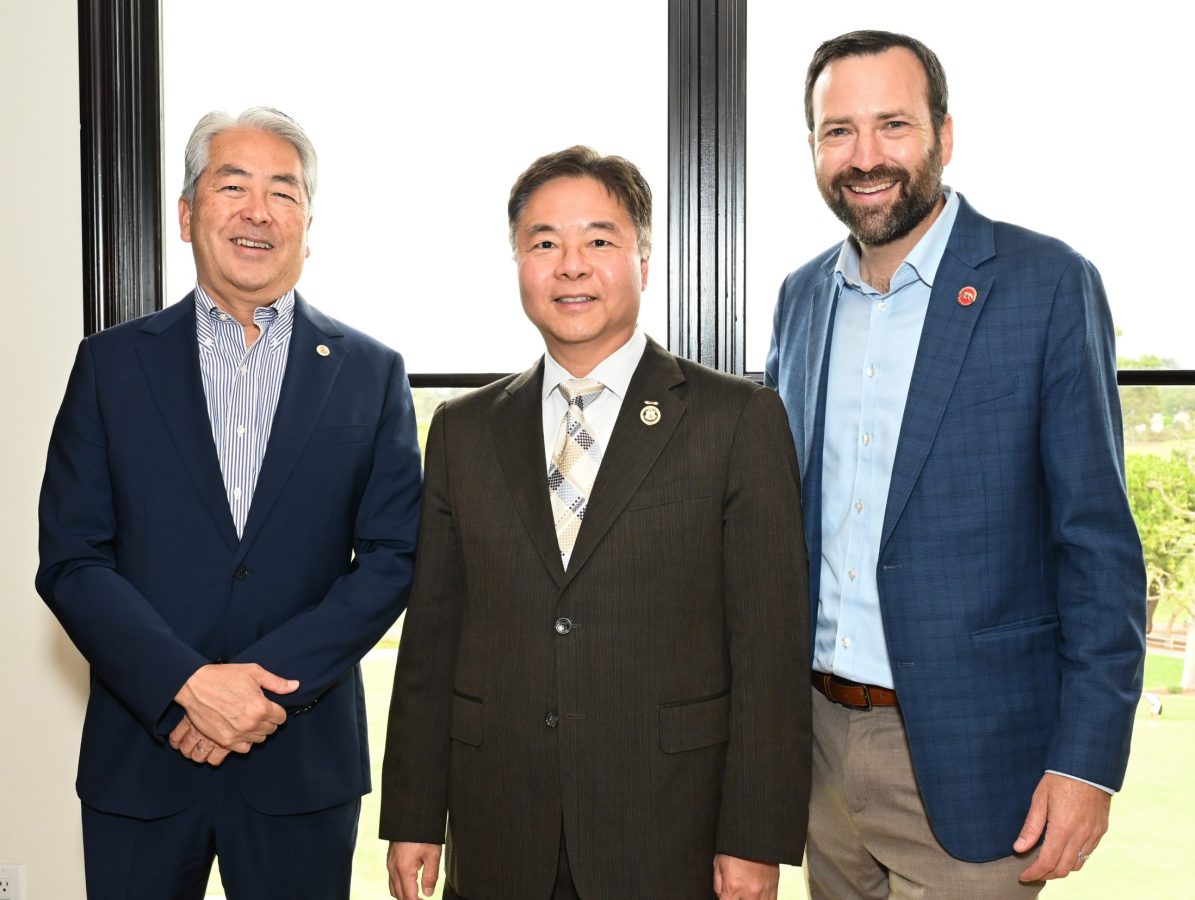
The South Bay’s three top legislators went to the hill Sept. 26 for the annual Palos Verdes Chamber of Commerce Legislative Forum & Luncheon: “From the Capitol to the Community.”
Congressman Ted Lieu talked about A.I., healthcare cuts and the looming government shutdown; State Assemblyman Al Muratsuchi told of the ‘Trump administration vs. California,’ and State Senator Ben Allen gave more updates from Sacramento. Each of the representatives are Democrats.
After the Chamber’s one-clap introduction for all of the local officials gathered in the windowed ballroom of Palos Verdes Country Club, Colleen Dillaway, a V.P. at Cox Communications and Chamber member, acted as M.C.
Other members collected questions written on cards at the tables.
State Senator Allen talked about rebuilding Pacific Palisades in a “much more fire-safe manner,” he said.
He also spoke of an expansion of T.V. and film tax credits.
“We ultimately doubled it in size,” he said, adding that 22 productions slated to go elsewhere will remain in Los Angeles.
He talked about commercial water theft – stealing from hydrants – that penalties were too lenient.
“After what happened in the Palisades, running out of water, it’s criminal. SB394 is at the governor’s office now to raise the fines,” he said.
He talked about ADA (Americans With Disabilities Act) lawsuits, of which California has more than the rest of the country combined. He talked of Assembly Bill 986, co-written with Muratsuchi: “State of Emergency and Local Emergency: Landslides and Climate Change.”
“We’ve got to get the governor to sign this bill,” Allen said.
Assemblyman Muratsuchi addressed the crowd next. The Palos Verdes resident is in his 11th year representing the South Bay.
“Just acknowledging, we are not living in normal times now,” he said, referring to the indictment of former FBI director James Comey the day before, on charges of making a false statement and obstruction related to his 2020 testimony before the U.S. Senate Judiciary Committee. Muratsuchi went on to mention the Trump Administration wanting to fine UCLA, and FCC Chair Brendan Carr’s comments regarding ABC’s “The Jimmy Kimmel Show.”
“When we start seeing our institutions (doing this), we cannot remain silent in these times,” Muratsuchi said.
Much of the room applauded.
The assemblyman noted that California is the fourth largest economy in the world, but also tied for the highest poverty rate in the United States, with Louisiana.
He talked about tariffs, a “Trump tax,” he said. “We’re going to start seeing it on our consumer goods… He is attacking California in so many ways.”
Muratsuchi voted “no” on Senate Bill 79, which would increase near-transit housing development projects by exempting them from local zoning.
“It (is) running roughshod over any semblance of local control,” he said.
Then he brought up the second largest issue he hears about, besides housing – moreso in the beach communities.
“E-bikes,” he said.
Assembly Bill 875 would allow police to confiscate traffic violators’ e-bikes – and require a one to two week safety class in order to get a bike returned. Muratsuchi hopes the bill gets signed. It is sponsored by the California Police Chiefs Association.
Six-term Congressman Ted Lieu took to the lectern next, speaking on the hill before his return to Capitol Hill in Washington, D.C. the following Monday.
Lieu named three topics he would address for the Palos Verdes crowd – healthcare, A.I. and landslides.
The “Big Beautiful Bill, which Democrats call ‘The Big Ugly Bill’,” he said, included the “largest healthcare cut in U.S. history.”
“Anyone on the Affordable Care Act, your premiums will rise,” he said. “ACA premiums go out in the mail Oct. 1.”
The Congressman said the millions of people who lose health insurance because of the bill will still receive healthcare, while the costs are shifted to others.
“To those with insurance; your premiums will rise to cover these Emergency Room (services),” Lieu said.
He followed with a piece of advice.
“If anyone is interested in buying a yacht, you should do it this year,” he said.
He referred to part of the “Big Beautiful Bill,” and a July article in Forbes magazine, saying that if you buy a $10 million yacht for business, the new law makes it 100% tax deductible in the same year it was bought, which then may be converted to personal use the next year.
“It’s too good to be true, and it is true,” Lieu quoted estate planning attorney Alan Gassman (Clearwater, Fla.) from the article.
On the subject of artificial intelligence, he told of the potential coming era of “A.I. Agents.”
“(Online) agents that do things in the real world for you,” he said. “It’s amazing and alarming at the same time. Imagine a rogue A.I. agent.”
“It’s also going to start having an effect on employment.”
He noted the current U.S. unemployment figure of 4.3% – the highest in four years, he said.
On landslides, he praised local authorities.
“RPV officials, they have slowed down the landslide. It is working but they’ve also drained the city coffers,” Lieu said.
Questions from the audience came next.
“The number one issue on the minds of educators is A.I.,” said Muratsuchi, speaking of education conferences he goes to around the country. He is chair of the State Assembly education committee and is running for California superintendent of education in 2026.
“Not only cheating their teachers but cheating themselves,” he said.
Local control and zoning?
“The hard truth that a lot of folks don’t want to hear, is that there is a bipartisan recognition that we need to build a lot more housing everywhere and anywhere,” Muratsuchi said.
Nonetheless, he met last week with the mayors of Redondo Beach and Manhattan Beach on the subject of local control: “how to take on this bipartisan juggernaut” and still protect neighborhoods.
“The rest of California, they’re not complaining about these projects,” Muratsuchi said.
Senator Allen chimed in.
“It’s not just about local character, it’s also about risk. Why, why would we do this in very high fire zones?” he said.
The room applauded.
The Palos Verdes Chamber “Capitol to the Community” luncheon is in its 14th year. ER





What if anything have these three ever accomplished?
They’re really good at collecting taxpayer paychecks.
So, Muratsuchi admits he voted against SB79 which sits on Newsom’s desk right now. Senator Ben Allen actually carved out an exemption in SB79 for his friends in Beverly Hills, but conveniently forgot to mention this and then he did not record a vote on SB79. Most likely didn’t want to upset his friend, Senator Scott Weiner of San Francisco who authored this bill which reeks havoc in South Bay cities. What a puss. This guy’s term can’t end soon enough.
wreaks
While I appreciate Assemblymember Muratsuchi’s note of our recent visit with him, we did not talk about how housing mandates impact the character of a city (which they certainly can). Rather we demonstrated the unsustainable fiscal impact these mandate have on city like Redondo that is already dominated by housing. Of private land under the city’s jurisdiction, 85% is zoned for housing. Only 15% is zoned for commercial and industrial. Using real revenue generation numbers in our city we average $7.60 more city revenue per square foot for commercial over residential. And if you apply cost of city services, housing becomes a net loss.
Each RHNA cycle erodes our commercial space to refine for housing. That means our financial revenue base is eroding with each cycle. But it is actually exacerbated beyond that. Online sales tax is distributed based on brick and mortar commercial space. So as we convert commercial into residential we lose online sales tax as well. And to add fuel to the fire, the other mandates beyond RHNA incentivize commercial property owners to sit on their property until they get a developer who wants to build housing. We’ve already seen one property owners pull a project in process for commercial development and resubmit as high density housing.
All in all the city’s already spent over $2.6M on our housing element and on housing mandate related lawsuits and we allocated millions more in our last budget. With a $3.5M General Fund deficit, these housing mandates threaten cities with abundant housing into fiscal insolvency.
Redondo is in the top 5% of housing density across the state. We have 85% of our land dedicated to housing already, most of it multi family housing. Unique in the whole SCAG area. About half our units are rental. And 11% of our housing is below the 80% market rate Federal standard. We are the only Beach City with a Housing Authority and Section 8 voucher program. We are subsidizing housing for about 500 residents including veterans. We are the only Beach City with pallet shelters and permanent supportive housing.
How bad would it look if a city like Redondo – a model of housing density, diversity and homeless programs – would slip into insolvency directly driven by the impacts of the state housing mandates?
Meanwhile the cities and Counties of the legislators leading this glut of mandates slip into insolvency directly loopholes to save their own wealthy constituents. This is just wrong.