
Take it to it: Tyler Hatzikian is inducted as a South Bay Legend
by Ed Solt
In 1993, a Loyola Marymount film student named Jason Baffa took advantage of a South Bay rarity, afternoon offshore winds. North across the bay, Malibu was on fire. The fall sky was surreal, dirty red and hazy, but the waves were glassy and good. On an outside overhead left, one lone rider, a tall goofy footer, took off into a deep wave-slicing bottom turn to trim high in the pocket. In the turmoil of the wave, time seemed to slow down. The rider’s footwork was quick but unhurried, somehow delicate, even elegant. He stepped to the nose of his blue resin tint noserider with a fabric inlay — a style of surfboard rarely ridden since the ’60s — to strike a locked-in hang ten, perfectly shooting the curl.
“Who is that?” Baffa thought to himself. The goofy footer perched on the nose for the length of a city block, statuesque, the fiery sky lending a weirdly golden aura, like some kind of apocalyptic saintly painting from the Renaissance. It was the most soul surfing Baffa had ever seen.
“That is Tyler,” Baffa said, still awestruck these years later. “Tyler Hatzikian. The real deal.”
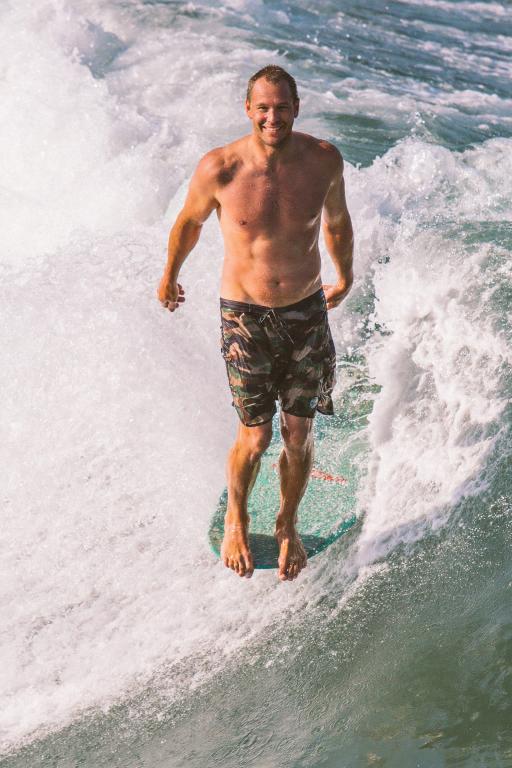
Grinnin and trinnin,’ hanging ten. Photo by Brent Broza
On April 25, the Hermosa Beach Surfing Walk of Fame will etch Tyler officially into history. He will be inducted as a South Bay Legend.
Christian Tyler Hatzikian was born January 7, 1972, in El Segundo, to Chris and Betty Hatzikian. His father — known in the Playa Del Rey surf world of the ’60s as “Zeke” — built everything with his hands, including Tyler’s first surfboard. When Senior Zeke got too busy, Tyler stripped the fiberglass off old boards and started making his own. By elementary school he was shaping thrusters for the older kids under his first label, Ty-Sticks. With his mom Betty co-signing, he got his first business license at 16.
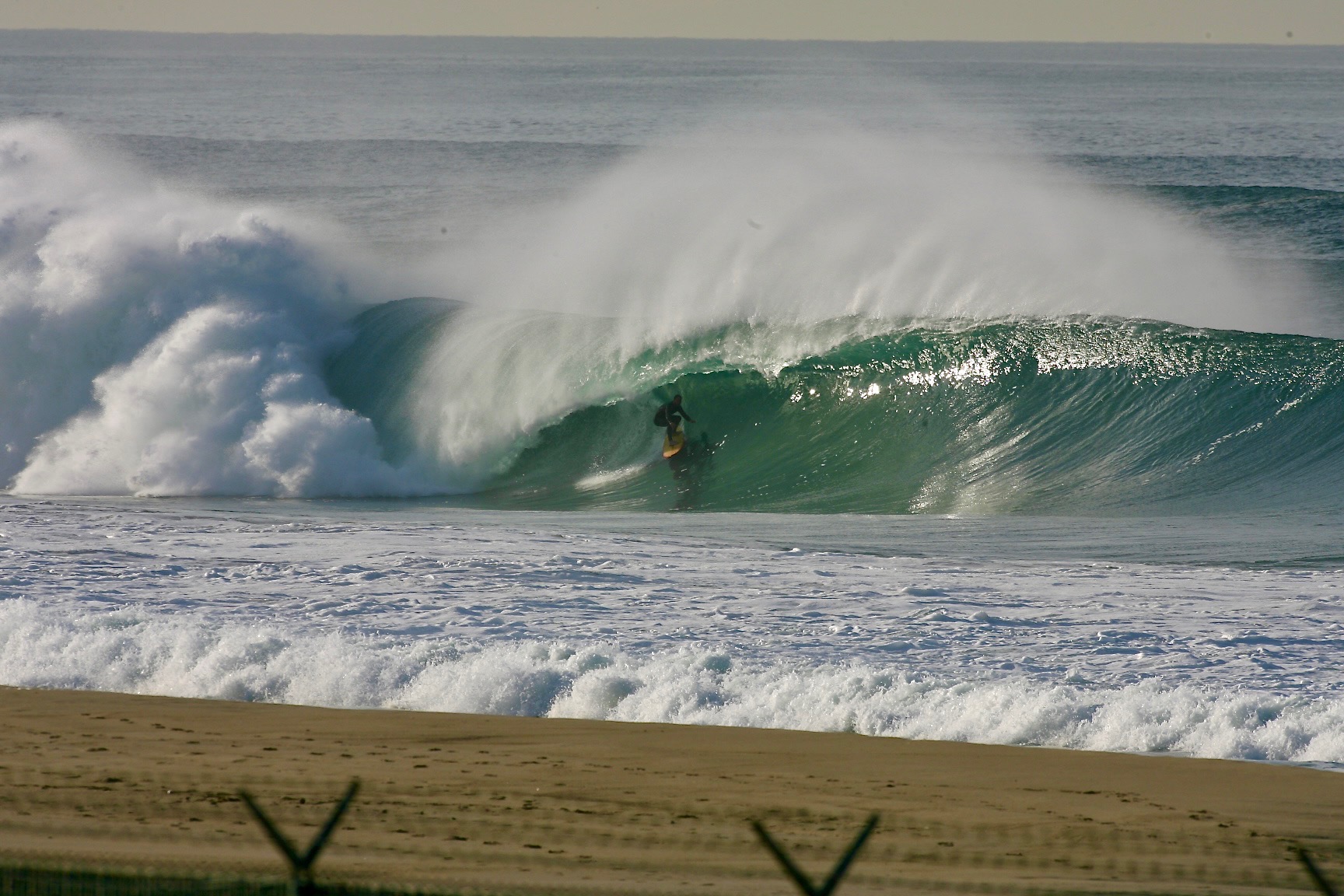
Before that, a pre-licensed Tyler bombed down Grand Avenue on his skateboard — ’80s flowing long locks catching the crisp morning air — making his way to the Strand and on to El Porto. On that route, something new had begun to emerge: a left off a new jetty, fenced off, dangerous, unfamiliar, that detonated on big winter northwest swells. After Chevron built the 900-foot groin in front of its El Segundo refinery in 1984, the wave quietly became Tyler’s proving ground — the spot the El Segundo crew called Northside, long before photographer Mike Balzer and surfers Ted Robinson, Chris Frohoff, and Kelly Gibson put it on the map as Hammerland.
“I was out shooting Ted and Frof, both in their prime — the A-team,” said Balzer. “And this teenager was keeping up with them. He dropped into a full top-to-bottom barrel, giant, and I got the shot. I was like, who is this? Some kid from El Segundo riding his own boards called Ty-Sticks?”
Balzer submitted the photo to Surfer Magazine, and Tyler appeared in the 1991 feature “15 Hellmen You Should Know.” He was also a legitimate competitive shortboarder at the time, winning the Fineline Triple Crown title against Dickie O’Reilly, Chance Barber, Pat Murphy, and Doug Weens. He did it riding boards not just from Ty-Sticks but from Dennis Jarvis at Spyder, Pat Reardon, Dave Higley’s Hig Sticks, and Craig Richmond at Open Ocean — most likely the only local surfer to dominate on four South Bay shapers .
Alongside surfing, Tyler was disappearing into the deep end of mid-century American car culture — Hot Rod Magazine, Motor Trend, those pocket-sized Rod & Custom zines you could hide behind a math book. He studied the same obsessive craftsmanship in chrome and steel that he was developing in foam and glass. It started with a stock time capsule in high school — a harvest gold ’55 Chevy four-door with a 265 cubic-inch V8 and a Powerglide transmission, already 30 years old when Tyler got behind the wheel — and grew into a life’s work restoring El Caminos, Nomads, Novas, hot rods, a 1950 Merc built for his wife that somehow became a chopped ’41 Ford, and a woodie he sold in the late ’90s for a house down payment. The two worlds — cars and surfboards — were never separate to Tyler. Both were about understanding what something was supposed to be, and then making it better than it had any right to be.
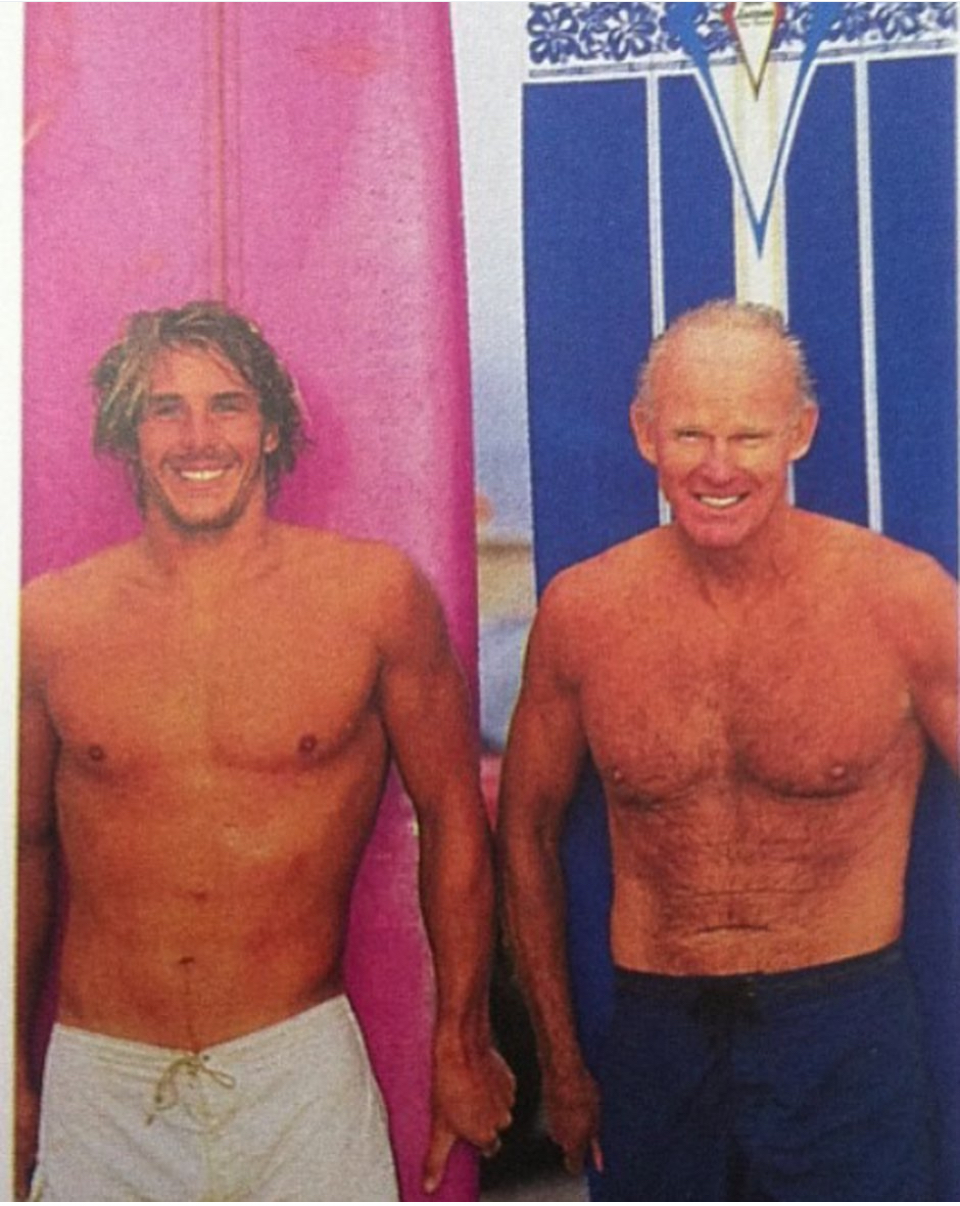
A young Tyler with his idol Hap Jacobs. Photo by Jim Russi
By his early twenties, Tyler had worked his way up to head sander at Shoreline Glassing in El Segundo. Around the same time, Hap Jacobs — the legendary shaper who had largely stepped away from surfboards when the longboard died in the late 60s — was finding his way back. At the urging of fellow Walk of Fame inductee Donald Takayama, Hap had reconnected with the culture at a contest in Oceanside and picked up his planer again. He rented a shaping bay from Shoreline’s owner, Mike Collins.
There was Tyler, grinding seven days a week, coated in sweat and foam dust. Out front of Shoreline were his two daily drivers, a 396 CI C10 truck or Crocus, and an Onyx Black ’56 Nomad. In his off hours he’d shape the occasional ’60s-style longboard for himself or for his dad. One board in particular — a true noserider, period-correct stringers, opaque white panel work, ten-ounce volan — looked like something off Hap’s showroom floor at 422 PCH, circa 1966. In the early ’90s, that was practically an archaeological artifact. The dominant “longboard” of the era was a light, multi-finned, hard-railed shape that was essentially a stretched shortboard.
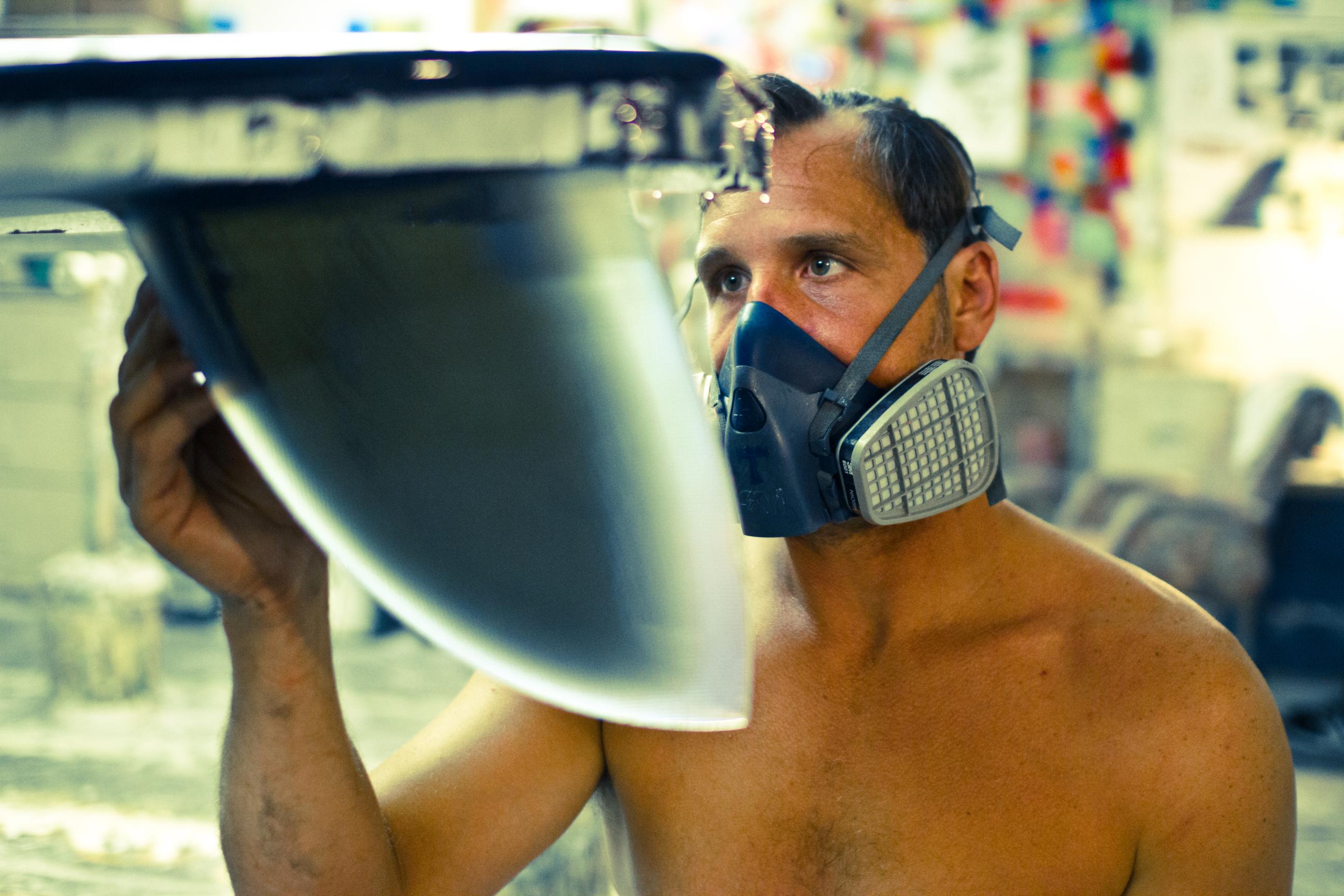
Tyler looking back to go forward and advancing traditional design. Photo by Brent Broza
“All of the local shapers were like, ‘What is this?’ They’d give me instructions like, ‘Why don’t you blend the concave’ and sort of scoffed,” Tyler said. “As I didn’t really have a label yet for these designs.Hap said, ‘Why don’t you slap a diamond on and ride for me?'”
The last step on the board: a taped-off red Jacobs diamond logo in resin on deck and bottom. The Hap Jacobs Tyler Hatzikian Model was born — a run of 50 to 60 boards, unique in the history of Hap’s signature models because Tyler made every single one himself, start to finish.
“He has a certain idea for his boards, and what they should be,” Hap said in a 2012 Daily Breeze profile.
Jim Russi — staff photographer for Longboard Magazine, South Bay local, one of the great surf photographers of his era — came knocking at Hap’s shaping bay looking for a longboarder for a Tavarua photo trip. Hap said: Tyler. The only problem was that Tyler was on the Shoreline payroll. Owner Mike Collins was direct: it was the trip or the job. Tyler quit and got on the plane.
It was Longboard Magazine’s first big-budget shoot, and the lineup on the trip was the era’s top longboard pros — Israel Paskowitz, Ted Robinson (SWOF 2016), Steve Farwell — with their sponsor rash guards, travel quivers, and fancy rolling bags.
“I remembered Tyler as a 16-year-old charger at Hammerland on his Ty-Sticks,” said Russi. “Here comes Tyler casually late to LAX holding two pintail Jacobs — 10 feet, heavy, wrapped in a sleeping bag with glassed-in fins sticking out.”
The collective thought: Who is this guy?
The boat pulled up to Cloudbreak. Half the pros were still fussing with their sponsor rash guards and leashes and fin placement when the unmistakable plop of a board hitting the water cut through the noise — a craft that probably outweighed the rest of the quiver combined. On the very first wave of the trip, Tyler pulled into a giant heaving barrel and made it. “A beast,” Russi said. “A monster.”
That image — Tyler on a heavy board in a serious wave, making it look like a foregone conclusion — became the signature.
Russi would go on to capture several iconic images of Tyler for various surf magazines.
“Tyler’s a hard worker, pulling a lot of influence from his blue-collar background,” Russi said. “I would come up with a crazy shot idea, and he’d be ‘Let’s do this.’ He always loved to do experimental stuff and put in the work.”
Tyler really brought Russi back to 1962, when Russi learned how to surf at 15th Street Manhattan Beach.
“He reminded me of my older brothers and their friends — all gearheads who wrenched and surfed,” said Russi. “He’s pure from the source.”
Tyler returned from Tavarua jobless, and glad for it. He set up shop in a warehouse in El Segundo. A simple half page ad in Longboard magazine announced the arrival of Tyler Surfboards, the bold lettering “Finally” under the iconic Tyler hexagon.
Tyler boards began appearing in South Bay shops, and for a certain kind of surfer they hit like a revelation.
“At Just Longboards, front window, middle rack — copper penny tint, sparkly wingnose,” said Mike Siordia, then a 15-year-old ET Surf employee who would later become a Tyler team rider. “Everything I had ever imagined a longboard could be — how it should look, how it should feel — was sitting right there in that rack. I came up in an era when boards like that weren’t even close to being popular. But that one. The craftsmanship was on another level. Pure, intentional, and beautiful.”
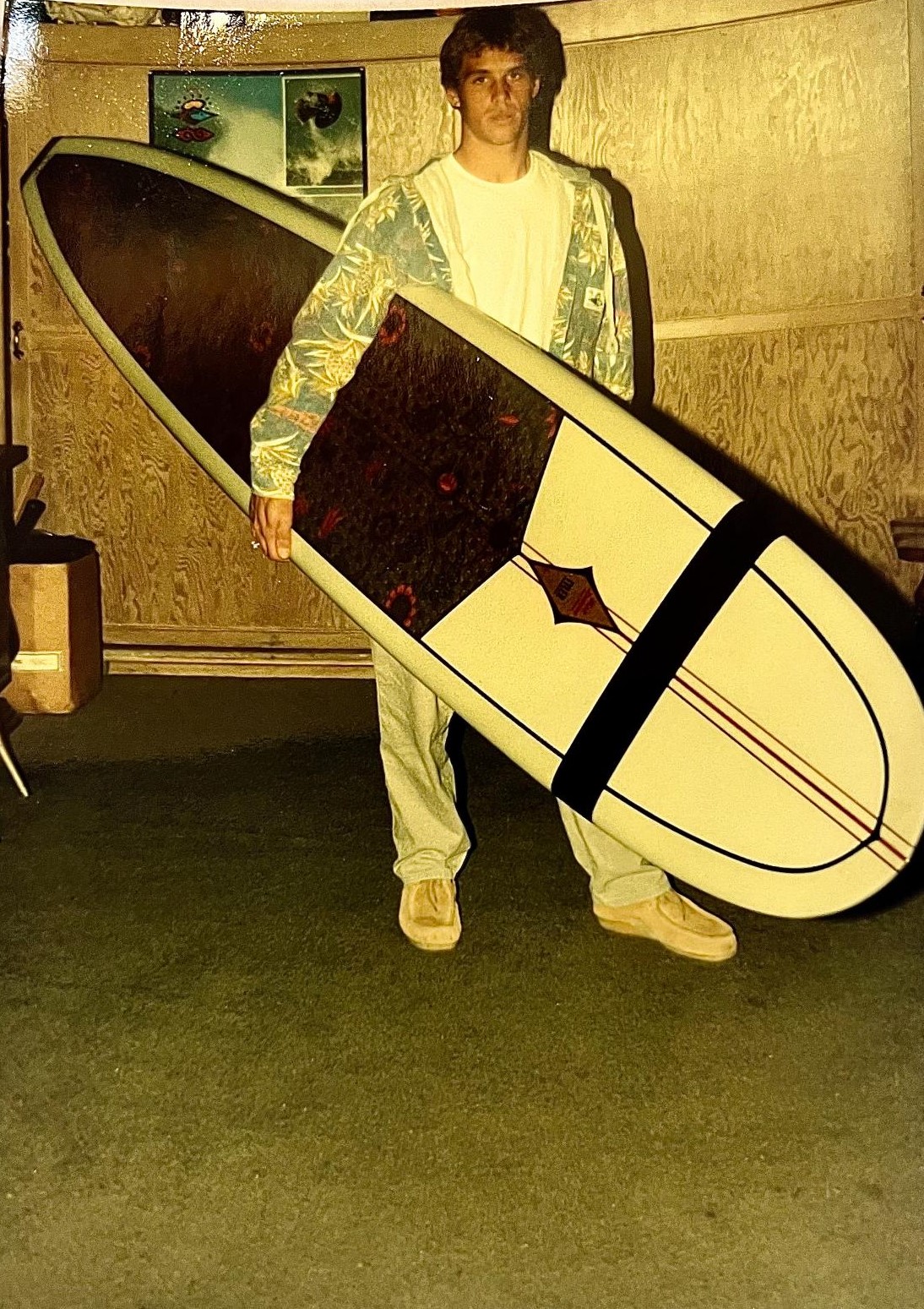
Tyer Hatzikian with a Hap Jacobs Tyler Hatzikian model
His factory became a destination. “The smell of resin, the showroom of the most intricately designed, most advanced traditional surfboards ever, Hap’s marlin on the wall from his 422 shop, whatever car project Tyler was tinkering on,” said Siordia. “It was the church of Tyler.”
Both his boards and Tyler himself cut a large swath through the surf world.
Baffa built his first feature, Single Fin: Yellow, around a prototype translucent yellow noserider that Tyler shaped, a board that then traveled five continents and was surfed by riders across six cultures. It went on to become the most-nominated film at the 2003 X-Dance Awards.
Baffa’s follow-up, One California Day, put Tyler in direct company with the era’s defining longboarders — Joel Tudor and Devon Howard — and the contrast was illuminating. Tudor was precision and stillness. Tyler was something else. In one scene in the film, Tyler takes a 40 year old Hansen “50/50” board out at Rosecrans and absolutely shreds, while his voiceover monologue touches both on his reverence for the past and his own style, “taking it to it,” understated yet aggressive.
“Maybe the person who owned this board before you never really got to take it to it,” he says. “Or maybe the guy went off to Vietnam or something like that. And, you know, being 40 years later, maybe this was one of the most radical waves this board has ever had.”
“The way Tyler is built, he knows how to leverage power points on a wave — he can sink a rail and truly power surf. It’s a completely different approach from everyone else,” Baffa said. “For a lot of people, it was refreshing to watch him in One California Day, especially seeing him tear apart our everyday, subpar waves.. People connected with that — the fact that the footage wasn’t in perfect conditions, just real surf. Tyler pulls influences from outside of surfing — car culture, sprint car racing — he’s always pushing things further. It’s very punk rock.”
Mike Purpus (SWOF 2003), whom many consider the greatest surfer to come out of the South Bay, reaches for the deepest compliments the culture has.
“Tyler is a highlight film of the past — combining the style of Phil Edwards but also the radical South Bay hotdogging style of Dewey Weber, just a lot taller,” said Purpus. “The coolness of Dora and a whole lot of the Fonz.”
Tyler took one notable detour. Inspired by a childhood of getting sprayed by dirt while watching sprint cars tear up the first turn at Ascot Raceway in Gardena, he stepped off the board long enough to earn 2022 Rookie of the Year honors on the dirt track — at 50 years old — building, painting, and wrenching on his own car.
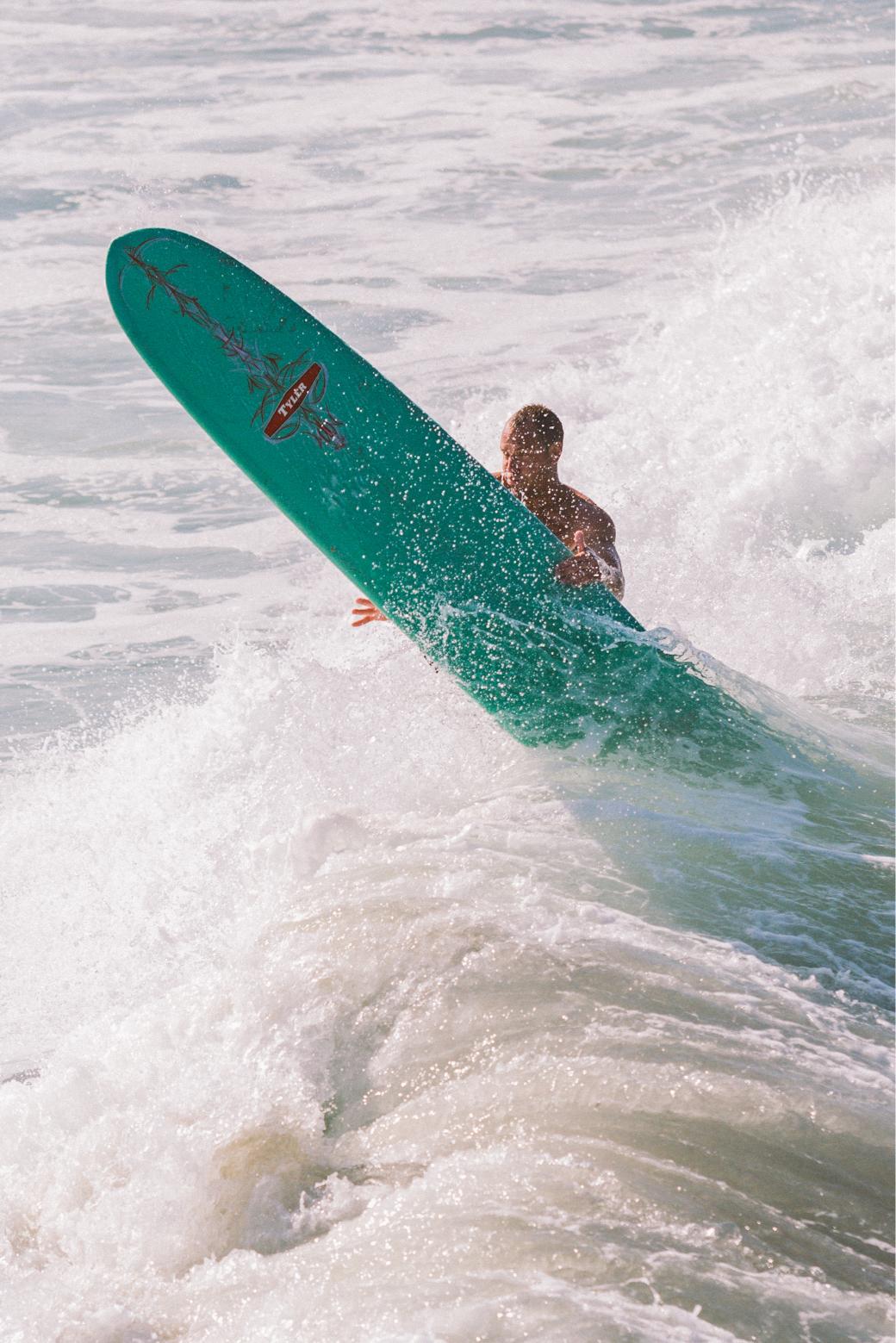
Tyler drawing a radical line on a surfboard design deemed archaic. Photo by Brent Broza
Today, Tyler runs two surfboard lines — the original hexagon red label, and Engineered by Tyler, his black label, mentoring the next generation of South Bay shapers and surfers. His team riders are all under 21: Jake Plourde, Peter Toumajian, and Cormac O’Brien..
This past winter, Cormac paddled into what many are calling the wave of the 2025–26 season, dropped in switch stance, and came out of the green room intact — on a red Tyler Surfboard, naturally.
“Riding real longboards in big waves — the only proper way — balls to the wall,” said Cormac. “That’s what sets him apart from all longboarders and is my major inspiration.”
“In the grand scheme of things of the entire surf world, shortboard, longboard, Tyler is the most influential surfer out of South Bay since the ’90s. He’s up there with Greg Browning.”
Balzer — who shot Browning more than anyone and has photographed virtually everyone, from Malibu to Pipeline — keeps coming back to Tyler, too.
“The stuff Tyler does at Hammerland — riding heavy boards and sticking them in the deepest pockets — is stuff I’ve never seen,” Balzer said. “And I have shot everybody.”
Shawn O’Brien, president of the Bay Cities Surf Club (and Cormac’s father), said Tyler’s significance goes beyond his singular style as a surfer and board maker. He represents the South Bay itself.
“Tyler is South Bay surf pride in a surf world saturated by Orange County, “O’Brien said. “South Bay surfers always zigged when they zagged. Tyler epitomizes that.”
In One California Day, Tyler speaks movingly about his gratitude for the surfers and shapers who came before him. The South Bay made him possible, and his hope – which his induction into the Surfers Walk of Fame affirms – was simply to be a link in that chain.
“The South Bay allows me to do my thing,” Tyler said, “and make my mark on history, build on top of guys like Velzy and Hap Jacobs, Greg Noll, all those South Bay legends who basically came out of this epicenter.” HBSWOF
Comments
Loading comments…