by Laura Garber
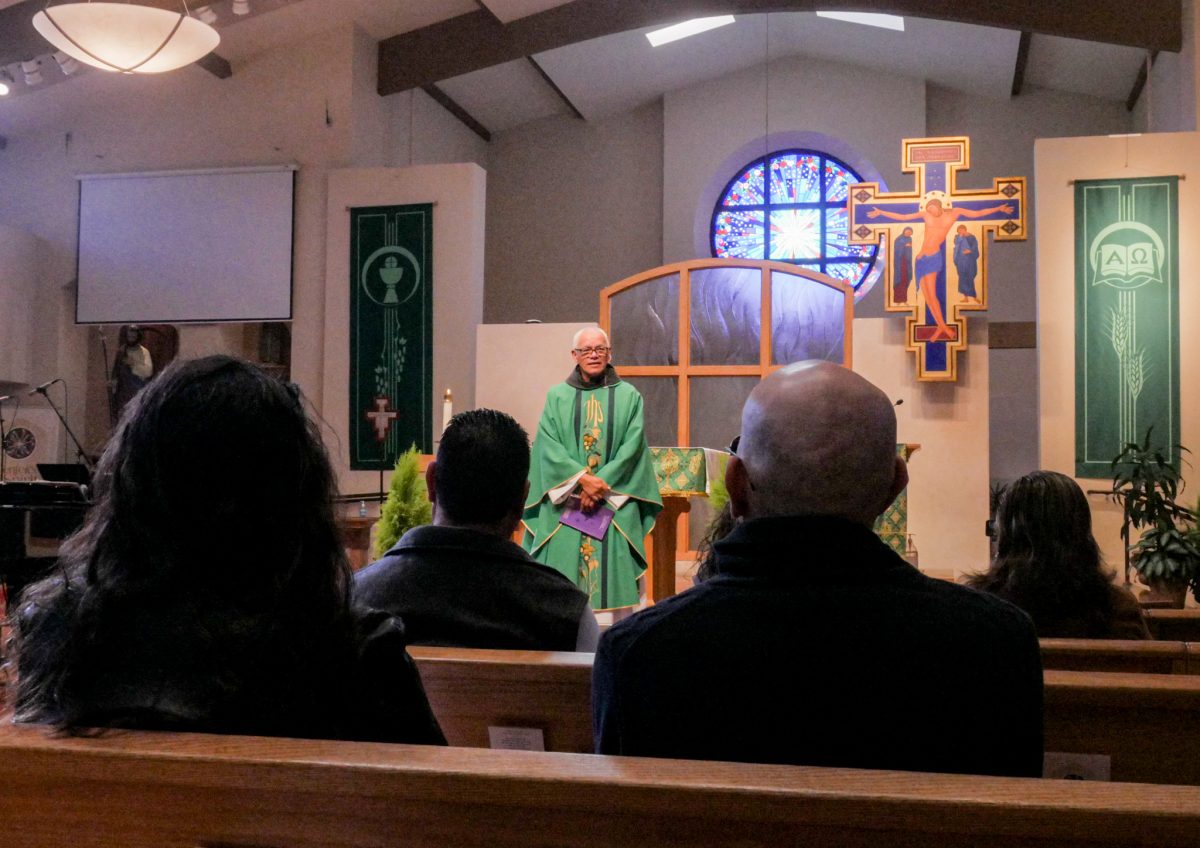
Claudia sits in the back pew of Our Lady of Guadalupe Catholic Parish every Sunday now, watching the door. Not for late arrivals, but for ICE agents.
The 54-year-old parishioner — who asked that her last name not be used — carries a passport card everywhere she goes, despite being a U.S. citizen. During the height of last summer’s immigration enforcement raids throughout Southern California, she took formal shifts as a door-watcher during mass, ready to lock the church doors and alert Father Carlos Morales if federal agents appeared.
“I still sit in the back and I’m still just watching the door in case,” Claudia said. “But it’s scary.”
The pews she’s watching have grown emptier. At Our Lady of Guadalupe, a Hermosa Beach parish that has served the South Bay’s Hispanic community since 1920, entire families have stopped attending Sunday mass. The Spanish-language services that once overflowed with multigenerational families now show visible gaps where regular parishioners used to sit.
“I know two families, because I visit them and they say, ‘No, we cannot come [to church], because we have our grandma, and we cannot expose our lives,'” Fr. Morales recalls a member of an undocumented family telling him. “I thought maybe we don’t have many, but we have more than I thought, people who are in that situation.”
This fear — of being arrested while exercising their faith — is what brought Catholics across the country together on Wednesday, February 4, for “Holy Hour,” a coordinated prayer service called by Archbishop Paul S. Coakley, president of the U.S. Conference of Catholic Bishops.
The Archbishop’s invitation came after a series of deadly force incidents involving Immigration Customs Enforcement agents, including the deaths of Minneapolis protesters Alex Pretti and Renée Good, and detainee Geraldo Lunas Campos in Texas.
“[These] are just a few of the tragic examples of the violence that represent failures in our society to respect the dignity of every human life,” Coakley wrote. “We mourn this loss of life and deplore the indifference and injustice it represents.”
For the first time in 12 years, the U.S. Conference of Catholic Bishops voted to issue a “special message” about immigration in November 2025.
“We are saddened by the state of contemporary debate and the vilification of immigrants,” the bishops wrote. “We lament that some immigrants in the United States have arbitrarily lost their legal status. We are troubled by threats against the sanctity of houses of worship and the special nature of hospitals and schools. We are grieved when we meet parents who fear being detained when taking their children to school and when we try to console family members who have already been separated from their loved ones.”
The church’s strong stance may surprise those who think of the Catholic Church as a conservative institution aligned with traditional power structures. But the church has a long and often radical history of defending human rights in Latin America that is directly connected to its current immigration advocacy.
During Latin America’s darkest decades — the 1960s through 1980s, when military dictatorships produced some of the worst human rights abuses in the hemisphere — the Catholic Church emerged as often the only institution powerful enough to challenge state violence.
In Chile, after the 1973 coup that brought Augusto Pinochet to power, Cardinal Raúl Silva Henríquez transformed the church from a mediating force into an active defender of the disappeared and tortured. In Brazil, under 12 years of military dictatorship, bishops organized 40,000 “base communities” to teach democracy from the ground up, with the church becoming what one observer called “a beacon, the one institution in the country powerful enough to challenge the military government.”
In El Salvador, Archbishop Oscar Romero — once considered conservative — became “the apostle of the poor” in the late 1970s, using his episcopal letters to document violence against civilians. He was assassinated while celebrating mass in 1980, killed for his public stance on human rights.
This transformation of the Latin American church came through what came to be called liberation theology, and the “preferential option for the poor” articulated at the 1968 Medellín Conference, where bishops declared that defending human dignity was central to the Gospel. The movement didn’t just influence Latin America. It reshaped Catholic social teaching worldwide.
“The church’s moral authority and because it has no partisan motives, it has endured where labor unions, student federations and political parties have not,” wrote Penny Lernoux in The Cry of the People: the Struggle for Human Rights in Latin America, which documented the church’s role during the dictatorship era.
Today’s bishops’ advocacy for immigrants flows directly from this tradition. It’s not a departure from Catholic teaching, but a continuation of a decades-long commitment to protecting vulnerable populations from state power.
That history resonates at Our Lady of Guadalupe, named for the Virgin Mary who appeared to Indigenous villager Juan Diego on Tepeyac Hill in Mexico City. The church was founded during another era of Catholic persecution — in the 1920s, when the Mexican government’s campaign against the church forced priests to flee north, some settling in Hermosa Beach.
For Fr. Morales, who came to the parish in 2013 after serving in Central America, the current climate feels deeply personal.
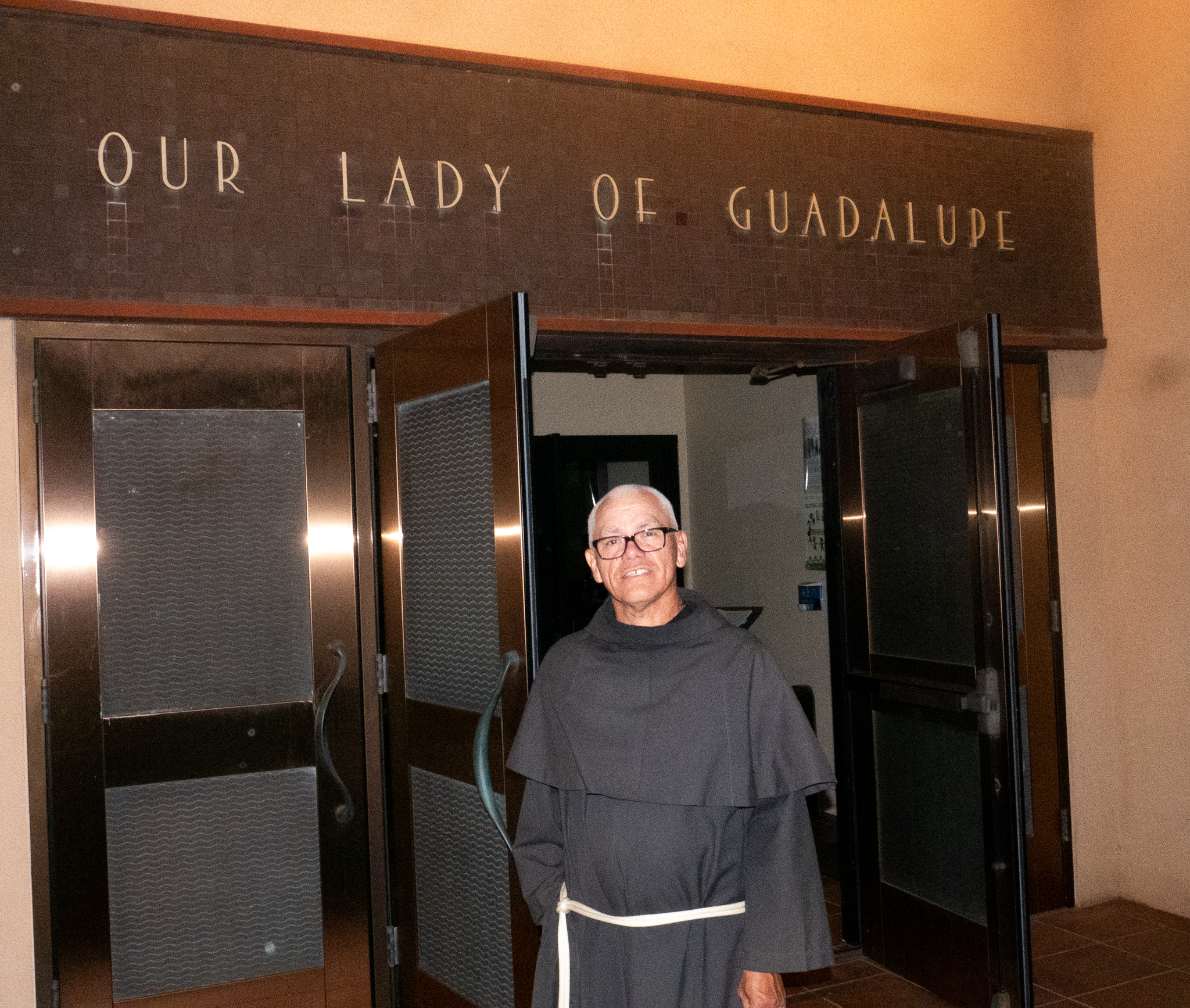
“I feel that they are part of the congregation…I know them, we talk, participate in activities together. It’s like we’re a family,” he said of the missing parishioners. “It’s something that, for me, it’s sad.”
The fear became acute last summer. Fellow parishioner Alberto Maldonado recalls the sudden drop in attendance: “We thought ‘what’s going on? Are they taking time off on vacation?’ But then you realize with whatever’s happening in the news, it was definitely fear.”
That’s when Claudia, Maldonado, and Joanna Velazco began their door-watching shifts. The three volunteers took turns monitoring entrances during services, ready to activate a plan developed after Fr. Morales attended a “Know Your Rights” workshop led by Isaac Cuevas, the Archdiocese of Los Angeles director of immigration and public affairs.
Initially, Cuevas told parishes that ICE was only targeting violent criminals. But after June 6, when agents raided garment factories, car washes, and parking lots in LA’s Fashion District, that reassurance evaporated. Locally, raids occurred at several car washes, and in one instance, a preschool known for its international student population.
“The [Catholic] Church doesn’t typically get involved in law or policy until those laws and those policies are unfair and unjust,” Cuevas told Catholic publication Angelus News. “And that’s when we’re called to be prophetic, and to defend people who can’t defend themselves.”
For Claudia, who celebrated her quinceañera at OLG and now serves as a catechist and member of the Hispanic Association, the impact extends beyond empty pews. It’s disrupted the social fabric of the parish.
“Somebody complained to Father Carlos that we talk too much, we socialize too much before mass,” Claudia laughed, recalling a pre-pandemic complaint. “We socialize before because we’re so close. We’re always having some kind of activity where you get to meet everyone, and everybody makes you feel very welcome.”
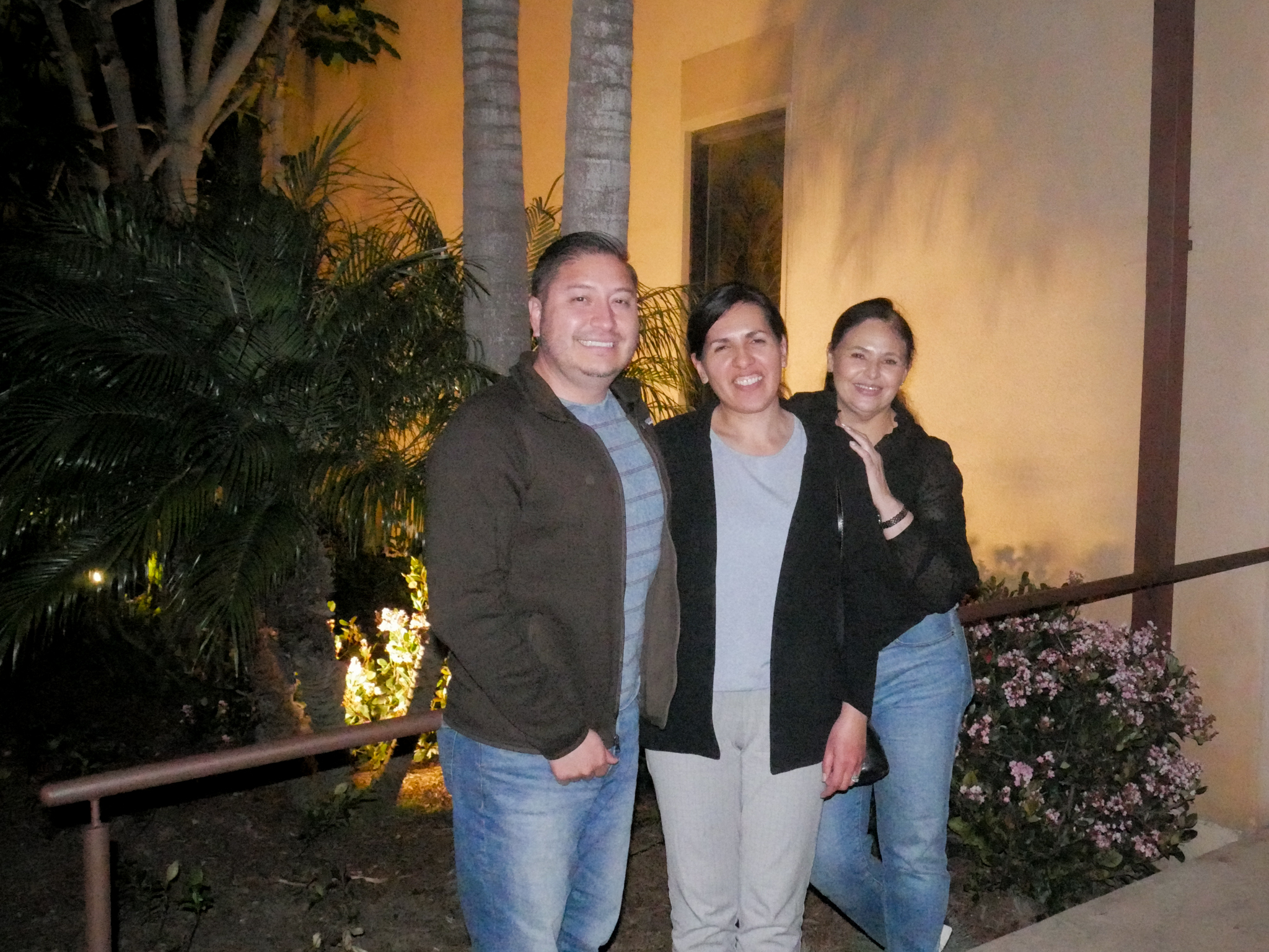
But now that welcoming community feels under siege. Claudia, though a U.S. citizen, carries her passport card constantly, aware that ICE enforcement doesn’t always stop to verify citizenship before making arrests.
“It’s affected us because there’s many people that stopped coming. They’re afraid to come. They’re undocumented, and they’re afraid to come,” she said. “It’s really sad, because this is their faith. Not to be able to be free to come. It’s scary.”
The fear isn’t abstract. “People would say, ‘no, they won’t go to Hermosa Beach,’ but that’s not true, because they’ve been in Manhattan. They’ve been in Redondo Beach,” Claudia said. “They can show up anywhere. It doesn’t matter. If they know there are Hispanic people, they’ll show up.”
Some parishioners have returned to mass in recent months, Fr. Morales said. But others remain at home, choosing safety over spiritual community.
During the Wednesday Holy Hour, Fr. Morales was joined by head pastor Paul Gawlowski, a former aerospace engineer who brings a systematic approach to the church’s advocacy.
Fr. Gawlowski explained that the parish now includes weekly intercessory prayers focused on migration and refugees, specifically addressing what he called “indiscriminate mass deportation.”
“They’re basically for the president of the United States and all government leaders, that the son of God, who became human, will help them understand the great dignity of human persons…and support legislation that better protects the rights of all people, especially the most vulnerable populations in our midst,” Gawlowski said.
The prayers also ask for commitment to refugee resettlement, for Catholics to take action in local communities, and for neighbors and coworkers to grow in awareness of migration issues.
While Fr. Gawlowski acknowledges the church doesn’t usually take bold political stances, he said immigration and abortion are two issues where the church will speak clearly. He believes current refugee policy — which has limited intake to a 45-year historic low and halted foreign aid — contradicts the Gospel’s core teachings.
“That’s against the Gospel, to not only not help your neighbor, but then close your door to your neighbor,” he said. “To turn our backs and to cut off aid, the combination of that is particularly against the gospel. At one mass, I even said it’s a sin.”
He cited two biblical passages: Matthew 10:40 — “Whoever welcomes you, welcomes me; and whoever welcomes me is welcoming the one who sent me” — and Matthew 25:40 — “Whatever you did for one of the least of these brothers and sisters of mine, you did for me.”
For Maldonado and Velazco, the door-watchers who spent their summer on alert, the response to current immigration enforcement is about strengthening community bonds.
“It’s good to come together as a community for all of us to keep in mind that we are going through difficult times,” Maldonado said before the Holy Hour service.
“It’s good for us to be here, united and possibly have other people grow in our community,” Velazco added. “We don’t ask anyone’s status, but you just never know, and we want to make sure that we are available if [a raid] were to happen.”
Maldonado emphasized the ongoing vigilance: “That’s one of the reasons why we keep an eye out, try to just be alert to see if anything suspicious is out there, but always encouraging, always trying to welcome new people to come in.”
Fr. Morales, who left his own family in Costa Rica to become a missionary priest, said he can empathize with the journey of coming to a new country. The crucial difference, he acknowledges, is that he can visit his family, while many of his parishioners cannot.
“I hope, I pray every day for this mess, for the country and for their families and that they’ll be back, praying with their family, and congregation,” he said.
Until then, Claudia will keep her seat in the back pew, watching the door. And the congregation will keep praying for the day when all their members can worship without fear. ER