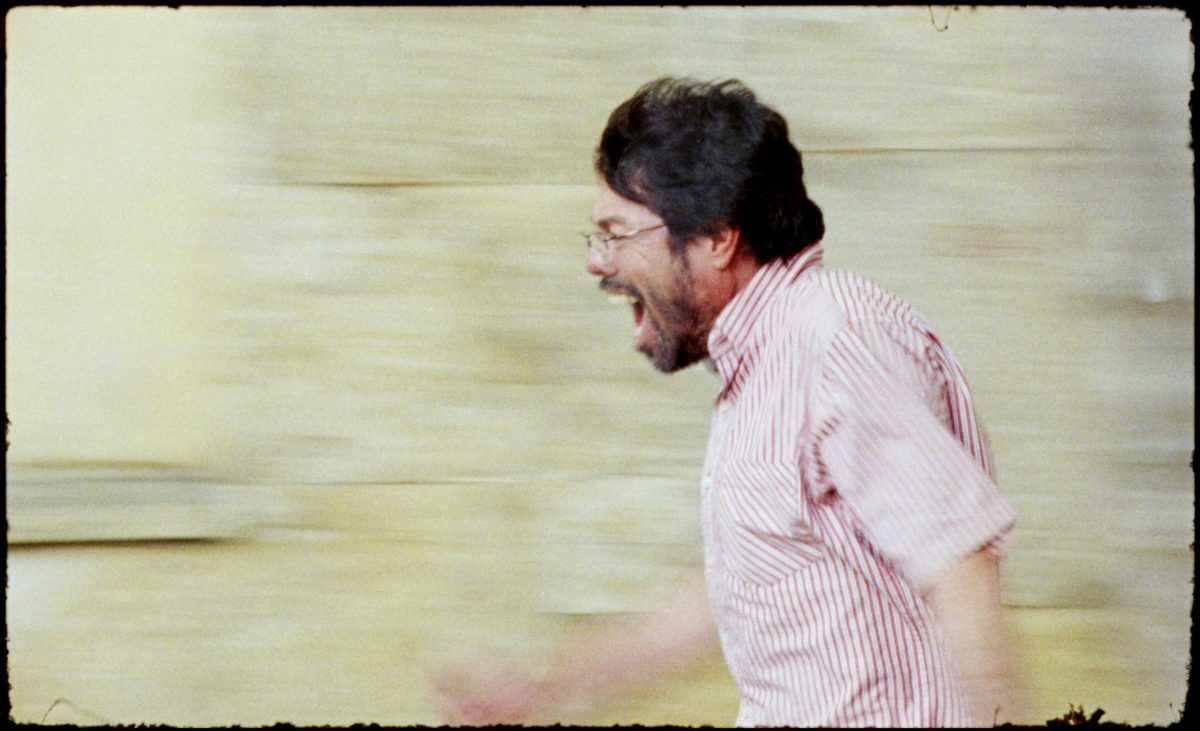
“ A Poet,” the subversively funny, sad and poignant film written and directed by Simón Mesa Soto, will gradually enmesh you until you feel a kinship with sad, lonely loser Oscar, a failed poet. Oscar gave up everything for his art—his job, his dignity and his daughter. It’s not so much that he gave anything up because it’s really about the choices he made and the consequences.
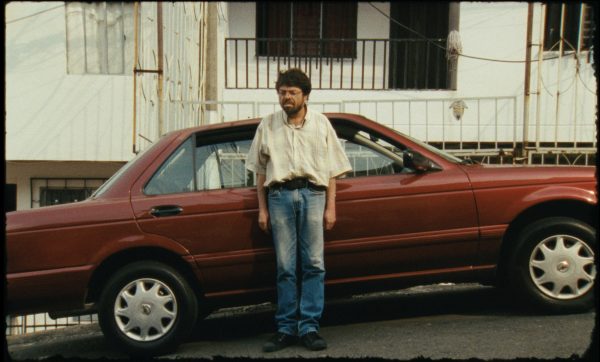
Told in three chapters, “Part One: Failure” gives us the middle-aged Oscar, a man without viable prospects. He lives with his mother and spends all day and night drinking. Earlier in life, having gained a modicum of renown for a book of poems, he decided that he should give up his university teaching position and make a living as a poet. Oscar lives in Medellin, Columbia and had he taken a look at the landscape, he might have noticed that only the two men, Alonso and Efrain, who run a poetry school and a small publishing house, are eking out a living. But, reasons Oscar, there is dignity in the pursuit even if there’s no money. Columbia is a country without a heart, uninterested in nurturing artists like José Ascunión Silva, who committed suicide at age 31 and whose photo he keeps on the wall. Bellowing bad poetry at the moon, he laments that Silva, unlike Garcia Marquez, did not write for recognition. Perhaps, his drinking buddy avers, that may be why Silva was only known to his mother. “Look at this,” Oscar shouts as he shows his friend that Silva is on the 5 peso note. “Yes,” admits his friend. “But Garcia Marquez is on the 50.”
His daily trips, always dressed in an increasingly dirty and wrinkled pink striped button down and crinkled pants that no longer adequately contain either his stomach or his backside, are first to the publishing house wondering why his one book, written when he was 25, hasn’t sold better and then in search of his next bottle of hooch. What he hasn’t done is write. As Efrain points out to him, “The problem is you. You’re a poem. A pretty sad one,” a sentiment pretty much shared by his estranged daughter.
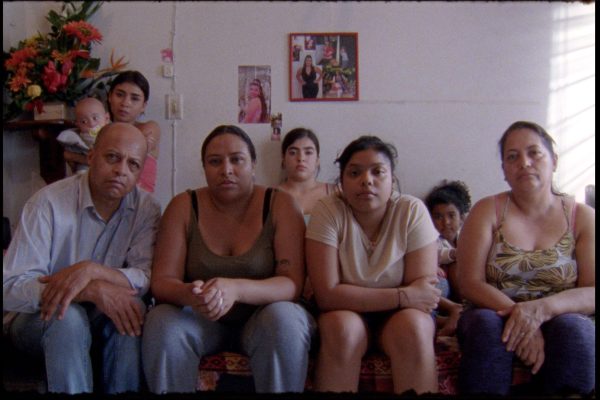
No money is decidedly a problem for this lost soul and his brother-in-law has given him an ultimatum. Get a job or leave the house. Dismissive of the mundane, he is, nevertheless, forced into a position teaching poetry to high school students. Damaging to his fragile ego, he fills his thermos every morning with his alcohol of choice, and trudges to the school in anticipation of more failure. It is, he assumes, like throwing pearls before swine. Of middle class origins and highly educated, his disdain for the lower classes and their hoards of illegitimate children all living, 10 to a room, in hovels is just one of the ironies in his failed life. Still, a job is a job, and he goes into it without aspiration or hope. Yet, like most things in life, art is found in improbable places from unlikely sources. His students are more attentive than expected and, even more surprising, he discovers a talented poet among them. Yurlady is the very definition of all he despises in Columbian society. She is one of a multitude of sisters and brothers, all with their own children, living with a mother, aunt, uncle and grandmother in a tiny flat. She is retiring, speaking little and reluctant to share her writing.
Yurlady keeps a journal and in it are her deepest thoughts, aspirations and drawings. As she explains to an awestruck Oscar after he’s read her journal, writing makes her feel better. What, he asks her, are her aspirations? Aspirations? University is probably not one of them. She likes to do nails and makeup. Writing is just personal. And it is here, in Part Two entitled “Magnum Opus,” that Oscar makes the first of a multitude of missteps. He determines to reshape her into what he failed to be. She has a talent he doesn’t have; her writing is natural and all she lacks is opportunity, opportunity he will seek for her, ignoring that her dreams are not his. As he tells her, “Through art you can find a path different from people like you.” But what’s wrong with people like her, she wonders? He enrolls the reluctant Yurlady into the poetry school where she is on track to win an important prize; but she doesn’t feel at home. Pushed to write about important subjects like poverty or violence in her barrio or the dark color of her skin, the teachers want her to think about reaching a larger audience. Oscar is on her side. She doesn’t write on command; she writes what she feels. When her aunt and uncle realize that prize money is involved, they push the reluctant Yurlady to continue. Perhaps everyone should have been listening to Yurlady because at this point things go disastrously downhill in ways unimaginable to Oscar.
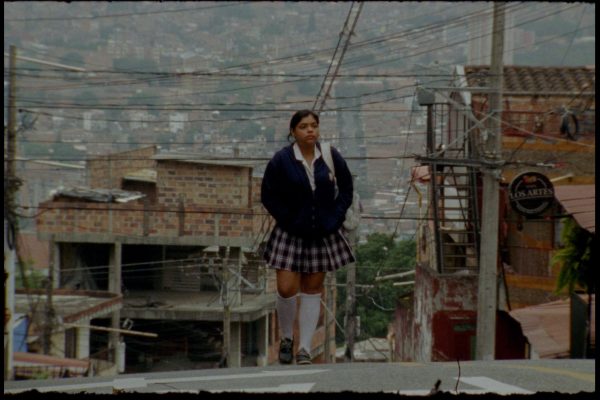
Oscar has gained more from his relationship to her than the other way around. She is his serenity prayer, teaching him to “accept what cannot be changed, have the courage to change what can, and the wisdom to know the difference.” This is both the comedy, tragedy and irony of Part Three: “Art will save us.” As everyone tries to fix a situation that went wildly out of control, Oscar finds he has no allies, including Yurlady. As a pariah he must go back to the beginning and find what is truly important in life, and once again, it is Yurlady who leads the way.
Mesa Soto’s cast is extraordinary, not just because most of them are first time actors but because we live with them throughout the story. Ubeimar Rios, Oscar, was the uncle of a friend. Soto was entranced, choosing him over professional actors who auditioned for the role. Rios has that hang dog everyman expression of hope gone missing. Even as he’s falling down drunk or whining about the lack of opportunities, mostly his own fault, he retains a vulnerability that has the audience on his side, always wishing for redemption or an enlightenment that never really arrives. Smiling through his crooked teeth, shaggy bearded and disheveled in appearance, he’s never unlikeable; pitiable, perhaps, but not unlikeable. Seeing him slug down a shot from his thermos as he’s trying to teach poetry to teenagers brings a smile every time. His mediocre poetry evokes wistful sadness and his desire to “fix” Yurlady involves self reflection on the part of the viewer. His Oscar is that seemingly impossible cross of comic and tragic.
Rebecca Andrade, another non-pro, was the perfect Yurlady. There is a serenity to her appearance that is almost beatific. Embodying a character whose only ambition is to do nails and makeup, she makes you understand the folly of placing your own ambitions and desires, no matter how generous, onto someone else. Her quiet beauty underscores who she is and why she writes.
Cinematographer Juan Sarmiento has captured the grittiness of Medellin and Production Designer Camila Aguadelo gives the film a very claustrophobic feeling.
“A Poet,” is an Independent Spirit nominee for Best International Feature, won the Cannes Film Festival “Un Certain Regard” Jury Prize in 2025.
In Spanish with English subtitles.
Opening January 30 at the Laemmle Royal