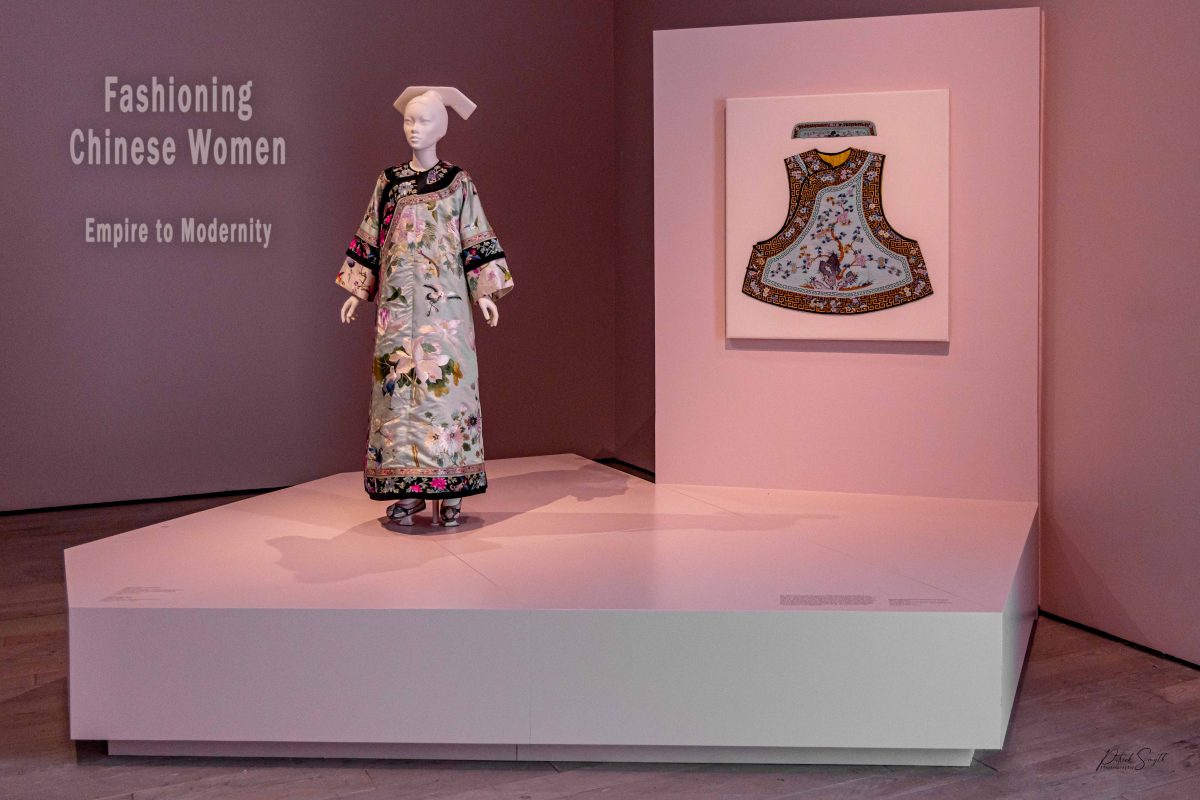
Poetry in motion
“Fashioning Chinese Women: Empire to Modernity” at LACMA
by Bondo Wyszpolski
The lavish dresses and ensembles in this elegant but austere exhibition are largely from the collection of Chere Lai Mah. For over 45 years she safeguarded the 19th and 20th century wardrobes that had belonged to her mother and mother-in-law, supplementing them with her own acquisitions, stunning outfits made not only in China but also Hong Kong, Bangkok, Singapore, Taiwan and Tokyo, plus San Francisco and New York.
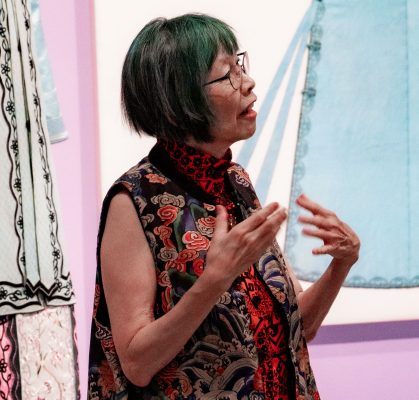
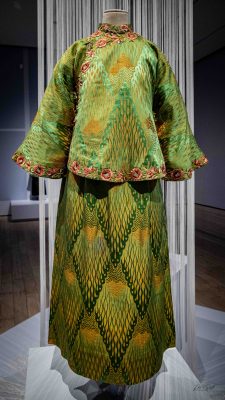
The exhibition, which is guest curated by Michaela Hansen, with a multiroom installation by Chu-Gooding, an L.A.-based architectural firm, is on view through Oct. 12.
The majority of the outfits are mounted on 3D-printed mannequins, their faces and hairstyles uniformly colored a creamy ivory, which were customized by fashion designer Jason Wu. It’s all very stylish, and in some ways singular, because for the most part the figures are highlighted without the flavor of an accoutrement or two. Meaning no handbags, cigarette holders, parasols, earrings, brooches, hats or bejeweled turbans, and no leashes with panthers or leopards.
I’ll concede that these accessories may not be necessary, but if they’d had wigs we’d better envision what the hairstyles were like at the time the individual pieces were sewn. But there’s another question one might ask: How would the women in these dresses have walked?
It’s true, as Anne Hollander wrote in “Feeding the Eye,” that “The beauty of dress comes alive in art,” but as Fritz Saxl pointed out in 1936, “”We know very little about a dress, especially about a woman’s dress, if we do not know how it looked when its wearer walked through a room, mounted a staircase, sat down, etc.”
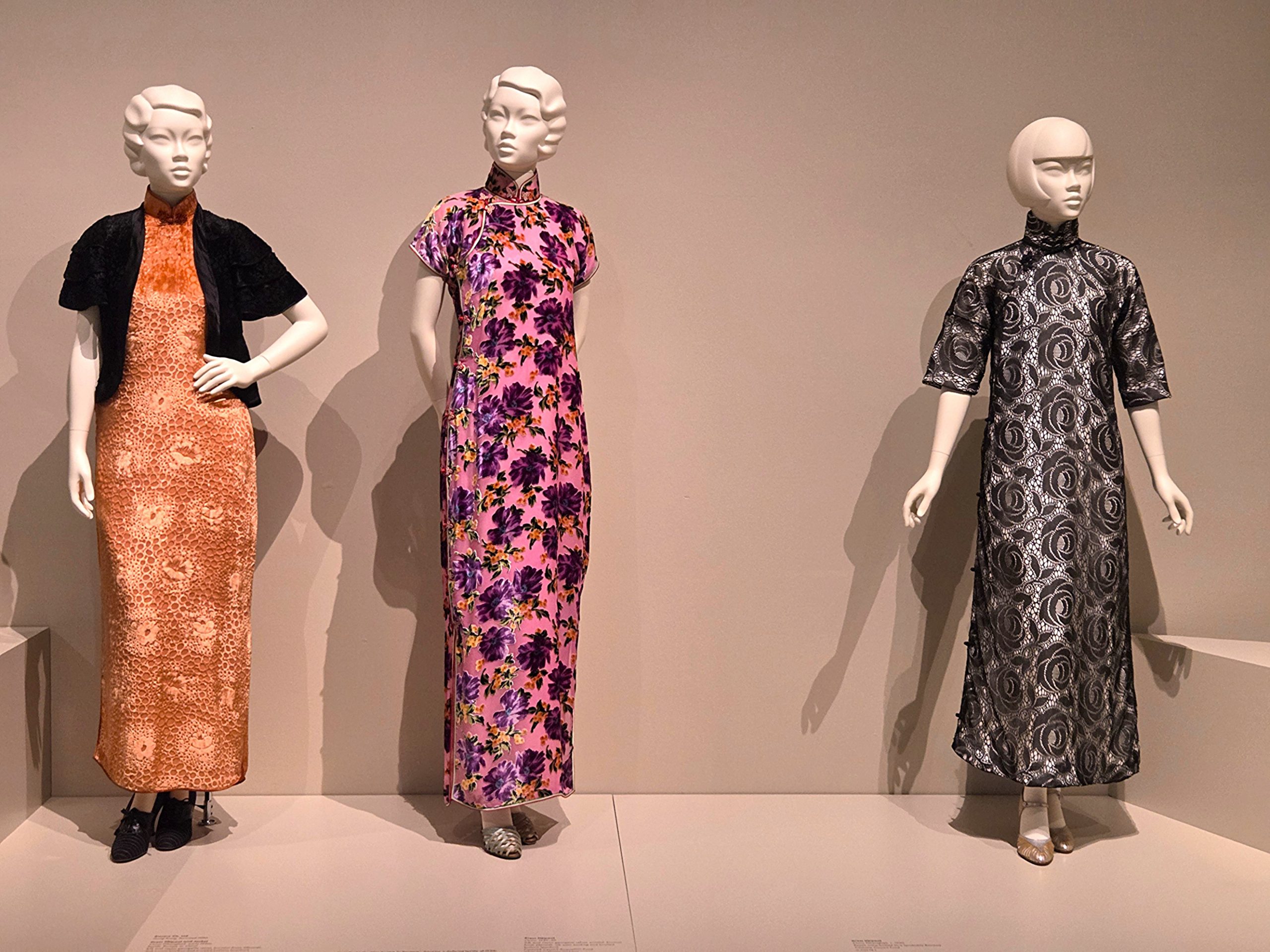
That’s not to imply that the outfits in “Fashioning Chinese Women” are in any way related to what are euphemistically known as brides of one night, but if these clothes were to come alive on the body of a sleek and slender woman there would likely be a certain level of irrepressible sensuality. Most of these ensembles are jaw-dropping gorgeous.
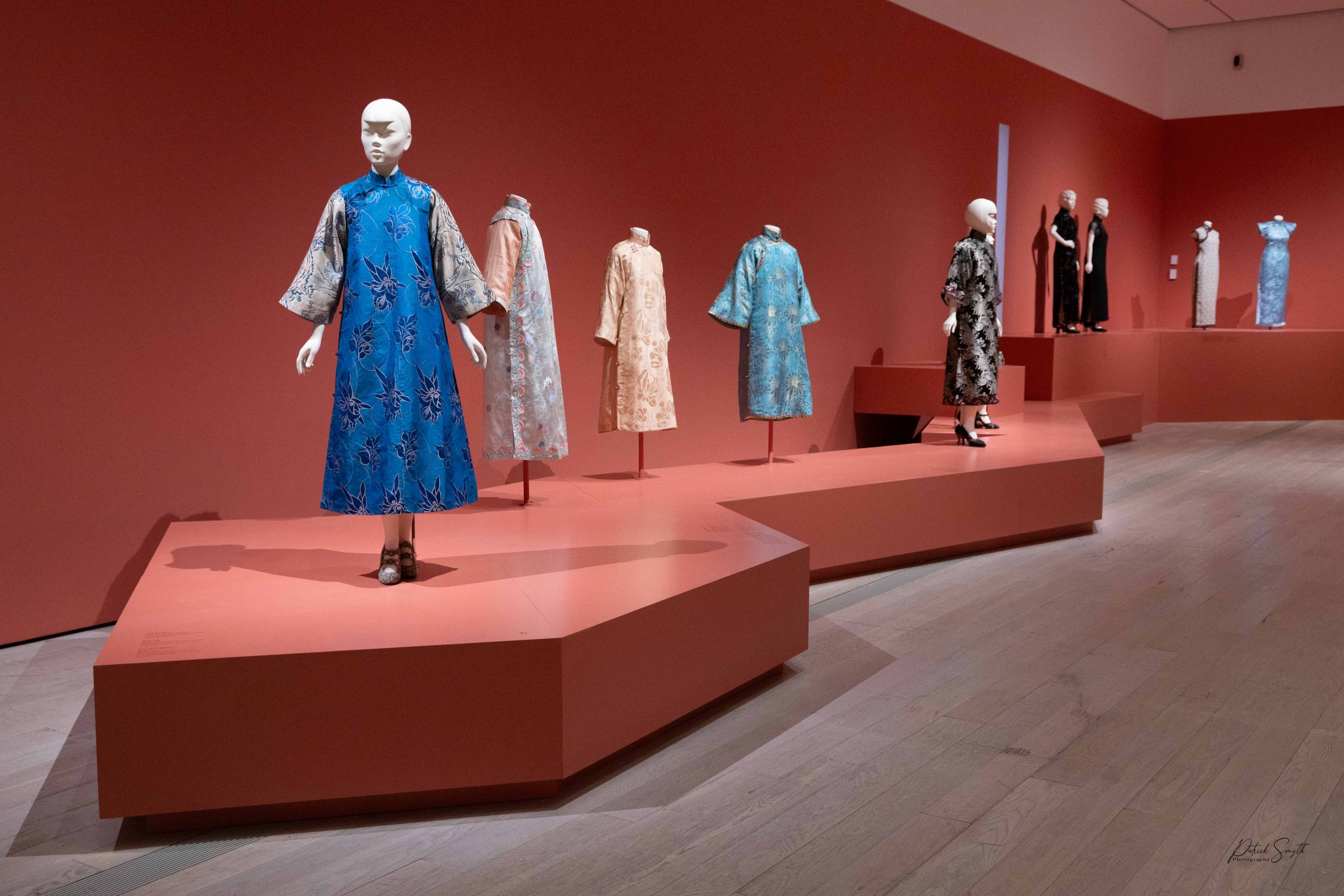
I could describe how, in the middle of the last century, textile technologies advanced, so that synthetic dyes and manmade fibers expanded the range of what was more colorful or more affordable, but this is a visual show to be immersed in and not so much read about, although there is an accompanying catalogue for those looking for terminologies and details, and the difference between a qipao (Mandarin) and a cheongsam (Cantonese), both of which are long, one-piece gowns with high collars. It’s fascinating, but first you must enter the galleries, take it slow and easy, and indulge yourself.
Fashioning Chinese Women: Empire to Modernity is on view in the BCAM (Broad Contemporary Art Museum) wing of the Los Angeles County Museum of Art, 5905 Wilshire Blvd, Los Angeles. Hours, Monday, Tuesday, and Thursday from 11 a.m. to 6 p.m., Friday from 11 a.m. to 8 p.m., and Saturday and Sunday from 10 a.m. to 7 p.m. Closed Wednesday. More at lacma.org. PEN