by Alessandra Haddick
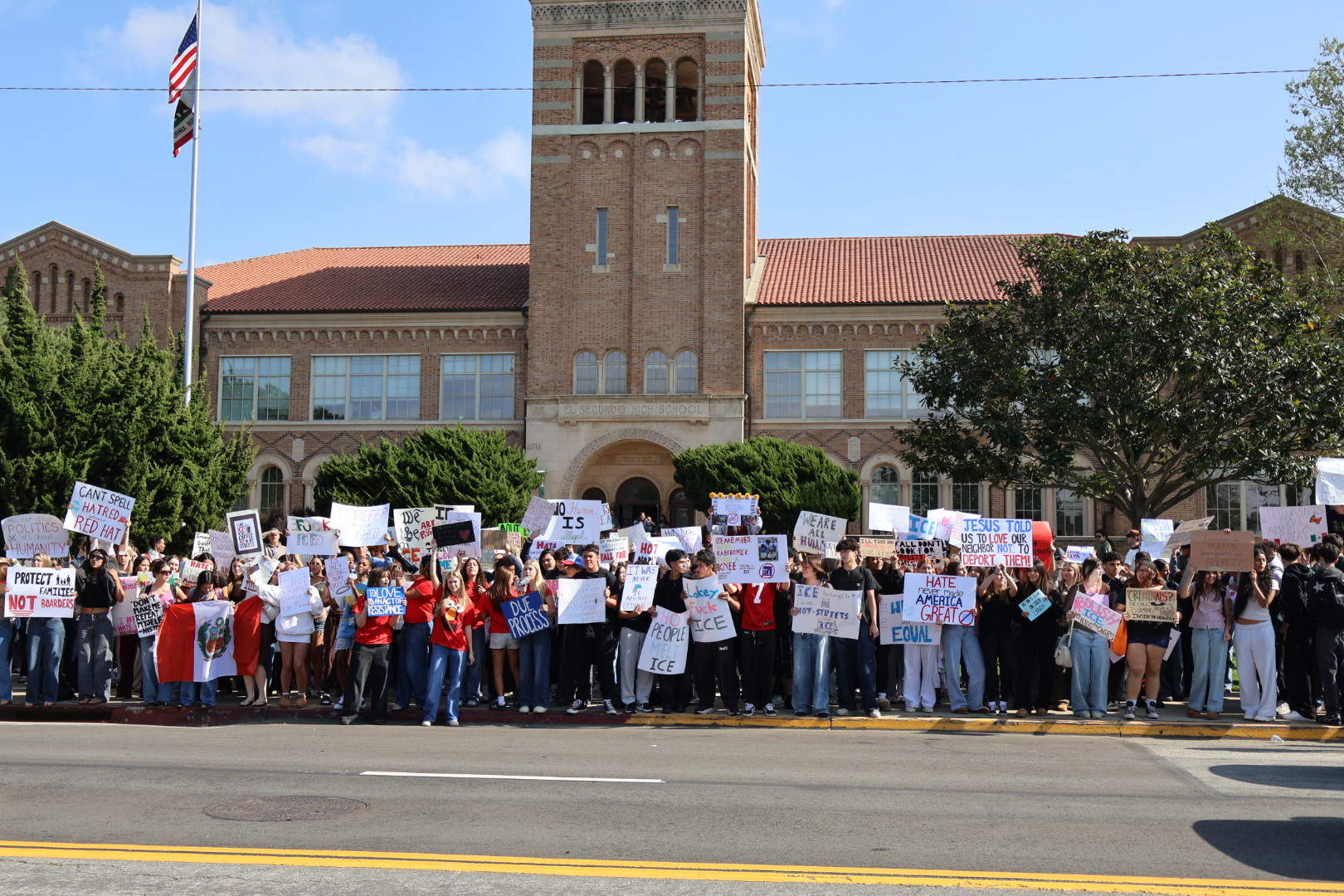
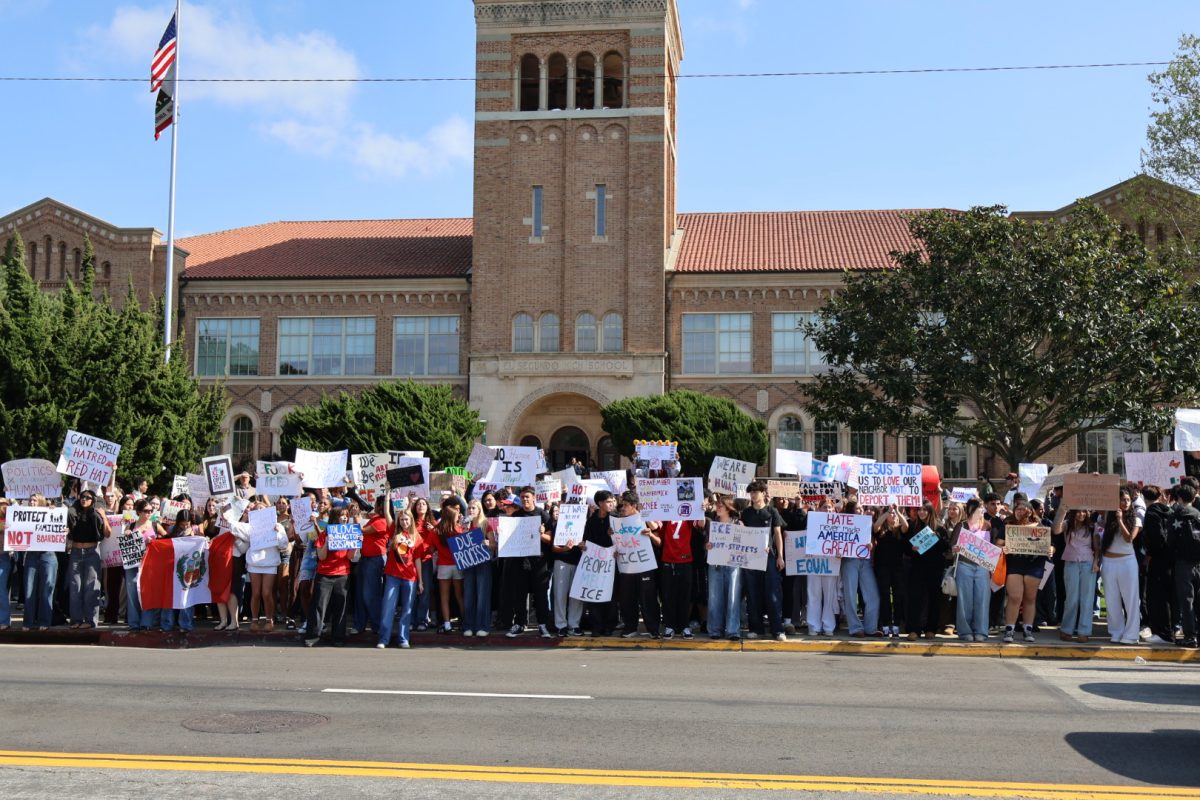
On February 6, hundreds of students stepped out of El Segundo High School and onto Main Street, transforming an ordinary passing period into a public demonstration calling for immigration reform and the abolition of Immigration and Customs Enforcement.
Handmade posters rose above the crowd as chants such as “No hate, no fear. Immigrants are welcome here,” and “ICE out!” echoed in the street. For nearly an hour, all campus-adjacent streets became a stage for youth civic engagement.
The walkout was organized by six sophomores: Liliana Snyder, Fiona Makhlouf, Leah Youngblood, Aletta Rijpkema, Abhaya Alurkar and Aiden Ali. All are active in the school’s debate club, which quickly became the planning ground for the protest.
“Crazy times call for revolutionary solutions,” Snyder said. “We felt like we couldn’t just sit in a classroom and pretend nothing was happening.”
According to organizers, the idea emerged after students approached them asking whether El Segundo High would participate in broader immigration-related demonstrations happening in nearby schools the previous week.
“When people kept asking us if we were going to do something, we realized there was a responsibility there,” Makhlouf said. “If we didn’t step up, maybe no one would.”
From there, the timeline compressed. Meetings were held in a specific teacher’s classroom — described by students as a “safe space” — where 20 to 30 students at a time gathered to brainstorm ideas for organizing the walkout and making posters the day before.
“It was chaotic in the best way,” Youngblood said. “There were so many ideas flying around, and we tried to incorporate as many perspectives as possible.”
Alurkar said inclusivity was central to the planning process. “We wanted it to be effective and representative,” she said. “Anything that someone felt strongly about, we tried to find a way to integrate.”
Within 48 hours, social media graphics were designed, an Instagram page was launched, posters were made and word spread through online and in-person conversations.
“We were running on adrenaline,” Ali said. “There was definitely risk involved, but staying silent felt like a bigger risk.”
The organizers also reviewed the student handbook before finalizing logistics. To minimize disruption, they deliberately chose to walk out during the passing period between third and fourth period classes.
“We chose that time to show we were being intentional,” Makhlouf said. “This wasn’t about being reckless or skipping class.”
The principal of El Segundo High School, Steve Gebhart, said he learned of the planned walkout two days before it occurred, after hearing from students and seeing posts on social media.
“As the principal, I cannot endorse it because education is compulsory,” Gebhart said. “However, if it does happen, my role shifts to making sure students stay safe.”
He coordinated with district leadership and the El Segundo Police Department to prepare. Administrators monitored the demonstration from campus to ensure student safety and to prevent conflicts with potential counterprotesters.
“The biggest challenge was that students started moving,” Gebhart said. “The best thing we can do is know where they are.”
As the group grew and shifted toward Imperial Avenue and the El Segundo sign, supervision became more complex. Gebhart cited concerns about students walking in streets, climbing on bus benches and navigating traffic.
“By and large, there were no students hurt,” Gebhart said. “I 100% support people exercising their rights on whatever side of a topic they happen to be. It’s not about the topic. It’s about people exercising their rights and their voice.”
Under California Senate Bill 955, students are permitted one excused absence per year for civic engagement with parent verification. Gebhart said the school received more than 300 parent emails invoking the policy, estimating turnout between 300 and 400 students.
Organizers noted the size of participation as well.
“When you’re standing in the middle of it, you can’t even see how big it is,” Snyder said. “Watching the videos later, it was overwhelming.”
In speeches delivered outside the school, organizers called ICE discriminatory and demanded accountability. “ICE targets people based on race and justifies it by labeling them as criminals,” Rijpkema said. “That is not justice. That is discrimination.”
The speech also referenced people killed by ICE in 2026, such as Alex Pretti, Renee Good, and Keith Porter.
“Today you are a part of history,” Snyder told the crowd. “You’ve decided that no one else can die or be taken before we fight for change.”
“We demand accountability,” Rijpkema yelled into a megaphone. “We demand liberty and justice for all.”
Makhlouf described the event as part of a broader generational movement.
“This is our generation telling older generations that we’re next,” she said. “We’re going to show up when we’re able to vote just like we’re showing up now.”
Snyder continued with that idea.
“Even though we can’t vote yet, that doesn’t mean we don’t have informed opinions,” she said. “Our purpose as students isn’t just to memorize facts. It’s to think critically about the world around us.”
The demonstration was also as much about identity as policy.
“As teenagers, we don’t always feel like we have a lot of power,” said senior Madisson Torres. “It was inspiring to see so many people of all grades stand together.”
Even with large amounts of support from the community, there was also criticism.
“There were grown adults flipping us off,” Youngblood said. “When adults say we don’t understand the issue, it overlooks the fact that we live in this country too.”
Snyder said criticism often centered on accusations that students were simply trying to skip school.
“The fact that so many students returned to fifth period shows that this wasn’t about skipping,” she said.
Gebhart confirmed that while not every student returned to class, a significant number did attend later periods.
Some teachers were also skeptical about whether the event could be organized responsibly on such short notice.
“There was definitely doubt,” Makhlouf said. “But that honestly made us more determined.”
At the same time, organizers said they received supportive messages from community members who praised students for engaging in civic discourse.
“If it didn’t matter, people wouldn’t react so strongly,” Ali said. “The reaction proves it mattered.”
For the six sophomores at the center of the effort, the walkout was a turning point.
“This experience pushed all of us outside our comfort zones,” Makhlouf said. “We had to take on real responsibility.”
Ali said the scale of the turnout shifted his perspective. “When people I barely knew came up to thank me, that’s when it hit me that this meant something,” he said.
Youngblood said what she remembers most is the sense of unity.
“It wasn’t just about politics,” she said. “It was about community.”
Snyder reflected on the broader implications of the walkout.
“History is built on moments where ordinary people decide to speak up,” she said. “Even if this is one small moment, we’re proud of it.”
“We’re so grateful to have been a part of this,” Alurkar said. “In El Segundo, the school is such an integral part of the community. To see students making this much change and caring this much — it inspired the community to talk about how they feel.”
The ICE Walkout marked a defining civic moment for many students at El Segundo High School. In a single passing period, a hallway transition shifted into a public statement, showcasing the organizational capacity and civic ambition of a generation not yet old enough to vote, but determined, the organizers said, to be heard. ER