

by Mark McDermott
Toni Scott’s proposed artwork for Bruce’s Beach had the feel of inevitability. Not only within the City of Manhattan Beach’s extensive selection process, but the narrative arc of the work itself, and how it came to be.
Both the Arts in Public Places Committee and the Cultural Arts Commission had recommended her proposal, “Unity: Circle of Memory,” an eight-foot bronze female figure lifting a circle overhead to frame a view of the ocean. Staff had also recommended the work. And then there was the matter of her bloodline: Scott is family to the Bruce family of Bruce’s Beach. Her great-great grandfather, S.B.W. May, owned investment property in Manhattan Beach in the 1920s. Her grandmother, great-grandmother, aunts and uncles all visited Bruce’s Beach during its heyday. She had planned to interview her cousins Marcus and Derrick Bruce at their mother’s funeral — Aunt Theresa, who was married to Bernard Bruce, was also Scott’s godmother — to document the family’s history on camera.
The figure she designed was, in a sense, Willa Bruce herself.
“I thought about Willa,” Scott said Wednesday, “and I said, I wonder how she felt when they first came to the beach. I bet her arms were just extended in front of her, saying, ‘Wow, this is amazing.’ And then she goes through everything, her head bows, and it’s like, ‘Oh, this is taken away. This is hard.’ But when it comes back [in the form of the sculpture], her arms are up — yes, this has come full circle. She’s looking up in gratitude.”
The Manhattan Beach City Council voted 5-0 Tuesday night to commission a different artist — April Banks, and her design “Building Paradise,” an abstracted beach cottage of brick and mosaic that evokes what was taken from the Bruce family and the other Black families displaced by the city’s racially motivated use of eminent domain a century ago. It was a decision that went against the recommendations those specifically tasked with vetting the work. And yet, in the end, it was unanimous.
Scott walked to her hotel on Sepulveda alone in the rain afterward.
“I felt like a quarterback,” she said. “I got out of there.”
The decision stung not only personally but professionally. Scott poured her life into the proposal, calling historians, interviewing community members, researching not only Bruce’s Beach but the broader tradition of monumental public art to understand how iconic female figures communicate resilience and transcendence across cultures.
“I wanted to have a Black woman’s face there,” she said. “And I went through all of these different analyses — how do I say that story without it being intimidating, because the community is only one percent Black. What is the national response to art in general, and how does it communicate? I considered everything from abstract to representational to something in between.”
The work she arrived at was meant to place the Bruce’s Beach story within the arc of something larger — a figure that was not Willa Bruce specifically, but carried her spirit and the spirits of all the families displaced from that shore, lifting a circle that framed a view of the ocean they had once been denied.
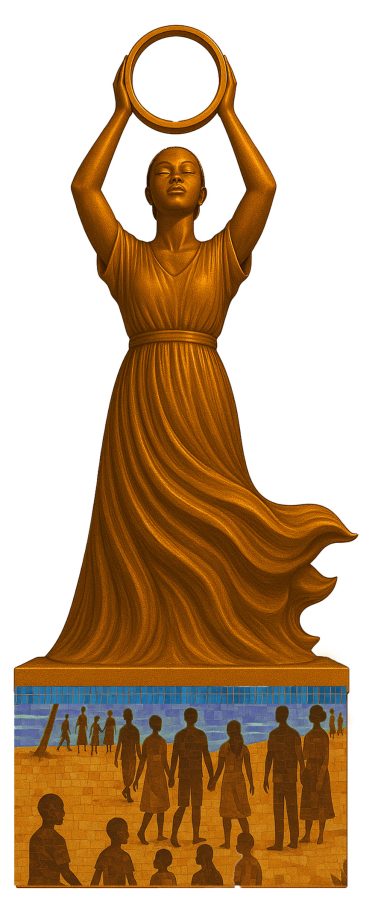
“Most of all last night, I felt that her voice — Unity — was silenced,” Scott said. “She represents something. It was the Statue of Liberty. It was the Statue of Freedom. It was the Black Madonna, it was Isis — all these heroic, iconic female figures. And there was a time here to have another opportunity to be present.”
Scott said she does not intend to let the figure disappear. She spoke of finding another place for the work to stand — of turning the loss into something else.
“I didn’t want her to go to sleep,” she said. “When the skaters fall at the Olympics, they just get right back up. Maybe I just tell that story — what it’s like to lose but still push on, and be okay with that, because I think we all have those moments in life. There’s a lot of humanity in being real and saying, this really hurts. But this work is important, and I hope she lives on.”
The road to Tuesday’s vote was neither straight nor short. The city allocated $350,000 from its Public Arts Trust Fund in March 2021 to commission a permanent artwork at Bruce’s Beach Park. A first round of proposals in 2023 was scrapped entirely after submissions proved infeasible. A restructured national search issued in March 2025 drew 115 qualified applicants. Six finalists were selected, each paid $1,500 to develop a full proposal. A community open house at the Manhattan Beach Library in October drew more than 150 residents, and an accompanying survey gathered 349 responses.
The survey ranked Nekisha Durrett’s surfboard-inspired sculpture highest, with Banks second and Scott third. The APPC identified Scott and Banks as its top two; the Cultural Arts Commission recommended Scott alone, citing long-term durability. Staff recommended Scott. The council went its own way.
The deliberation had the feel of a coin flip that kept landing on its edge. Council Member Steve Charelian, the first to speak, came out for Scott, praising the “symbolism of the lifted circle” as offering “not just reflection, but renewal.” Council Member Nina Tarnay said her heart was moved by April Banks’ house but couldn’t quite commit. Council Member Amy Howorth, who had served on the APPC throughout the multi-year process, said she was leaning toward Scott — and then changed her mind.
“I have changed my mind three times tonight,” Howorth said, before making the motion for Banks. “I really do think that it is slightly representational, it is a house, but it has all these storytelling aspects to it that I think would be important for telling the story.”
Council Member Joe Franklin made a case for Hana Ward, whose sculpture of two bathers at rest on the beach was inspired by a photograph of her great-grandmother at Bruce’s Beach, but said he would join the majority whatever they decided. Mayor David Lesser made the case for Banks.
“Through that small house structure, one can really envision what might have been for that family with that vista of the ocean at that location,” Lesser said. “It’s solitary. It’s thoughtful. It’s powerful.”
It came down to Banks and Scott.
“Could we do both?” Tarnay asked.
“Well, maybe,” Howorth said.
Both artists brought formidable credentials to the competition. Scott, a multidisciplinary sculptor with more than 30 years of large-scale and public work exhibited nationally and internationally across the U.S., China, Europe and Africa, has spent her career centering African American and Indigenous heritage in monumental form. Banks, working across mosaic, metal fabrication and installation under her Mezostudio practice, has built a body of public work that consistently threads community history and the Black experience into public space — from a sweeping mosaic mural at Jackie Robinson Park in the Antelope Valley to sculptural installations along the Venice Beach boardwalk.
“I don’t think any of us want to make the motion to exclude the other,” Howorth said, before making a motion for Banks’ artwork. “We have such amazing art that we have nothing but a good choice.”
The motion passed 5-0.
What Banks designed is both intimate and ambitious. Two facades — one exterior, one interior — are connected by an arched passageway, standing 10 feet tall and 10.5 feet long. The exterior wall is composed of patterned brickwork with indigo and cobalt blue glass accents, paying homage to Black laborers who migrated west and built new communities along the California coast. The blue bricks reference two traditions: the improvisational designs of quilts, which preserved storytelling through craft, and Southern blue bottle trees hung outside homes as spiritual protection.
The interior walls are where the history becomes most intimate. Archival photographs of beachgoers and residents from the Bruce’s Beach era — drawn from UCLA’s Miriam Matthews Photograph Collections and other public archives — will be rendered in hand-cut sepia glass mosaic tile, set against blue and white ceramic backdrops that evoke vintage toile wallpaper. The backdrop imagery will be created using cyanotype sun prints made from leaves and plants gathered from the present-day park itself, weaving the living site into the historical record. The arched passageway between the facades invites visitors to walk through and around the structure, experiencing simultaneously an inside and an outside, a past and a present.
The selection is the latest chapter in a story that stretches back more than a century. In 1912, Willa and Charles Bruce opened Bruce’s Lodge, a modest resort that gave Black Angelenos a rare place to gather at the beach during the Jim Crow era. From the first weekend, they faced resistance. Neighboring developer George Peck had the beach in front of their property fenced off and patrolled by constables. The Bruces and their guests walked a half mile around the fence to reach the ocean. “I own this land, and I am going to keep it,” Willa Bruce told the Los Angeles Times.
She couldn’t. By 1929, the city had seized the property through what was later documented as a racially motivated use of eminent domain, forcing out the Bruces and five other Black families. City leader Frank Doherty later admitted the truth in a newspaper column titled “The Negro Problem” penned 20 years later: “We had to acquire these two blocks to solve the problem, so we voted to condemn them and make a city park there.”
The story resurfaced a century later. Activist Kavon Ward’s Justice for Bruce’s Beach movement brought renewed attention to the history beginning in 2020. LA County Supervisor Janice Hahn led a legislative effort resulting in the Bruce family regaining title to the land in 2022 — the first time in U.S. history that land taken from an African American family by a government agency was returned. The family later sold it back to the county for $20 million. In 2023, the Manhattan Beach City Council voted 4-1 to formally apologize to the families dispossessed at Bruce’s Beach.
Former Bruce’s Beach Task Force member Dr. Anthony Lee, whose eyesight has been deteriorating for years, told the council Tuesday that he hoped to see the artwork before his vision was gone entirely. He placed the selection in a broader national context.
“The city is to be congratulated and commended for its forward-looking commitment to this piece of art, especially in these times,” Lee said. “Manhattan Beach is going forward to a commitment to African American history, and that’s really a leadership position right now. You should be very proud of this commitment. This sculpture, whichever one is chosen, will be a national monument and will be noticed and recognized in newspapers all over the country, and possibly internationally as well.”
Michael Jenkins, another former task force member, called the public art commission one of the task force’s signature recommendations and said every resident who attended the library open house came away impressed.
“Whichever piece is chosen will both enhance the park and make an important statement about the legacy of the government-sponsored racial discrimination of the 1920s that led to the condemnation and removal of the Bruce family resort and the homes owned by other Black residents of Manhattan Beach,” Jenkins said. “Whatever you select will send an important, lasting and symbolic message about justice and our commitment to being a welcoming community.”
Banks’ project is expected to be fabricated and installed by November 2026, with an opening celebration in December. The $350,000 budget is split equally between artist fabrication and oversight, and engineering, permitting and installation.
As for Scott, she said she intends to find a home for her figure somewhere — to make sure that voice is not permanently silenced. She left Tuesday night with the same resolve that has always defined the Bruce’s Beach story itself.
“Onward and upward,” she said.
A century ago, Willa Bruce refused to be turned away from that shore. The city is building a house in her memory now, on the ground above where her lodge once stood. And somewhere, if Toni Scott has anything to say about it, a bronze woman will still be lifting her arms toward the sky. ER



2 Responses
“Businesses reduce bounce rates with ultra-fast hosting – speed converts visitors.”
Both make sense, but I personally prefer ‘Building Paradise’ over ‘Unity: Circle of Memory’. I believe this structure will finally allow Manhattan Beach to move past their racism.