In a record store, a record deal is made
Record Recycler is a rarity, a beacon from from another era, long before music was accessible with simply a few keystrokes, and without ever getting up and leaving home.
Located on Crenshaw near Artesia in Torrance, the store is a destination for album collectors, for those who still treasure vinyl LPs and the physical act of thumbing through stacks of them in bins or on shelves.
Roy Kaiser has been in the record buying/selling business for years, 17½ in his present location plus four years before that on Hollywood Blvd., and he’s had thousands of customers. Other people who deal in records also come in to check out his wares, because somebody, somewhere, is always in search of a copy of a particular release by a specific artist; and often they’ll pay top dollar for it when it’s offered for sale.
Enter Derek See, living in San Jose at the time, playing in different bands but also selling records on the side to supplement his income. After moving down to L.A., See stopped in at Kaiser’s store virtually every Tuesday. Eventually they got talking and Kaiser gave See a Record Recycler T-shirt. See reciprocated with a Chocolate Watchband T-shirt and poster.
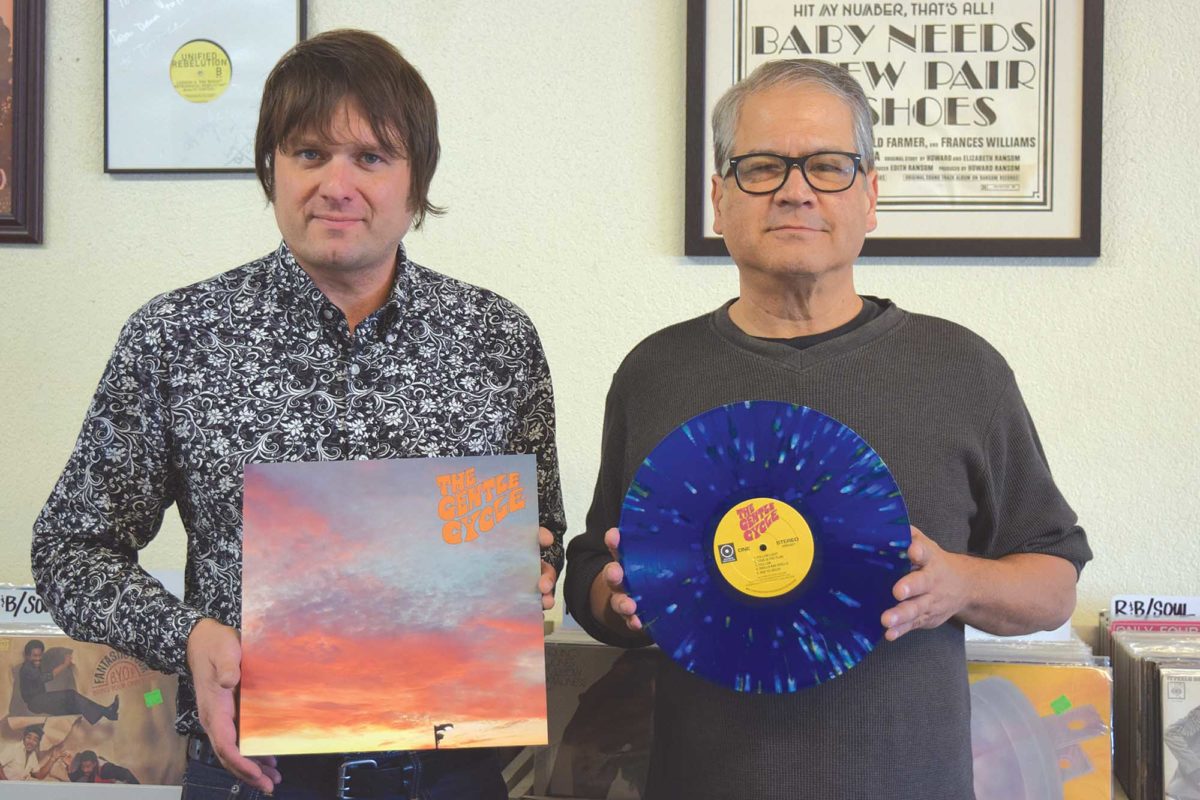
“And then I grabbed one of the last copies of the original pressing of the Gentle Cycle record and gave it to Roy as a thank you for taking good care of me with records.”
Before placing the disc on his store’s turntable, Kaiser was skeptical. What if he disliked it?
Surpassing expectations
Prior to meeting face-to-face, Roy Kaiser attended a show at the Echo in which the Rain Parade performed, and Derek See was in the group playing guitar. The Rain Parade (not the Parade, the purveyors of 1967’s “Sunshine Girl”) is essentially an ‘80s version of a ‘60s group. See has also been performing with the Hellenes and the Chocolate Watchband, the latter a revival band with two of the original members, whose look, sound, and name (in the vein of the Strawberry Alarm Clock) goes back to a specific time and place: in this instance, the mid-1960s. On the back of an LP in my own collection the Watchband’s music is described as acid-punk, but that would be the “punk” of the Standells and the Seeds rather than of Black Flag or the Dead Kennedys.
“Once I (learned) that he was associated with all these kind of legacy psyche groups,” Kaiser says, “I figured this guy’s probably at home practicing the solo of ‘Pushin’ Too Hard’ (a Seeds “classic”). That’s not the worst thing to be, but I just imagined somebody in music like that to be derivative, and I don’t think Derek’s music is derivative. I think it’s evocative of ‘60s psychedelic and ‘90s kind of British show-gaze. If I didn’t have anything to do with the record I would think it’s a good record and I would listen to it.”
Let’s lift the needle and place it back a couple of tracks.
As Kaiser was later to write, “After I dropped the needle on the record I started to grasp for some faint praise to give him because my customers’ vanity projects are invariably bad. But in this case it was not necessary.
“What I heard that day surprised me,” he added. “The writing, playing, singing and production were so sure-handed that I started to wonder why he was in the background with these legacy groups and not front-and-center with his own band.”

Derek See, who grew up in El Segundo, was exposed to music at a young age.
“Both my mom and my uncle gave me a bunch of records when I was a kid. My mom’s a musician, and my stepdad at the time, in the early ‘80s, was drumming with Iggy Pop for a while.”
See acquired his first electric guitar when he was 11, and at 13 he was playing gigs. At 16 he landed a job in a record store, where he worked for five years. And at around that time he began selling records on the side.
He says there was a bit of a musical gap in his twenties, but during “the last 10 years I’ve been doing my best to make up for it. I’ve been lucky enough to play with some heroes, legacy artists, and I learned a lot from them. I get to play music that I love and it’s been a big inspiration.”
A few years ago, however, See decided to try and put out a record on his own. After some hesitation (well, the worst that could happen would be that he’d have a couple of hundred copies stashed away in a closet somewhere) he did just that. So he released a single; it did well, and was followed by another. He pulled together some fellow musicians from San Jose and in the fall of 2016 they cut and pressed a nine-song LP. The band played a few gigs and by August, 2017, six months after the record was released, they’d sold out nearly all of the 300 albums. Then See moved to L.A.
It was this record, “The Gentle Cycle,” that See presented to Kaiser this past year.
Archival and now actual
“The next thing I know,” See recalls, “he asked what it would take for him to reissue the record.”
“I said to him,” Kaiser interjects, “‘Hey, if you ever need somebody to reissue this record, I’m your man.”
Since See regularly dropped by the Record Recycler on Tuesdays, Kaiser figured it would be another week before they’d again meet in person. “But two days later, on Thursday,” Kaiser says, “he showed up with the master, and essentially we did a handshake deal right there.”
And what was it about the Gentle Cycle album that appealed to him?
That the music had echoes of earlier bands, earlier sounds, but wasn’t stuck in that groove.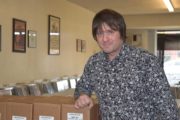
Later, he says, “I’ve always been looking to do something in records, but I’ve never been one to pound the pavement and just put out something (for the sake of) putting it out. I don’t think I could have done this with a regular kind of wannabe rockstar mentality. I just don’t have the patience for it.”
Nor was Kaiser setting his hopes unrealistically high.
“I was just looking at this as an archival project,” he says. “His band was up in San Jose, so I was like putting it out for record collectors. And then Derek said to me, ‘I’ll get a band together, to get out and promote this thing.’ So it became bigger that way than I was even initially looking at it.”
The first pressing totaled 1,000 copies, 500 of these on black vinyl, 300 on clear/splatter vinyl, and 200 on blue/splatter vinyl. Black vinyl sells for $15.99 and splatter vinyl goes for $19.99. Through Bandcamp and social media, See sold 83 copies in the first 10 days.
What’s intriguing here is that See has two Gentle Cycle bands, one for any Northern California dates and one for gigs in Southern California. That’s an amusing thought in some ways, but if it’s viable, then why not?
Mutually invigorating
One upshot about this collaboration, no matter where it goes, has been its energizing effects on both men, and it’s motivated See to refocus on his songwriting.
“Just the fact that Roy was interested in putting this record out again has given me a bit of a spark to write because, after I initially released the album I figured that this is one of my last statements, and that I was happy just being the side-guy playing with other people. But since all this has happened in the last few months I’ve been writing a lot again, getting ready for the next record.”
And if things go well, maybe it’ll be on Roy’s label?
“I’m totally into it,” Kaiser says.
That does look to be the direction they’re headed in right now, and See for his part intends to keep on playing.
“I can’t see myself doing anything else,” he says with a laugh. “Whether it’s my own music or contributing guitar and vocals to bands or songwriters that I like and respect, I’m in this for life.”
The Gentle Cycle eponymous release, with all songs written by Derek See, was recorded “live and loud, with minimal overdubs,” in a San Jose loft with guitarist and co-producer Maxwell Borkenhagen, bassist Todd Flanagan, and drummer Craig Heitcam. Licensed courtesy of Psychedelphonic Records, ⓟ and ⓒ 2017, 2019, it’s now available at Record Recycler, 17312 Crenshaw Blvd., Torrance. (310) 704-2320 or email recordrecycler@gmail.com. ER