by Mark McDermott
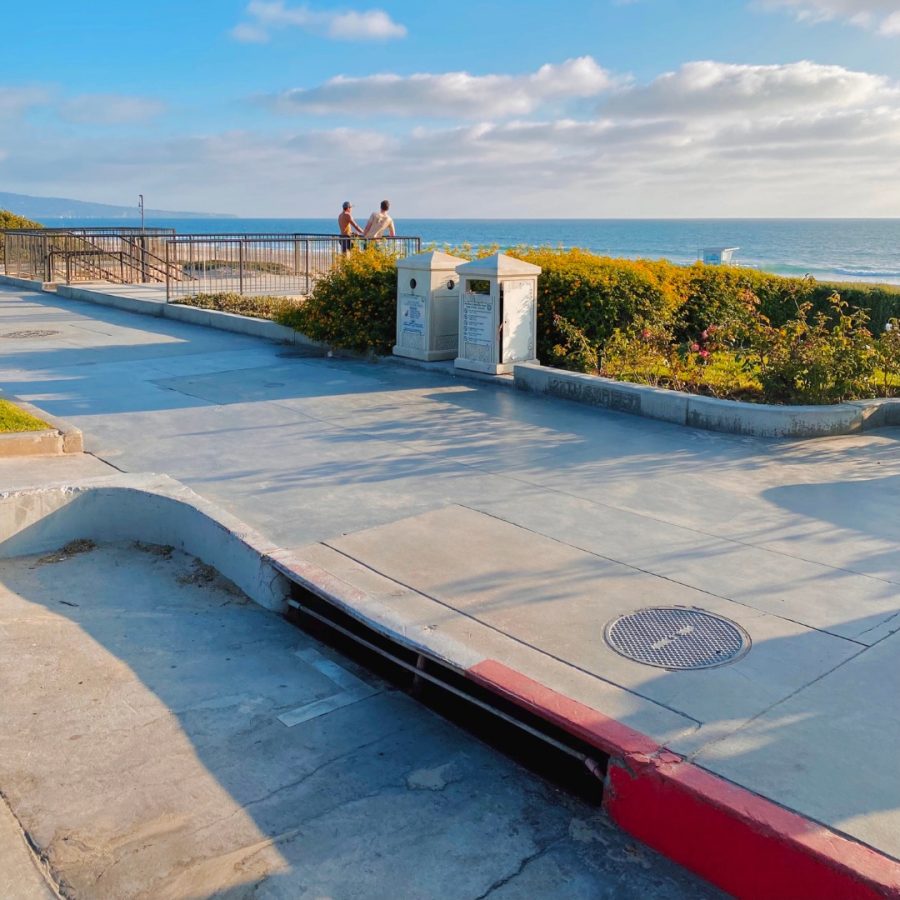
What began as a straightforward decision by the Manhattan Beach City Council to use state grant funds to build a new storm drain along 28th Street waterfront to address chronic ocean pollution coming from a broad swatch of the city turned into a saga of sorts, one that culminated at last week’s council meeting and included vociferous advocacy by local environmental activists; another discussion of the Canada geese of Polliwog Park and the astonishing volume of their excrement; and the interrogation of a contractor who had neglected to tell the City of a $650,000 fine he was forced to pay state regulators, as well as his offer to “come by and pick up” the $27.8 million contract award check at City Hall due to concerns over his P.O. Box business location.
In the end, the Council voted 3-2 to award the contract to Zusser Company, Inc., with Mayor David Lesser and councilmembers Amy Howorth and Nina Tarnay supporting the award.Mayor Pro Tem Joe Franklin and Councilmember Steve Charelian voted no.

The city faces fines ranging from tens of thousands of dollars to potentially millions if the pollution at 28th Street continues. But Mayor David Lesser said the project’s importance went beyond financial concerns.
“We are a coastal city and a steward of our oceans and our beaches,” Lesser said. “Our stormwater is impacting our Santa Monica Bay. Forget about the fines. It’s what, in fact, is happening.”
The stormwater drain’s overall $31 million budget, which includes two other smaller contractors, is funded almost entirely through grants: $17.5 million from the regional Measure W program, $8.5 million from the State Water Board, and nearly $5 million from the California Natural Resources Agency. The project will capture stormwater runoff from approximately 60 percent of Manhattan Beach before it reaches the ocean. After capturing the runoff, the system will filter out trash and sediment, and pump it through underground wells where it will seep into the groundwater instead of flowing into the bay.
It represents the city’s most significant effort to comply with state water quality regulations. The 28th Street storm drain system has exceeded bacteria limits set by the Regional Water Quality Control Board in 11 of the past 20 years. The new regulations that took effect in July 2024 allow only 17 days of exceedance per year before penalties kick in.
The project was approved last March. The December 16 agenda item was simply meant to award the contract to the lowest bidder. But the two hour discussion that followed, which included some fraught exchanges between council members and with the general contractor himself, was anything but simple.
The meeting took a turn for the farcical at one juncture when Zusser Company owner Misha Fyodorov appeared via Zoom, explaining he was stuck in traffic despite being “all dressed up and ready to go,” having been told this discussion would occur later in the night. Franklin, acting as a one-man grand jury, immediately bored into the contractor’s recent legal history.
Franklin questioned why Zusser’s bid questionnaire marked “None” under a section asking for all arbitrations, claims, or settlements within the past five years — this, despite the fact Zusser had just finished a multi-year battle with the California Department of Industrial Relations (DIR) that resulted in a judgment for misclassifying workers and failing to pay prevailing wages on a project for the Metropolitan Water District.
Fyodorov’s defense was a temporal technicality.
“The underlying event took place 10 years ago, in 2015,” Fyodorov said over a somewhat garbled connection. “That’s why we omitted that question… because underlying events to the dispute were more than five years ago.”
Franklin wasn’t buying it. He noted the fine wasn’t paid until mid-2024 — well within the five-year disclosure window. “It’s not for the vendor to presume what we mean or to make judgments on what we were asking,” Franklin said. “They willingly neglected to be forthright… This is a question of character and integrity.”
He continued: “Paying prevailing wages is the law. It can’t be more clear. It’s that simple and straightforward. This sows doubt as to how this contractor will make the myriads of decisions as the project proceeds. Will they work and make decisions for the best interest of our residents, taxpayers, or will they work to serve their own interests?”
The exchange reached its peak oddity when Franklin questioned Zusser’s business address, which he’d discovered was a mailbox at a Pacific Palisades strip mall.
“So when we send the checks, it’s going to go to a mailbox drop?” Franklin asked, referring to the $27.8 million contract award.
“Let’s get to that point,” Fyodorov said. “But if you do, we can pick it up.”
“So, you’ll come by to pick up a check?” Franklin said, chuckling, a bit incredulous.
“We’ll be there working all the time, so it’s not a long run for us,” Fyodorov said.
According to the DIR’s August 2022 decision, Zusser had misclassified workers as lower-paid “sewer and storm drain pipelayers” when they should have been classified as higher-paid “industrial pipefitters” on the Los Angeles Department of Water and Power Lagoon Refurbishment project. The DIR found Zusser owed $171,476 in unpaid wages, assessed $248,400 in penalties for wage violations, $100 in overtime penalties, and $60,000 in apprenticeship violations. With liquidated damages, the total came to $653,177. The DIR decision noted that Zusser “knowingly violated” apprenticeship requirements. The document says Zusser had “a prior history of prevailing wage violations” and notes there were “three prior cases against Zusser” where “DLSE issued assessments for unpaid or underpaid wages and training fund contributions, as well as penalties.”
City Attorney Quinn Barrow noted that even if Zusser had disclosed the DIR assessment, the company still would have been prequalified to bid. Staff had reviewed Zusser’s references, including Baldwin Park, which had raised similar concerns before ultimately awarding Zusser a comparable $19.65 million stormwater project in 2024. Baldwin Park representatives told Manhattan Beach staff they were satisfied with Zusser’s work.
Several speakers urged the council to move forward despite the concerns regarding the contractor.
Mary Simun, a science teacher and vice chair of the Surfrider Foundation’s South Bay chapter, asked council members to imagine beaches without trash and ocean water that doesn’t make people sick.
“Some of the worst water quality in the entire South Bay is in this area,” Simons said. “My students are aware of this because they’re your students. They live here. They’re on the surf team, they’re in the dive club, and they’re going out into these waters, and they’re at risk for bacterial infections, for viral infections, due to fecal contamination, mostly from runoff. How can we look our children in their faces and tell them we could fix this problem for them and make their oceans, waves and beaches healthier, and we choose not to?”
Naomi Maurice, a water quality data analyst for Heal the Bay, presented data showing that while Manhattan Beach at 28th Street typically receives A+ grades during summer dry weather, the site consistently receives F grades during wet weather. Even in 2024, an unusually dry year, the location received an F annual grade during wet weather.
“These data tell us that pollution spikes return quickly as rainfall intensifies, suggesting that the pollution in this watershed after storms isn’t coincidental. It’s structural,” Maurice said. “That’s exactly what the 28th Street stormwater infiltration project is designed to fix.”
Craig Cadwallader, policy coordinator for Surfrider’s South Bay chapter and chair of the Safe Clean Water Program committee that awarded the city $17.5 million for the project, noted he recently contracted a bacterial infection during a hospital stay and is still receiving daily antibiotic infusions.
“When kids get in the water, even if it’s not a rain event, they can be infected,” he said. “I would strongly recommend that you go forward with approving this project.”
Cadwallader said the Safe Clean Water Program committee specifically chose this project for funding because of its importance to the overall health of south Santa Monica Bay. His warning about future funding carried weight given his role as committee chair.
“I can tell you, from my standpoint, and I’m not speaking for all the members, I would be reluctant to re-approve money going to the City of Manhattan Beach,” he said. “And I love this city, so please move forward with it. It’s prevented a lot of other projects from happening.”
Michael Jenkins, a 47-year Manhattan Beach resident who swims regularly at Marine and 26th Street beaches, cut to what he saw as the core issue.
“Let’s get to the real issue here, which has just not been stated very clearly,” he said. “Is this contractor a responsible and responsive contractor? All of the noise and all of the distraction about the fine, when it was paid, when it was incurred, is missing the point. Because the issue here is, do you want clean water, or don’t you?”
“If your staff says this is a responsive and responsible bidder, notwithstanding the payment of that fine, then that’s the end of the story,” he said. “None of it matters, not the fine, not where they have their post office box. It’s irrelevant.”
43 tons of goose poop
Franklin proposed a different approach. Instead of the $27.8 million filtration system, he argued the city should focus on treating water at Polliwog Park.
Drawing on data from the council’s Canada goose problem discussion in September, Franklin presented his calculations. Biologists have calculated that the Polliwog Park’s 80 resident geese produce three pounds of fecal matter per day. The geese, which once migrated seasonally, have become year-round residents due to ample food sources. The council approved various control measures including hazing with green lasers, applying grape-skin-based repellents to grass, and installing fencing around the pond, though stopped short of population control through egg addling.
Franklin argued that the geese are among the chief culprits in the city’s ocean pollution problem.
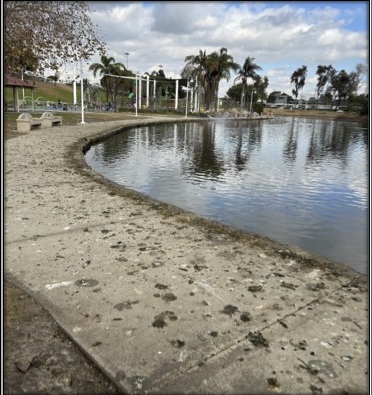
“Three pounds of fecal matter per day by 80 geese is 240 pounds per day,” Franklin said. “365 days per year times 240 pounds is 87,600 pounds — over 43 tons of fecal matter introduced into Polliwog Park.”
Franklin also challenged the economics of the project. Consultant Chris Wessel confirmed that over 20 years, the city had exceeded allowable bacteria levels by 47 days total, meaning 0.64 percent of days had violations. At $10,000 per day, that equals $470,000 in potential fines over 20 years, or $23,500 annually.
“We’re being asked to spend $30 million taxpayer money to save … the actual fine would be $23,500 per year,” Franklin said. “That’s a 1,276-year payback.”
He noted that Governor Newsom has said California should expect a “hotter, drier future” with fewer rainy days, potentially meaning fewer exceedance days in the decades ahead.
“Why not treat the source, Polliwog water?” Franklin asked. “Treat the water at Polliwog. That will essentially give you two great benefits: a better, cleaner pond at our park, and cleaner water that’s going straight into the ocean. You can do it for far less than $30 million.”
Senior Civil Engineer Eduardo Pech clarified that Polliwog’s role was more limited than Franklin’s argument implied. The pond itself represents less than 2 percent of the 28th Street drainage basin, though water flowing into the park from neighboring streets represents about 30 percent of the total watershed.
Earlier in the meeting, staff had presented information about potential penalties that went beyond Franklin’s $10,000 per day calculation. While that’s the minimum daily fine, state regulations allow an additional penalty of $10 per gallon of contaminated discharge. According to city staff, a one-inch rainstorm produces approximately 25 million gallons of discharge from the 28th Street outfall.
Interim Public Works Director Ted Semaan emphasized the scale of potential penalties.
“So the $10,000 per day, per exceedance becomes a much smaller value than it can be for the actual discharge calculated based on the gallons of discharge that occur,” he said.
Chris Wessel, a water resource engineer hired as a consultant by the city, also raised concerns about third-party lawsuits. “To be frank, the bigger issue, cost wise, is really third party lawsuits,” he said. “You’re talking, you know, seven figures plus potentially.”
As the debate intensified, Howorth and Lesser emphasized that the council’s charge that evening wasn’t to reconsider the project itself, which had already been approved, but to award a contract based on legal requirements.
“The contracting code requires us to take the lowest bid for a project such as this, correct?” Howorth asked City Attorney Barrow.
“Yes, lowest responsive and responsible,” Barrow said.
The terms are technical legal standards under California’s Public Contract Code. A responsive bid meets all material terms and conditions without significant deviations. A responsible bidder is capable of successfully completing the contract based on experience, financial strength, and reputation.
Howorth also addressed concerns about prevailing wage compliance. “We absolutely expect to live up to the standards set of prevailing wage,” she said. “It’s the law, and it’s one of my values, and we would absolutely make sure that the workers were being paid the prevailing wage.”
Staff confirmed that the city has labor compliance support that checks and interviews employees of contractors and subcontractors to confirm proper classification and wage payment. The $1.1 million construction management contract with Transtech Engineers includes full-time inspection to monitor compliance.
The Stakes
Staff made clear the consequences of not moving forward. The majority of the project’s funding is the $17.5 million Measure W regional grant that expires in June 2026. Without a contract award showing the project is moving forward, that funding could be lost. The other grants would also be in question.
“If we don’t award and we go back out to bid, basically by rejecting all the bids, I think it sounds like you’re telling me we’re going to have the timing elapse so that we’re not going to have the money to do this project, or any project,” Howorth said.
“It jeopardizes our funding source,” said Semaan.
The meeting featured sharp exchanges between council members, particularly when Franklin attempted to present a slideshow with his alternative, including his goose excrement calculations, near the end of deliberations.
“Do we want transparency and some additional information?” Franklin asked, requesting to show about 10 slides.
“I object,” Howorth said. “We, as a city, the public, didn’t see a slide presentation. That’s not a good process. That’s not transparent if the public hasn’t had a chance to see these ahead of time and comment.”
Tarnay objected even more sharply.
“You’ve raised many questions, and you relitigated this issue time and time again the last three or four hearings that we’ve had,” she said. I respect your right to do that, but we are at the point where we are awarding the contract.”
Public input at earlier meetings included many nearby residents who pleaded that the project be halted due to the disruption the construction would cause in the neighborhood. Tarnay, who is a resident of North Manhattan Beach, acknowledged that disruption will be a burden for nearby residents. But she said Franklin’s attempt to derail it wasn’t helping them.
“I feel like it’s a waste of people’s time,” she said. “You’re giving people false hope that we are reconsidering this project, and I think the majority of council has already stated that we feel confident about proceeding with this project.”
Lesser, as mayor, denied Franklin’s request to show the slides, ruling that public comment had closed and it was too late for new information during deliberations.
After Franklin verbally presented his alternative, Tarnay offered an olive branch.
“If you would like to bring back the staff to examine Polliwog Park and become part of the solution cleaning up that water, I would be supportive as a future agenda item,” she said.
After Howorth moved to approve the contractor bids, Franklin moved to reject all bids and rebid the project. Charelian seconded.
“Based on what I’ve heard tonight, I’m not prepared to support this contract at this time,” Charelian said. “This project is too significant in scope to move forward with unresolved concerns.”
The substitute motion failed 3-2.
The council then voted on the original motion to award three contracts: the construction agreement with Zusser for $25,308,810 plus a $2.5 million contingency; construction management and inspection services with Transtech Engineers for $1,095,755; and Amendment No. 2 with design consultant CWE for $521,380 in additional services during construction.
All three resolutions passed 3-2.
Howorth, in her final comment before voting, addressed Franklin’s concerns about taxpayer money.
“I am glad my taxpayer money is coming back to me here in Manhattan Beach,” she said. “The Measure W taxes, I am glad [they are] coming back here to the beach for better beach quality and better ocean quality.”
Franklin countered one last time.
“This isn’t a question of, do we all want this? It’s to find the right solution, to find the solution that is going to be easier, not requiring digging up streets for two to three years, not requiring use of a contractor which has proven to be untrustworthy. This is about finding a sensible solution, a cost effective solution, a fast solution.”
The city will schedule a community meeting in early January to provide information on neighborhood impacts, construction phases, road closures, and mitigation strategies. Construction is expected to begin in February 2026 and continue through the summer of 2027, with the 26th Street parking lot closed for 12 to 15 months. The stormwater drain system includes a 50-foot-deep diversion pit at 28th Street and Manhattan Avenue that will route stormwater through up to 40 underground drywells where it seeps into groundwater instead of flowing into the bay. Traffic in the area will be impacted.
“I am really sorry about that. It’s just not easy to do,” Howorth said. “If it were easy to do, we’d do it.” ER