by Mark McDermott
Three unfathomable losses overshadowed everything else that happened in Manhattan Beach in 2025. Ford Savela, Braun Levi, and Ryan James were all 18 years old, all brilliant, promising, and kind young men who were beacons of hope, joy, and inspiration for everybody who knew them. Savela and Levi died only a few months apart, only two blocks apart, on Sepulveda Boulevard, each the victim of a reckless driver. James, a singular force who’d lived determinedly strong and free in the face of the lifelong challenge of epilepsy, lost his life to a seizure only weeks into his freshman year at UCLA.
Their loss made other news seem relatively trivial, although a lot happened in Manhattan Beach over the course of the year. The town was deeply affected by the Palisades fire because so many people who lost their homes chose to relocate here, so much so that Manhattan Beach earned the name “Pali South,” a migration that impacted local real estate and schools. Meanwhile, policy hit pavement as the dictates of state laws intended to address California’s housing crisis began coming to fruition in Manhattan Beach, with over 1,000 new housing units entering the city’s planning docket against the will of city leaders and residents. A fire at the El Segundo Chevron plant terrified local residents, and the city grappled with an unusual problem — the decision by a population of formerly migratory Canada geese to make Polliwog Park their permanent home, and, significantly, their remarkable capacity to eat and make a high volume of waste.

Class of 2025
The local Class of 2025 endured losses no graduating class should bear. Three young men — Ford Savela, Braun Levi, and Ryan James — died within months of each other, and the connections between these three fallen stars only deepened the collective grief.
Savela, a Mira Costa High School senior, was killed January 7 when a speeding car struck the car he was riding in as a back seat passanger near 3rd Street and Sepulveda Boulevard. He was 18, returning home from the gym with his brother Chase and a friend when they stopped at Taco Bell. The suspected driver, Kameron Lee Peterson, allegedly fled the scene but was arrested two days later and charged with murder, hit-and-run causing death, and reckless driving.
“Ford Savela was the embodiment of what every teacher dreams of in a student — brilliant, driven, and compassionate,” said teacher Ken Brenan, who teaches computer science and engineering at Mira Costa. “…Beyond his remarkable intellect, Ford’s kindness and humility set him apart; he made our classroom a place of collaboration and joy. He wasn’t just an exceptional student — he was a beacon of hope for the future, someone destined to change the world.”
Savela was an avid rock climber and devoted science and tech geek who’d earned his Teen Mental Health First Aid Certification the previous summer. His friends described him as someone with an extraordinary gift for transferring his own happiness to those around him.
“Ford was confident and kind, unafraid to be his happiest self,” said his friend Lance.
Less than four months later, on May 4, another 18-year-old was killed on Sepulveda Boulevard, just two blocks from where Savela died. Braun Levi, a Loyola High School tennis star ranked 50th nationally, was struck by a suspected drunk driver while crossing the 100 block of South Sepulveda shortly after midnight. Levi’s family had relocated to Hermosa Beach after losing their home in the Palisades fires in January. He and three friends — all Mira Costa students — had left a nearby gathering to find food. Two had crossed, another was at the median when the car struck Levi. The boy at the median called 911 and waited with Levi as paramedics arrived. He had also been a friend of Ford Savela.
Days before the accident, Levi and his doubles partner had won their fourth consecutive Mission League championship. He was committed to the University of Virginia.
“Braun was a shining presence in our Loyola family, bringing light, joy, and inspiration to everyone he touched,” wrote Loyola Principal Jamal Adams.
His doubles partner Cooper Schwartz, who’d been friends with Levi since they competed against each other at age 8, wrote on Instagram: “18 years or 125, no one had a better life than you did Braunny. The tears are joyful because of that.”
The driver, Jenia Belt, a 33-year-old Los Angeles resident, was arrested at the scene. She was driving with a suspended license due to a previous DUI. The LA County District Attorney did not file charges until late December — murder, gross vehicular manslaughter while intoxicated, and driving with a suspended license.
Later in the year, the Class of 2025 lost another star. Ryan James died October 14 from a seizure related to his epilepsy during his third week as a freshman at UCLA. James had been a standout runner on the Mira Costa Cross Country team, known for his relentless determination and gift for forming deep connections with others. He’d once run seven miles on a collapsed lung, and in July had completed a grueling backpacking trip through the High Sierra with his friend Eric Albelda — who happened to be Ford Savela’s best friend.
“Ryan completely changed my life,” Albelda said. “I learned that you need to let people into your lives, spread nothing but kindness and love, and leap out of bed every morning to seize the day because you don’t know how long you have to be alive.”
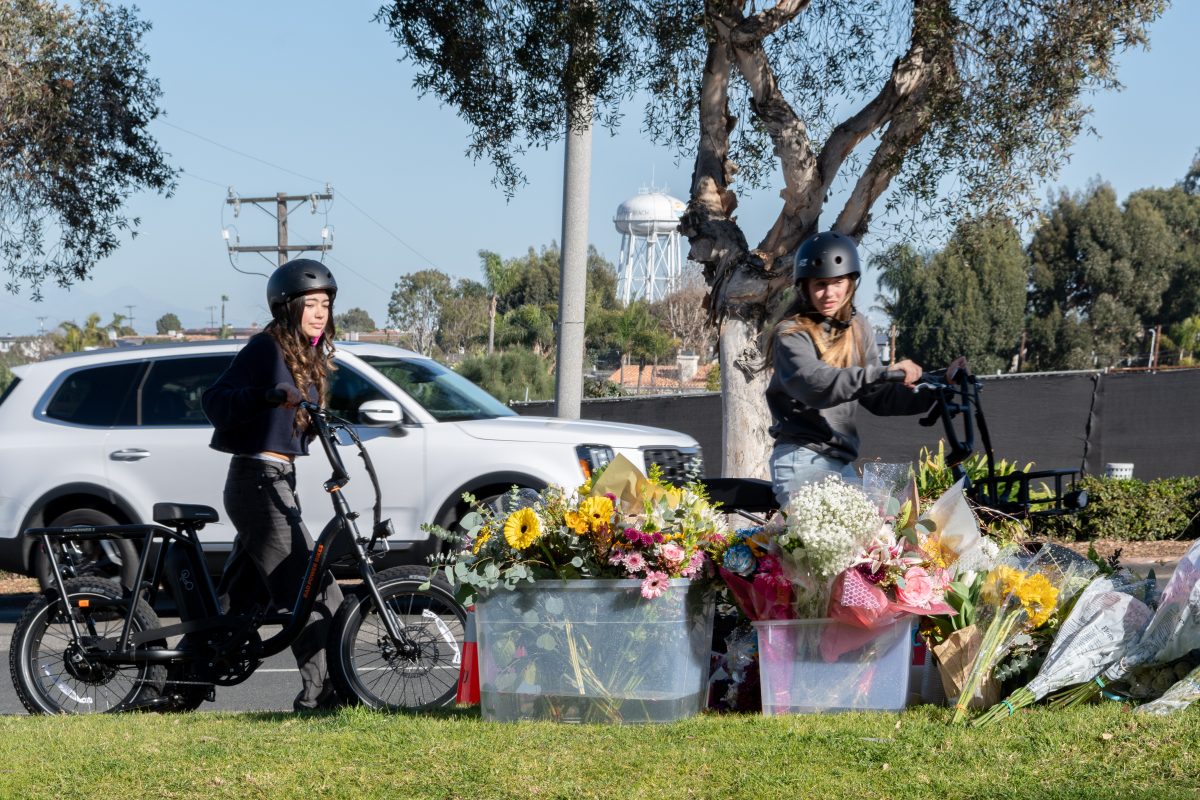
The deaths hit the community with cumulative force. Savela’s and Levi’s deaths were actually the second and third fatalities on the boulevard since December 2024, when Michael Kawasaki was struck and killed between 8th and 9th Streets. The clustering of three deaths in less than six months on the same stretch of state highway sparked what city officials described as a “sea of comments” and immense pressure to take action.
At a May City Council meeting, Mayor Amy Howorth addressed the crisis directly.
“We’ve received many, many, many valid concerns about safety on Sepulveda Boulevard…particularly that stretch south of Manhattan Beach Boulevard, which tragically has been the site of multiple fatal accidents in recent years,” Howorth said.
The fundamental problem: Sepulveda Boulevard is State Route 1, controlled by Caltrans, not the city. Manhattan Beach cannot unilaterally change speed limits, striping, or signals without Caltrans approval. But the deaths transformed the city’s approach from “advocacy” to what officials called “expedited partnership.”
Since June, city staff and Caltrans have held meetings every three weeks specifically to fast-track safety countermeasures. The Manhattan Beach Police Department deployed specialized surveillance cameras along the corridor to record pedestrian behavior and traffic flow, providing the “visual data” Caltrans required to justify infrastructure changes like lighted crosswalks. The city launched DUI saturation patrols and high-visibility speed enforcement, particularly south of Manhattan Beach Boulevard. The city is also collaborating with the “Live Like Braun” Foundation, established by the Levi family, to integrate DUI prevention into official safety campaigns. The Manhattan Beach Boulevard & Sepulveda Intersection Project, funded by Measure R, moved into final design phase with spring 2026 completion targeted, aiming to widen quadrants and extend medians to better protect pedestrians.
Howorth said the city was also working with State Senator Ben Allen to pressure Caltrans into more aggressive action.
“They must understand the urgency, and they need to act with urgency and implement robust safety protocols,” she said. “And we at the city are going to leverage every available resource to continue to advocate for those measures that protect our residents.”
But residents weren’t satisfied with bureaucratic timelines. Tanya Monaghan, whose son was with Braun Levi the night he died, implored the council not to wait for Caltrans.
“Three lives taken along the same stretch of Sepulveda Boulevard,” she said. “This is not a tragic coincidence. It is clear signal that the current conditions on this major thoroughfare are unsafe and unacceptable. I just don’t want this to get blocked by, ‘Whose responsibility is this?’ Everybody wants to help out with this and make our city safer.”
Another mother, who didn’t identify herself by name, spoke with raw urgency about waking up to news of Levi’s death the morning after prom.
“Two children in three months is completely unacceptable,” she said. “Our children are 17 and 18. They need their independence. These are pedestrians. They weren’t doing anything wrong. Killed by drunk drivers. So I really feel like it’s a civic responsibility that we do something to take drunk drivers off the roads. This is Manhattan Beach. We can do whatever we need to do to keep our children safe. And we need to do more.”
In late December, Braun Levi’s mother Jennifer spoke at a press conference announcing the murder charges against Belt, calling for tougher DUI laws.
“California’s current DUI laws are broken and weak and fail to protect families like ours,” she said. “I guarantee if any of you had to identify the body of your child or loved one in the manner that my husband and I did a few months ago, you would not be silent. The feeling, the sight, the smell of identifying our son’s body will never leave my mind, body or soul.”
The Levi family also filed a $200 million lawsuit against Belt. Los Angeles County District Attorney Nathan Hochman used the case to push for legislative reform.
“These very, very serious charges are a message not just to Ms. Belt,” Hochman said, “but to everybody out there who is thinking during this holiday season or at any point in time of getting behind the wheel, drunk and intoxicated, or engaging in excessive speeds.”
But no amount of legislation or infrastructure improvements could restore what was lost. The Class of 2025 were forced to confront a heightened sense of life’s fragility — three bright futures extinguished, and a community left to grapple with grief that arrived in waves throughout the year.
Pali South
The term “housing crisis” took on new meaning in January when wildfires consumed Pacific Palisades. Over 5,000 homes were destroyed, and within days, displaced families began arriving in Manhattan Beach, looking for temporary and permanent homes in a community most akin to that lost town — coastal, casual, affluent, with good schools.
Local Realtors were involved in the mad scramble to help find these families homes. The impact on the real estate market was immediate and unprecedented.
“I spent a chunk of yesterday trying to place a family of five,” said Dave Fratello, broker at Edge Real Estate. “Every single property that could possibly have suited them in Manhattan Beach was taken, with more than a dozen applications.”
The lease market became a frenzy within 48 hours. One property on Longfellow had 30 applicants the moment it became available. Robb Stroyke, co-founder of Stroyke Properties Group and Bayside Real Estate Brokers, said he and his team worked 14-plus hours a day for eight straight days trying to find homes and basic supplies for fire-affected families.
“We are working tirelessly to help these people. We all have so many friends who were affected by the fire, and so many friends of friends who are affected by the fires,” he said. “And helping them is so rewarding because the gratitude and appreciation and the relief that they feel just getting one part of their life stabilized is just glorious to behold and experience.”
The real estate community mobilized in ways that went far beyond typical transactions. Many brokers reduced or waived their commissions. They reached out through their databases to find people who owned second or third homes locally who might be willing to lease to fire victims. They worked to quickly activate lease properties that weren’t yet on the market, telling owners that people would take homes in whatever condition they were in, furniture and all, because that’s what the displaced families needed.
Realtor Annie Hartley worked with a seller who refused to raise his price the day after the fire, expedited the sale to help families scramble if they lost out, and left a million dollars on the table simply because it was the right thing to do. The home, on a walk street on the 400 block, was listed at $8.2 million and sold for $9 million, but could have easily gotten hundreds of thousands more, quite likely another million.
“He was one of these people you just don’t come across often in life,” Hartley said. “And he never once asked me, ‘How can we make more money? Should we come out at a higher price?’ Instead, it was, ‘Oh, these people. I can’t believe this has happened to them.’ And that was so refreshing. Because it could have become a very greedy situation.”
The purchase market would prove equally dramatic. January became the biggest January in Manhattan Beach real estate history. Homes cumulatively valued at $181.7 million went into escrow, compared to $56.7 million in January 2024.
“There’s never been a $100 million January, and this year, we beat the record by $100 million,” Fratello said. “That’s how extraordinary it was.”
Richard Haynes said sales over $6 million jumped from three to nine compared to the previous January. Jerry Carew’s data showed escrows more than doubled from the second week of January to the first week of February. Stroyke’s analysis showed properties under contract, pending, or sold at over $221 million through the end of January, compared to $103 million for January and February combined the previous year.
“We just experienced a historic dislocation of supply and demand that will have a lasting impact on the housing market here for five years or longer,” Stroyke said.
Within weeks, a new term emerged for this community-within-a-community: “Pali South.” By mid-February, several local moms organized a welcoming event and fundraiser, bringing together the hundreds of displaced families who’d relocated to Manhattan Beach. The educational impact was equally profound. Manhattan Beach Unified School District enrolled 175 new students overall and 125 at Mira Costa specifically. American Martyrs Catholic School enrolled 57 students, most from Corpus Christi School, which was destroyed in the fire.
At Mira Costa, Link Crew leaders greeted fire-affected students before school even started, offering campus tours and posting welcome signs throughout campus. “Welcome to Costa! You belong here!” one such sign read. Teacher Andy Caine told the school board students were “responding with open arms and open hearts.”
“They are fitting right in,” Principal Jennifer Huynh said. “It’s starting to get to a point where now I can’t even recognize who was here before…They’ve definitely started to blend right in, and in the most good and positive way.”
Huynh said the experience revealed something beyond the school’s academic rigor: “Costa is known for its compassion and kindness.”
Stroyke said the experience brought the real estate community together in unprecedented ways, as people waived fees and worked around the clock to help the displaced families.
“The real estate community in general here is more polite and courteous to each other than Beverly Hills or West LA,” he said. “So we all got together, and we’re still getting together, and sharing information and trying to help people the best we can. It’s more than a refreshing experience, really gratifying to be able to help people and find a spot for them.”
The fires also impacted local marine life. Toxic algal blooms, possibly worsened by ocean runoff from the fires, caused the worst domoic acid poisoning event in recent history. The Marine Mammal Care Center rescued hundreds of sick sea lions and dolphins, with dozens stranding on Manhattan Beach beaches through the spring.

State housing crisis vs. MB
Two years after reluctantly approving Project Verandas under threat of state sanctions and a $50 million lawsuit, Manhattan Beach confronted the reality that the 79-unit development had been merely a preview. In 2025, the full force of California’s housing mandates arrived on Sepulveda Boulevard and Rosecrans Avenue.
The catalyst was the Residential Overlay District, a state-imposed zoning designation the City Council adopted in March 2023 to avoid losing all local permitting authority. The ROD encompasses 34 sites totaling 43 acres along the city’s main commercial corridors. At minimum densities, the ROD could result in roughly 850 new residential units. At maximum allowable densities under state density bonus law — which the city has almost no power to deny — the theoretical maximum approaches 5,100 units. By year’s end, preliminary proposals submitted totaled more than 1,000 units across five projects, including a 273-unit development featuring 10-story and 7-story buildings at the former Fry’s Electronics site, and smaller projects scattered along Sepulveda.
The projects are designated “by right,” meaning they must be approved administratively by city staff without public hearings or input processes. Neither the Planning Commission nor City Council have oversight. To qualify, twenty percent of a project’s units must be deemed affordable under state guidelines, with the rest selling at market rate. This combination is meant to incentivize affordable housing by allowing developers to absorb the unprofitability of lower rent units through higher profit from market rate units.
For residents, particularly those on Oak Avenue behind a proposed seven-story, 40-unit development at 2301 N. Sepulveda, the reality felt like a betrayal of the small-town character they’d fought to preserve.
“This is the biggest thing,” said resident Steve Alexander at a council meeting. “This is going to permanently change the character of Manhattan Beach.”
Developer Matt Moore, whose family LLC proposed the 2301 Sepulveda project only after neighbors previously opposed a doggy daycare business he’d proposed, took the unusual step of introducing himself on Nextdoor in April, hoping to make himself accessible during construction. What followed was a 184-comment thread, most opposing the project.
“Unfortunately, transparency is very kind, but totally doesn’t make up for the fact that you’re about to put a giant building nobody wants in our backyard,” wrote one resident. “I’m sure the government gave you plenty of money and you’re going to look the other way…You could choose to wait, and rent to a local business owner or other, but your greed and disregard for our actual community is showing.”
Moore defended both his project and the problem it aimed to address. He thought about his daughter, a young adult for whom the modest condo he and his wife bought for $188,000 in the late ’90s — now valued at $800,000 — would be completely out of reach.
“She is every bit as capable, if not more, so every bit as deserving,” he said. “She has worked every bit as hard as we had, and yet that’s just completely out of reach for her. So what, I’m lucky because I happen to have landed on the Earth in 1977? I don’t feel comforted by that.”
While Manhattan Beach grappled with the local impact of new developments, the state’s aggressive mandates were driven by a staggering deficit. According to the California Department of Housing and Community Development (HCD), the state must plan for 2.5 million new homes by 2030 to address its chronic shortage — including at least one million units designated as affordable. Despite recent legislative efforts, production remained sluggish: California added roughly 125,000 units in 2024, far below the 310,000-plus annual units required to meet state goals. This scarcity pushed the statewide median home price to approximately $852,680 (as of November 2025), a figure that remained more than double the national average. For many, the crisis was defined by a widening “affordability gap,” where the income needed to qualify for a mid-tier mortgage now exceeded $220,000, leaving even high-earning professionals — and the next generation of local residents — priced out of the communities where they grew up.
Moore acknowledged a profit motive but insisted the housing crisis was real. “This didn’t come about out of nowhere,” Moore said. “This came about out of a series of laws that have been passed now over the last almost 50 years in response to this issue.”
The City Council, meanwhile, struggled within the narrow confines of what state law allowed. In April, the council passed five, state-imposed code amendments that further streamlined affordable housing processes. Planning Manager Adam Finestone warned that failure to adopt them could lead to decertification of the city’s Housing Element, allowing the state to take over all permitting.
“We are already overdue on these code amendments,” Finestone said. “They were due two years ago.”
Councilperson Nina Tarnay asked City Attorney Quinn Barrow if any city had succeeded in legal challenges to the state’s housing requirements.
“Not yet,” Barrow said.
Mayor Pro Tem David Lesser said the state had usurped the council’s ability to ensure projects fit the community’s character.
“I’ve asked myself the question, what is the role of city councils in an era where the state has clawed back the jurisdiction over permitting and building these large scale residential projects?” he said. “What is our role? We get to be the targets of angry residents who are justifiably angry.”
Within those constraints, the City tried to manage what it could. In December, the council approved a residential permit parking program for Tree Section neighborhoods west of Sepulveda and overhauled its notification system for ROD projects — expanding the notification radius, simplifying language, and adding developer contact information. The council also made one aggressive move to preserve local control where possible: in April, it purchased the former U.S. Bank site downtown for $13 million, preventing what could have been another density bonus project in the heart of town.
“Wow, we just prevented a five, six, or seven story apartment building from going in,” said Mayor Amy Howorth.
But such victories were rare. As the year closed, Manhattan Beach braced for a wave of development beyond its control, the fabric of its small-town character about to be tested by forces from Sacramento that local leaders felt powerless to stop.

The Year of the Canada Goose
Once upon a not-too-distant past, the Canada Geese who came to Polliwog Park were just wintering. When things warmed up they would go back to Canada, following their migratory pattern. But somewhere along the way, things changed. The geese stayed. Food supplies in and near Polliwog, apparently, led them to cease their wandering ways.
What made this particularly apparent was the sidewalk bordering the pond at Polliwog. In September, field operations manager Sean Roberts presented the input-output equation of the local Canada Goose to the City Council.
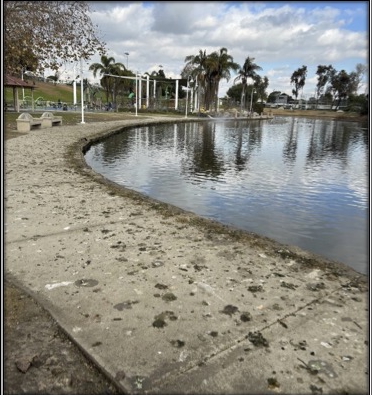
“Up to 95 Canada Geese have been seen at Polliwog at the same time,” Roberts said. “The Canada Goose can live upwards of 24 years. They are approximately 12 pounds in weight. And the staggering number here is they can consume four pounds of grass per day, and create about three pounds of fecal matter — times 80 birds a day, times a week, times a month…You can do the math on the amount of fecal matter.”
The city hired biologist Robert Hamilton to help devise a way to deal with the poop. His recommendations included public outreach and signage to stop people from feeding the geese, a three to four foot fence around the pond, hazing the birds with green lasers, reducing reproduction by “addling the eggs,” and applying goose repellant to grasses on nearby sports fields.
“We have almost the perfect scenario for a food source for these birds,” Hamilton said.
Councilperson Joe Franklin asked if the Canada Geese had any natural predators. Hamilton said coyotes were the main one. Coincidentally, they were the City’s other problem wildlife because they prey on local pets.
The council agreed to use all the options except population control through addling goose eggs.
But the geese weren’t done making appearances at City Hall. In December, when the council considered a controversial $28 million storm drain project meant to address chronic ocean pollution, Franklin proposed a different approach. Instead of the filtration system, he argued the city should focus on treating water at Polliwog Park.
Drawing on data from the September goose discussion, Franklin presented his calculations.
“Three pounds of fecal matter per day by 80 geese is 240 pounds per day,” Franklin said. “365 days per year times 240 pounds is 87,600 pounds — over 43 tons of fecal matter introduced into Polliwog Park.”
Franklin argued that the geese were among the chief culprits in the city’s ocean pollution problem, and treating Polliwog water would be far less expensive than the $28 million project.
Senior Civil Engineer Eduardo Pech clarified that Polliwog’s role was more limited than Franklin’s argument implied. The pond itself represented less than 2% of the 28th Street drainage basin.
The council approved the storm drain project 3-2, with Franklin voting no.
As the year closed, the Canada Geese remained firmly established at Polliwog Park, their 43 tons of annual excrement a persistent reminder that some problems — particularly those involving stubborn waterfowl who’d decided Manhattan Beach beat migrating — defy easy solutions.
El Segundo Chevron Fire
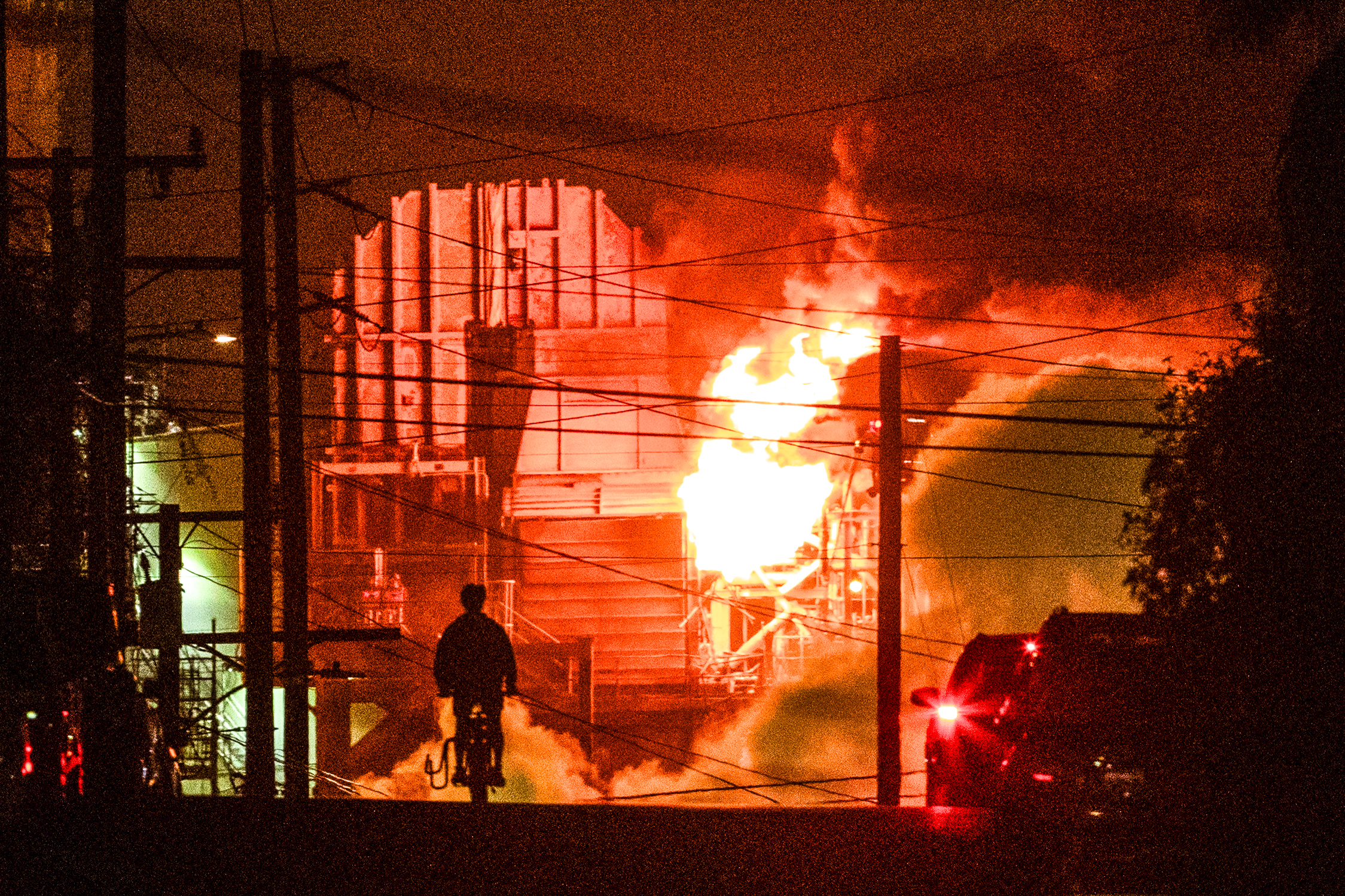
The explosion and fire at the El Segundo Chevron refinery on the evening of October 2 lit up the South Bay sky and frightened neighbors in both Manhattan Beach and El Segundo. Flames could be seen rising from the southeast corner of the refinery, bordering Manhattan Beach, at the ISOMAX process unit, which produces jet fuel.
“I want to acknowledge the Manhattan Beach residents who experienced fear and uncertainty during the Chevron refinery fire,” Mayor David Lesser said at the following Tuesday’s council meeting. “Many in our community saw the flames, smelled the smoke, and questioned whether they and their families were safe.”
Manhattan Beach Fire Department Chief Jesse Alexander praised the swift response by first responders from MBFD, El Segundo Fire Department, and Chevron’s own fire crew, who arrived on scene within two minutes. The fire was fully extinguished by 7:30 a.m. Friday morning. No injuries were reported.
Brian Stock, director of the El Segundo Chevron refinery, gave an emotional apology to the community at the council meeting.
“On behalf of myself, the women and men who work at the refinery 24/7, and the entire corporation, I want to express to you how deeply saddened we are that this fire occurred,” Stock said. “We work tirelessly every day, every night to prevent incidents like this from happening, and we will continue to do so.”
“For 114 years we have operated in this community,” he said, “and I commit to you that we will do everything we can to continue to be a good neighbor.”
The cause of the fire remained undetermined at year’s end, though Chevron Corporate Affairs Manager Jeff Wilson said the company had “no indication that the fire was a result of terrorist activity.” The refinery produces 40 percent of the jet fuel used in Southern California and 20 percent of motor vehicle fuel. Since the fire, production continued at reduced rates, with Chevron stating it anticipated continuing to meet supply obligations.
However, the orange glow over the South Bay faded more quickly than the legal and regulatory heat. Despite initial corporate statements reporting “no injuries,” a series of lawsuits were filed in late 2025 by contract workers—including welders from Texas and Louisiana—who alleged they were working just 50 feet from the ISOMAX unit when it exploded and sustained permanent physical and emotional trauma.
On the regulatory front, the South Coast Air Quality Management District revealed that Chevron had been issued a notice of violation just months before the fire for failing to control excess gases in that same ISOMAX unit. By year’s end, the investigation shifted amid a troubling backdrop: with the U.S. Chemical Safety Board effectively defunded by the Trump administration, local watchdogs and Manhattan Beach leaders expressed growing concern that California lacked a centralized agency capable of conducting a truly independent investigation of why the South Bay’s largest industrial neighbor erupted in flames.
Leadership changes
Manhattan Beach saw significant transitions in civic leadership throughout 2025, as key figures took new roles or announced their departures.
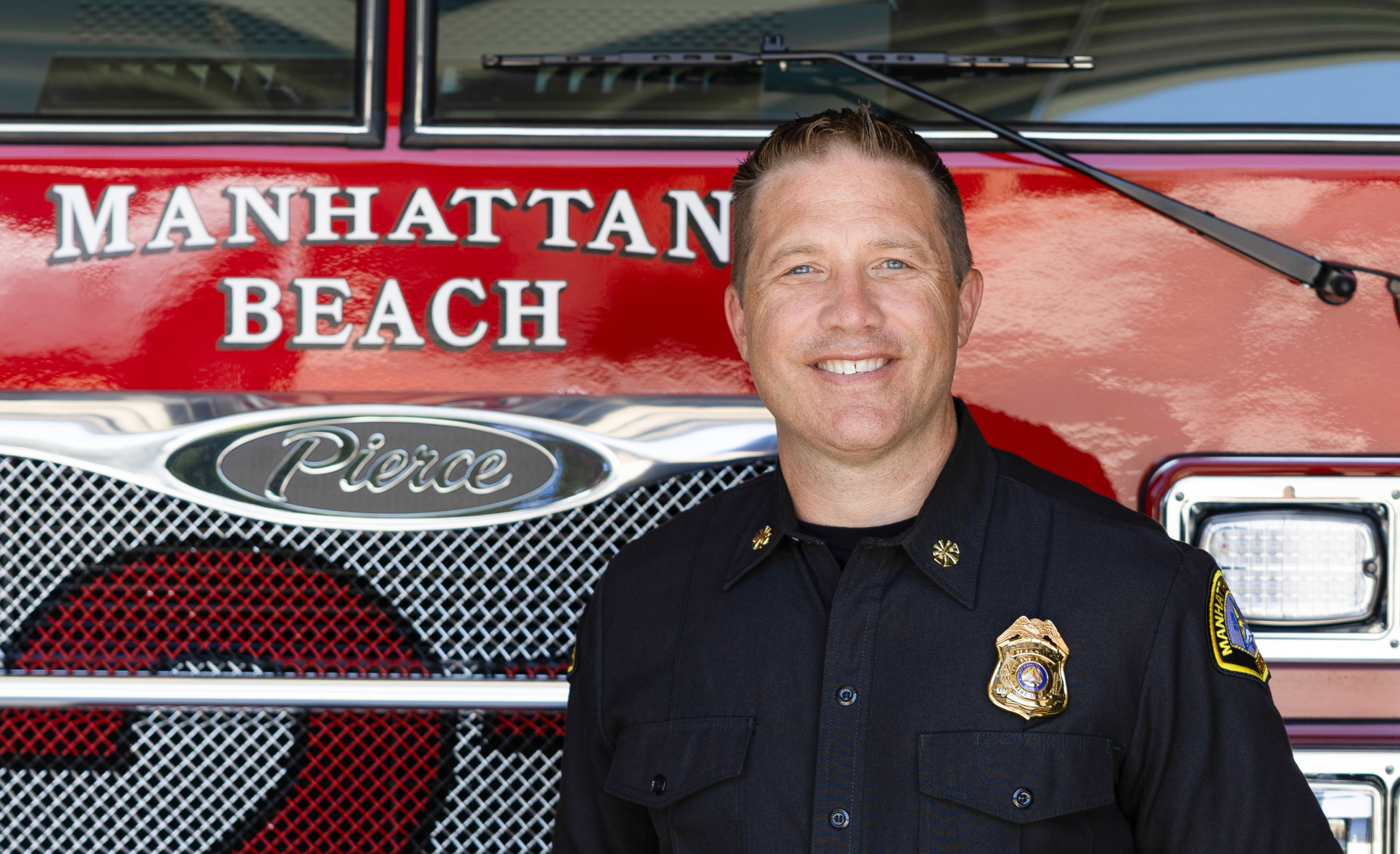
In July, Jesse Alexander took the helm of the Manhattan Beach Fire Department after serving as chief of the Yuba City Fire Department for five and a half years. Alexander brought 25 years of firefighting experience, including some of the most challenging incidents in California history—the Cedar Fire, the Camp Fire, and the Oroville Dam evacuation.
“The diversity is what is so amazing about the fire service,” Alexander said. “And that is why I love it so much.”
Alexander was credited with being a “stabilizing force” in Yuba City, where firefighters praised his care for rank-and-file crews. Yuba City Mayor David Shaw called him “a pillar of excellence and humility.” YCFD Captain Kevin Kennedy, who also served as the head of his department’s firefighter’s union and thus ostensibly an occasional adversary of the chief, said he had come to a place of outright admiration for Alexander.
“I’ve been in the organization I currently work for for 24 years, and Jesse is one of the greatest guys I have had the opportunity to work with…Right from the beginning, I could tell he is a selfless guy,” Kennedy said. “He wants to come in and do what he can to make an organization better. And he’s humble.”
Kennedy said that Alexander also represents a newer generation kind of leadership that is more data driven but also more cognizant of the human side of the fire service.
“He’s that younger generation, he’s still in his late 40s,” he said. “So [issues like PTSD] are coming out more on the forefront than they ever did before and younger guys like him can recognize it a little bit and see where there’s something missing.”
Alexander brought that modern, trauma-informed approach to Manhattan Beach, along with his family, who quickly fell in love with the Beach Cities lifestyle.

In July, Jill Lamkin was appointed president and CEO of the Manhattan Beach Chamber of Commerce. Lamkin came to the role after serving as executive director of the Downtown Manhattan Beach Business and Professional Association, where she’d become known for extraordinary attention to detail and relentless advocacy for local businesses.
“The board is excited about the growth and evolution of the Chamber’s mission,” said board chair David Curry. “What it’s lacked, and what has been asked for for decades, has been economic development, and that’s something that Jill has presented a vision for.”
Lamkin’s departure from the Downtown Business Association brought the return of Kelly Stroman, a steady hand who’d led the Chamber during the pandemic. Mayor Amy Howorth said she found herself at a meeting with both women shortly after they’d taken their new positions and felt a sense of relief.
“To me, it’s like, oh my gosh, this is such good news for our community,” Howorth said. “These two women are both brilliant.”
Lamkin quickly made her mark. By December, she’d orchestrated a transformed North Manhattan Beach Holiday Stroll that drew thousands of residents after the City closed Highland Avenue for the event. The expanded festival, which included a curated holiday marketplace and Santa Claus staying until after 9 p.m., represented a gamble that paid off.
“It was honestly kind of the best of everything that could happen,” Lamkin said.
In November, Manhattan Beach Unified School District Superintendent John Bowes announced his retirement effective June 30, 2026. Bowes, who served as superintendent since August 2021, brought 36 years of public education experience to the district.
“I am deeply grateful for the opportunity to have served in public education for 36 years,” Bowes told the board, “and especially for the privilege of spending the last decade as a superintendent, including the last five here in MBUSD.”
The board planned to launch a comprehensive search process for MBUSD’s next superintendent in the coming months. ER