
In Nagasaki, cathedral bells ring again after 80 years. St. John Fisher’s Church marks the occasion with a concert
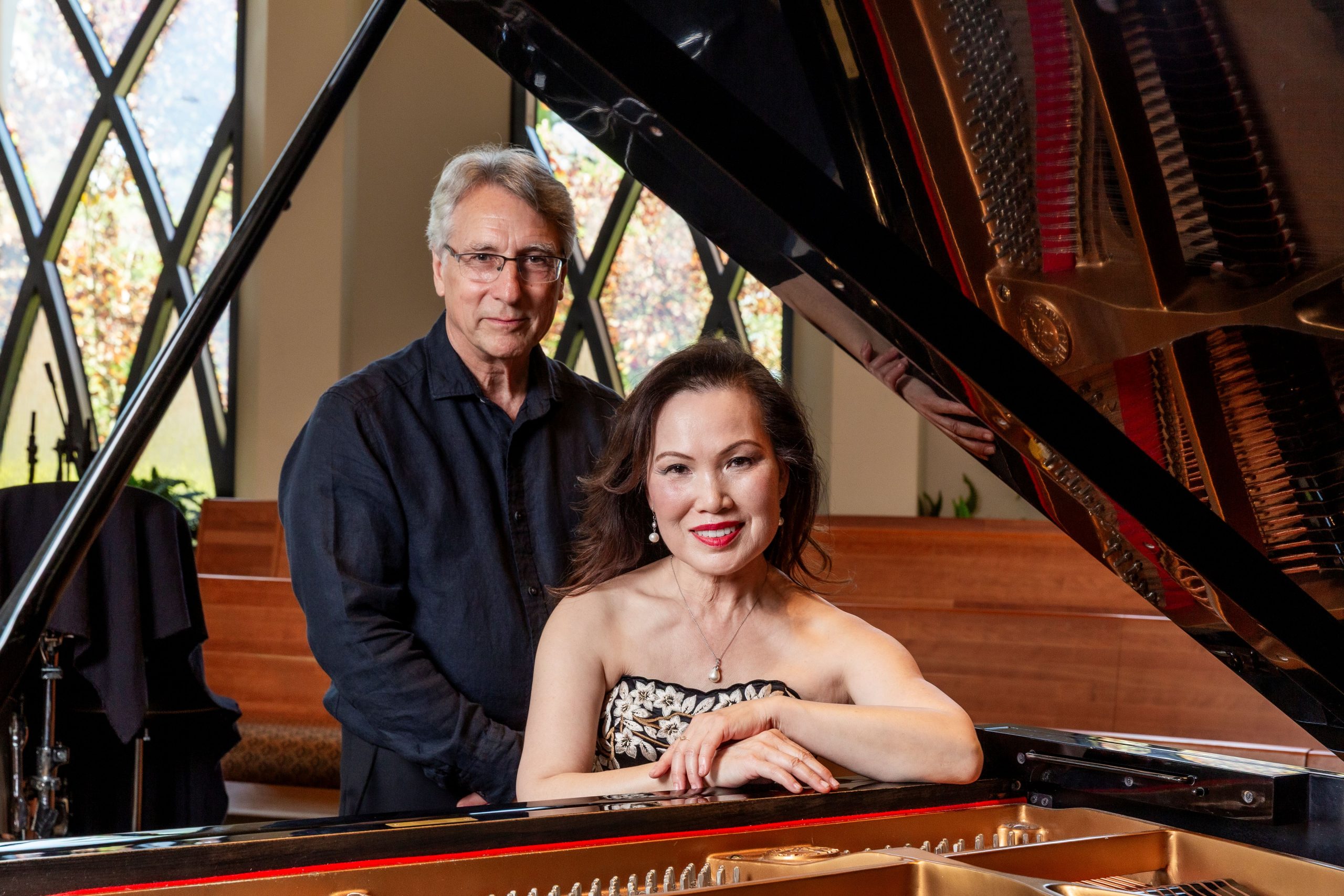
The bells may stop, but the ringing continues
“Bells of Nagasaki: Music for Contemplation” is a special concert at St. John Fisher Church
by Bondo Wyszpolski
Eighty years ago this month — on August 6 and 9 — atomic bombs were dropped on Hiroshima and Nagasaki, effectively ending the war with Japan but introducing a weapon so destructive it should never have been created.
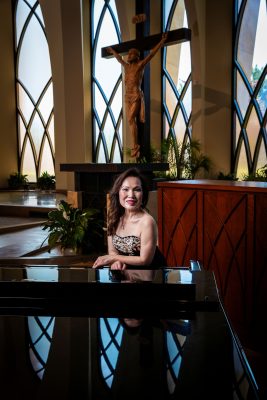
Anli Lin Tong at St. John Fisher Church. Photo by Patrick Smyth
There’s quite a story behind this concert, so let’s start with some historical background.
The Urakami Cathedral in Nagasaki was built in 1925 to serve the Catholic community. Nagasaki was the first Japanese port to open up to the West, its window to the world, and along with trading opportunities came missionaries with their Christian theologies. During the 1500s as many as 300,000 Japanese converted to Catholicism, which didn’t sit well with the shogunate.
Twenty-six Japanese Catholics, later to be known as the Holy Martyrs of Japan, were executed in 1597, and there were periodic purges throughout the following century. Skipping ahead a few hundred years, some 12,000 Catholics were living in Nagasaki in 1945 and about 8,500 died in the bombing. Altogether, between 40,000 and 80,000 people were killed that August day, with many others succumbing to their injuries, largely as a result of radioactive poisoning.
The Urakami Cathedral was largely demolished. Both bell towers were reduced to rubble. The large bell from one of the towers was salvageable, and reinstalled after the cathedral was reconstructed in 1959. The other bell wasn’t so lucky, and so the north bell tower has been absent a bell until now, that is, this past July 18. On August 9, at 11:02 a.m., both bells will ring out together for the first time in 80 years.
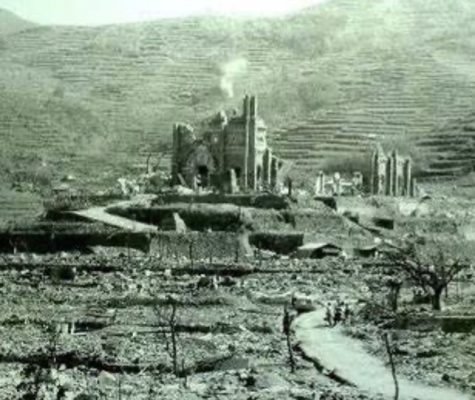
Urakami Cathedral, Nagasaki, after the atomic bomb in 1945.
In 1950, a movie was released in Japan called “The Nagasaki Bells,” based on the 1949 memoir by Dr. Takashi Nagai, whose wife died in the bombing. Nagai was a convert to Catholicism, and despite the utter destruction of his city he became an advocate for world peace and forgiveness. His accomplishments were notable considering that he was ill and died of leukemia just six years later.
“The Bells of Nagasaki” theme song (“Nagasaki no Kane” in Japanese) was the portal, so to speak, through which Anli first learned of the Urakami Cathedral story.
That was in 2013 when she’d gone back to her native Taiwan to see her ailing father. He was then living in a senior care facility whose recreations included a karaoke room. One of his favorite songs, which he sang often, was “The Bells of Nagasaki.” The music was accompanied by visual images from the film — and by asking her father, Anli was able to piece together what the song related to.
In 2016, a year after her father’s death, Anli saw Martin Scorsese’s film “Silence,” based on the 1966 novel by Shūsako Endō, which tells the story of 17th Century Jesuit priests who come to Japan to spread Catholic Christianity.
Her father, Anli says, “emphasized to me that he believed that the arts — artists, musicians — play a unique role in being able to contribute to the betterment of humanity, in a way that no politician, economist, or business person can.” He also believed fully in his daughter’s latent talent, and when she was young he sent her to the States to develop her pianistic skills.
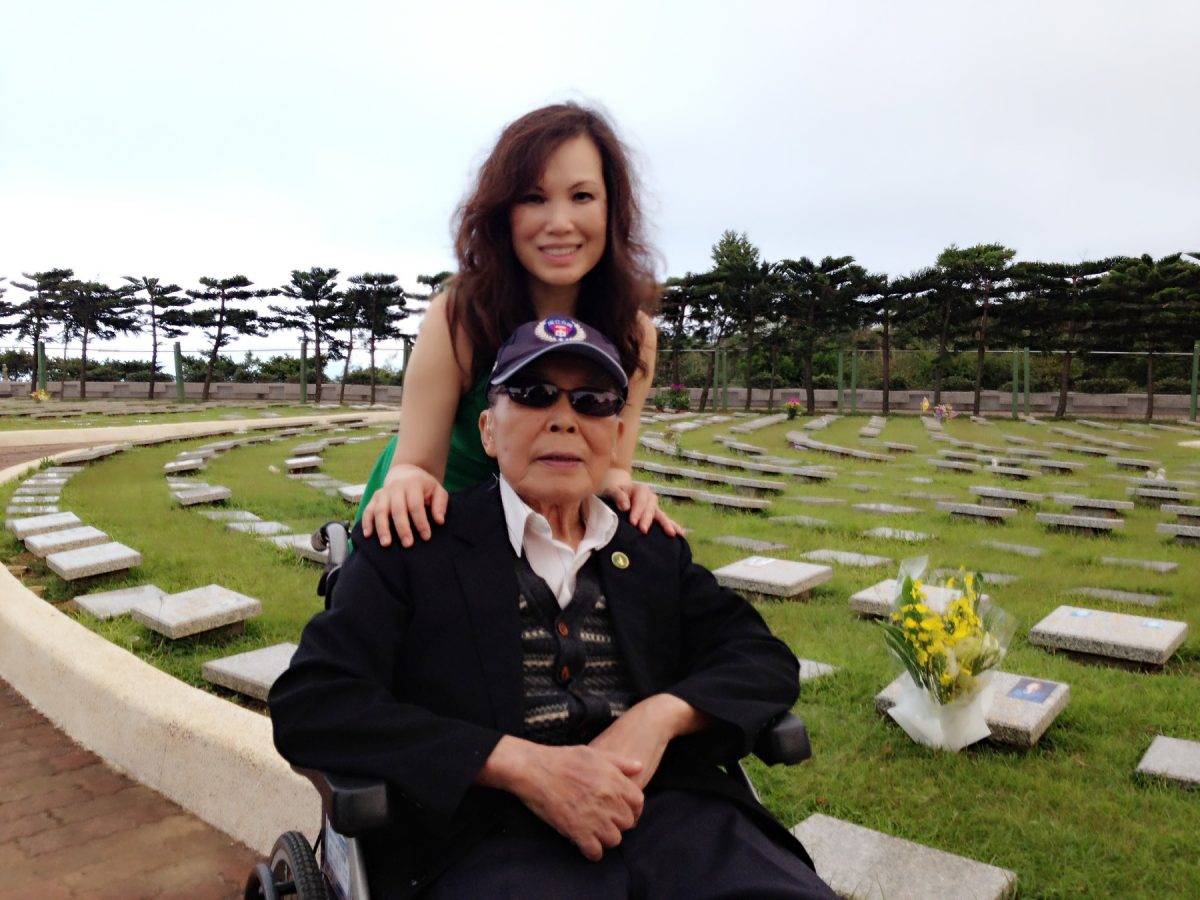
Anli and Papa visiting Mom at Peace Garden, September 11, 2013. Photo courtesy of Anli Lin Tong
Meanwhile, James L. Nolan, Jr., a professor of sociology at Williams College in Massachusetts, had been pursuing a project to finance a new bell for the Urakami Cathedral. This had begun in 2023 while he was in Nagasaki doing research for a book about Catholics in Nagasaki and their centuries of faith, persecution, and hope.
During a conversation with one of the cathedral’s parishioners, it was suggested to Prof. Nolan that it would be a fine gesture if American Catholics could donate a bell to replace the one that had been destroyed decades earlier. The man then added that it would be nice if, in his lifetime, he could hear both bells ringing together.
The professor was impressed and motivated by the idea, and that’s how the Nagasaki Bell Project started, its goal being to raise $125,000 to cover casting, shipping, and installation of the new bronze bell.
In December of last year, Anli saw a notice about the fundraising endeavor and she made a small donation. It came to the attention of Prof. Nolan himself, who sent a thank-you note, and then Anli replied with some words about her father and how she herself had come to know the story of the Nagasaki bells. Having seen her return address, Prof. Nolan mentioned that he had grown up in Rancho Palos Verdes.
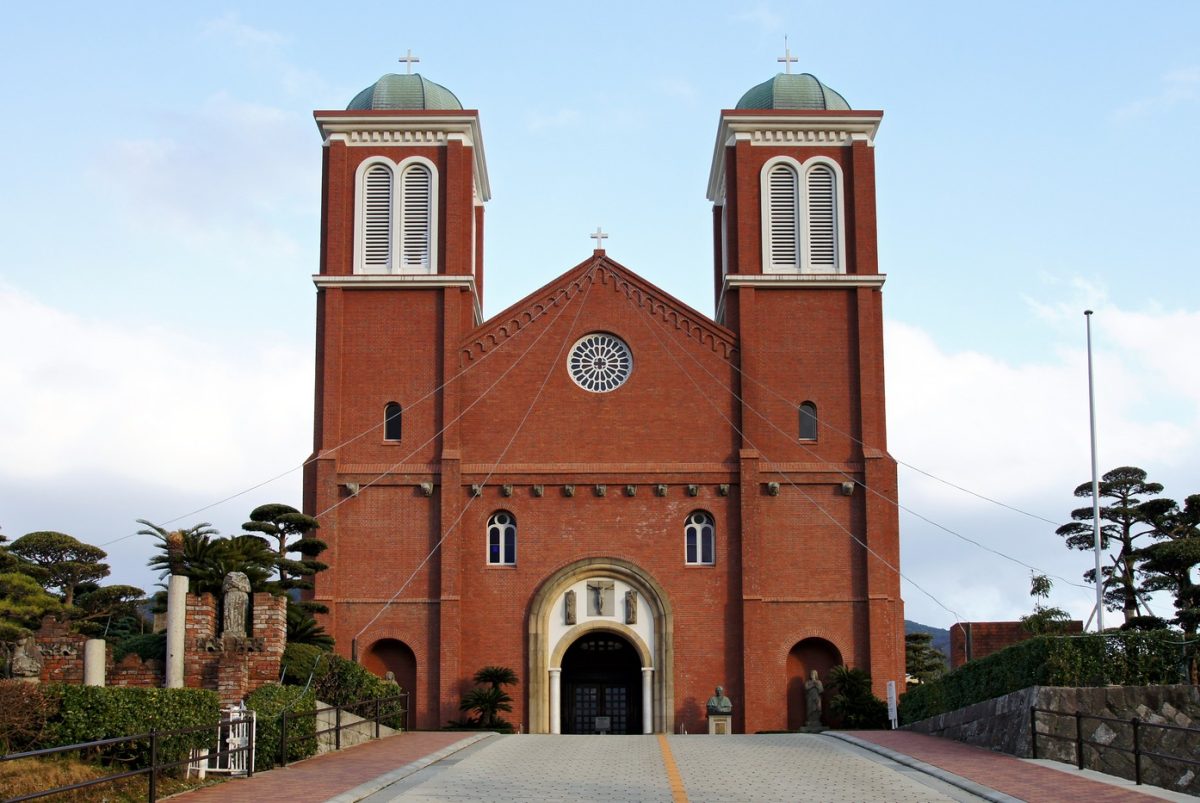
The Urakami Cathedral in Nagasaki, built in 1925 and reconstructed in 1959.
Several streams are now merging. Prof. Nolan’s grandfather was a radiologist, and he served as a doctor for the Manhattan Project. He was also among the medical staff sent to Nagasaki and Hiroshima after the war to assess the health and injuries of the survivors.
Now, interestingly enough, Anli’s father was a student at Tokyo University Medical School in 1945, and when Tokyo was firebombed in April 1945 he survived the attack, his daughter says, “with nothing except the shirt on his back.”
At the time, Taiwan was a Japanese colony, and being a colonial subject this is why Anli’s father was in Japan. At some point, and Anli’s isn’t quite sure when, her father made his way back to Taiwan via Manchuria.
Her mother had been studying at an elite girls’ college in Tokyo, Anli says, and her roommate was the daughter of Admiral Yamamoto, who spearheaded the attack on Pearl Harbor. Somehow, Anli’s mother also managed to return to Taiwan — where she met Anli’s father.
Although Anli was born much later, she carries the horrors of warfare in her veins.
As a young woman, Anli remembers accounts of her aunts and other relatives “all crying when Japan lost the war, because they considered themselves Japanese.”
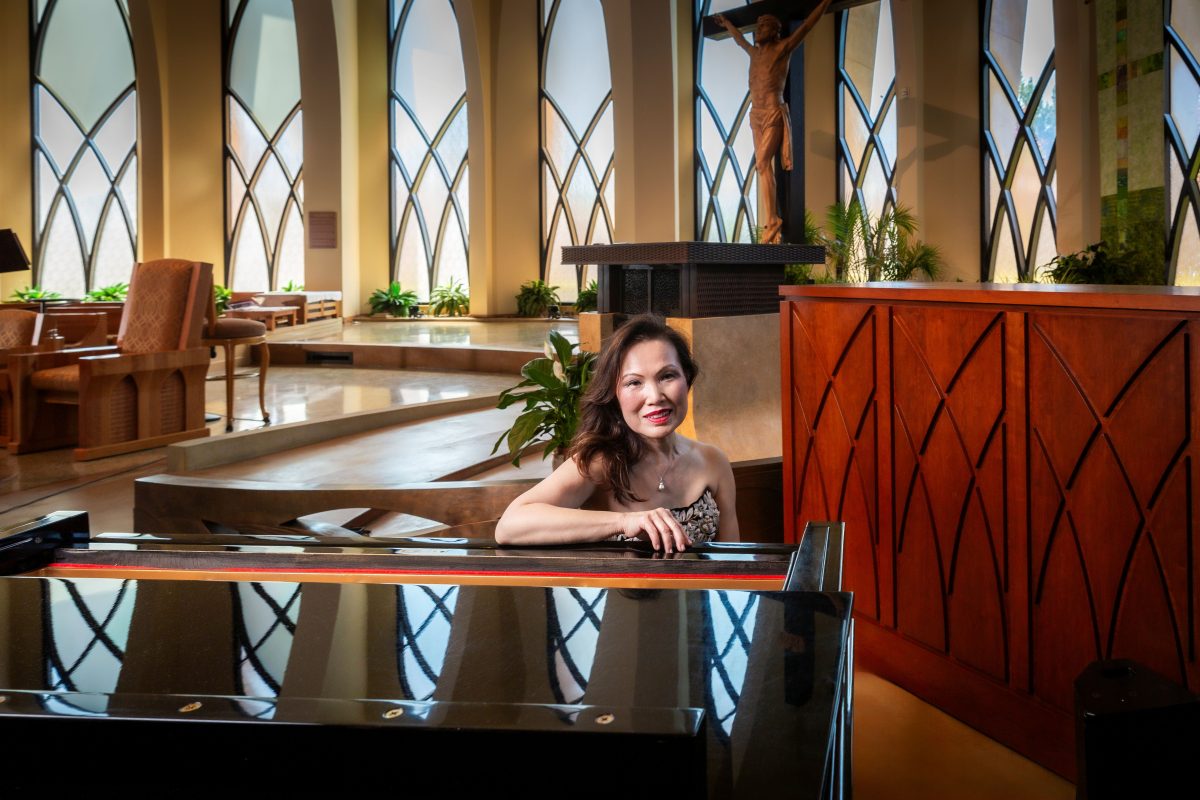
Concert pianist Anli Lin Tong performs on Sunday, August 3, at St. John Fisher Church in Rancho Palos Verdes. Photo by Patrick Smyth
The deciding factor, she says, “was when I found out on June 24 from Dr. Nolan himself that the bell was going to be installed on July 18th, and (on August 9) both bells would be rung exactly on 11:02, “the time when the bomb was dropped.”
The clock was ticking.
“I had two weeks to pull this together for the program,” Anli says, “and I wanted to do it at St. John Fisher because of the Catholic church, and it’s also my parish.”
But there was a potential snag: one pastor was leaving and so a formal approval was needed from the incoming pastor, who began his duties on July 1. Fortunately, he had no objections, and “on July 2 was when we knew this was a go.”
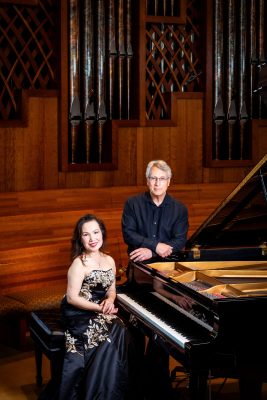
Anli Lin Tong and Grant Hungerford. Photo by Patrick Smyth
St. John Fisher’s music director Grant Hungerford also saw the importance of Anli’s concert proposal:
“I had started using the popular app Hallow, and as a Lenten meditation they presented an audio version of the book, ‘The Bells of Nagasaki,’ by Takaski Nagai, with reflections on it. So when Anli approached me about the idea of a concert to connect with the ringing of the new bell at the cathedral in Nagasaki, I thought it was more than a coincidence.
“We don’t typically bring in outside groups to perform in the church for various reasons, but this offered an opportunity to bring our music ministry in service of an awareness of Catholic faith in another country where our histories are intertwined through great suffering, forgiveness, and redemption.”
There were bells…
The program, selected and arranged in order by Anli herself, begins with Rachmaninoff’s “Trio Elégiaque No. 1 for Piano, Violin and Cello,” which Anli will perform along with violinist Yutong Sharp and cellist Catherine Biagini. It is an elegy, Anli explains, to honor the souls who perished.
Anli will then perform three piano solo pieces, Rachmaninoff’s “Prelude in G# Minor, Op. 32, No. 1,” Frank LaRocca’s “Meditation,” and Rachmaninoff-Wild’s “O Do Not Grieve.” Of these shorter works, she notes, “There’s something that evokes the bells in them. Bells are a symbol of so many things about life — birth, marriage, death, funerals…”
Regarding the LaRocca composition, she says, “I heard bells in there. He wrote it for a friend who passed, so it’s a little bit of a lament, but there’s hope. Bells also symbolize hope, right? And that really is what I want to highlight. Yes, there’s tremendous tragedy in all of this, but we can’t just wallow in the tragedy.”
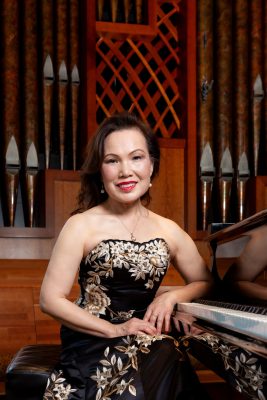
Anli Lin Tong. Photo by Patrick Smyth
“Ave Maria” then segues into one last piano solo, “Concert Etude in D-Flat Major,” by Franz Liszt. “It’s a piece that really brings comfort to the listener.”
In closing, the St. John Fisher Church Music Guild Choir will sing the “Bells of Nagasaki,” which not only fits the program but serves as a lovely tribute to Anli’s late father.
“I’m not Japanese, and neither were my parents, but they were physically connected to the horrors of the war, and yet they both came out with this amazing outlook on life. They chose hope and forgiveness.
“Dr. Nogai’s hope was for the bells to symbolize peace and to bring comfort and encouragement to those who suffered, and that’s a universal message.
“We are all tied together,” Anli says at the end of our conversation. “The fate of humanity is tied together and we have to look for the good and the noble wherever we can find it.”
In commemoration of the installation of the new bell at Nagasaki Urakami Cathedral, Anli Lin Tong presents “Bells of Nagasaki: Music for Contemplation,” to be performed at 2:30 p.m. on Sunday, August 3, at St. John Fisher Church, 5448 Crest Rd., Rancho Palos Verdes. Free. Information, sjf.org. PEN
Comments
Loading comments…