
It’s another Friday night at the Purple Orchid, and an Australian instrumental trio fusses for a while with their instruments before deciding they are ready to start playing. When they do, it’s worth the wait – the flamboyant guitar is electrifying, and the audience is riveted.
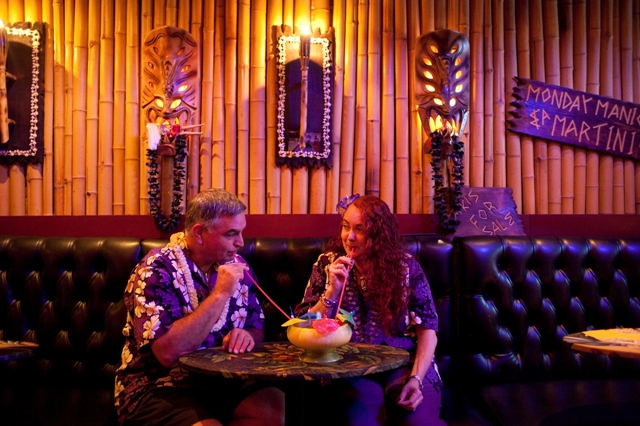
Among the crowd is a middle-aged couple wearing bright Polynesian shirts who chat with regulars between tunes and sip drinks from elaborately sculpted tiki mugs. It’s another day’s work for David and Rebecca Fernandez, owners of this back street bar in El Segundo that is a favorite local watering hole and part-time concert venue.
The Purple Orchid looks like it has been there since the 1950s, but it has only been existence for a dozen years. The tikis, lamps, and other decorative elements may look like vintage pieces, but most were crafted by the Fernandezes themselves. David explained that before he thought about getting into the business, he was attracted to the iconography of the islands.
“Six or seven years before we bought this place, I redecorated my home bar in tiki style. That’s where I tried ideas about décor that we later used here. The bamboo on the walls – we split that in our front yard with a radial arm saw. I have a great picture of Rebecca covered in sawdust – she looks like a yellow snowman.”
Rebecca continued the thought – something common with this couple, who have the telepathy that comes from long relationships.
“We decoupaged the tabletops and created the bar top – there are postcards and memorabilia from all different parts of the islands, and we poured the entire bar top with four coats of clear lacquer.”
Neither of them had any real experience in owning a bar when they started, though Rebecca had a family connection to the industry.
“My family owned a bar in San Francisco, but I chose not to be involved in it. When I was in high school I wanted to get into interior design, but ultimately didn’t want to do it for a living, just for myself. I went to work for Mattel toys, and still do today. I work full time, and this is my side job. David handles the day to day stuff here. We used to go to parties and he would tell people he was a psychologist. One of two things would happen – either they would tell him everything he didn’t want to know, or they would shut up and walk away. When he says he runs a tiki bar, there’s more to talk about. “
Rebecca wanted to open a themed bar as early as the 1980s and considered a location in Venice, but they decided that El Segundo was a better location. David wasn’t very impressed with this location.
“When we first saw it, I didn’t want to buy it. It was a dive bar called Panama’s, and in its heyday just about everyone in El Segundo went there. For the last five years it had deteriorated because the owners weren’t putting any money in – lots of the furniture was broken, the lighting was kinda cheesy.”
“It was a classic dive bar, and fights broke out all the time,” chimed in Rebecca.
“I looked at it and figured, it’s a problem,” he resumed. “Why would I want to buy a problem? Rebecca insisted it could be made into something.”
Rebecca continued, “I believed that we could do something fun and bring people in, because the city had changed. People have good jobs, and they deserve a good place to get a cocktail.”
The transformation was immediately successful, attracting a new crowd and keeping some of the patrons of Panama’s. As we sat in the bar at around 4:30 on a Friday afternoon, David could identify most of the customers by name.
“Some of these people I’ve known for twelve years. Some had been hanging out at Panama’s just put on a Hawaiian shirt and kept coming in. One told me that he was happy that I had remodeled his rec room. Daytime it’s mostly locals, evening brings in the out-of-towners and people from all over the world.”
Asked about why both locals and travelers would make El Segundo part of their itinerary, Rebecca offers, “Older people come here because they remember places like Beachbum Burt’s, and younger people – this is all new to them. It’s multi-generational. It’s exciting for them. I watch their faces as they absorb it and it’s a Kodak moment – wait, would that now be a Facebook moment? An Instagram moment?”
This time it’s David’s turn to finish the thought. ”They see people sitting around communally, drinking from big bowls with long straws, and you can see that it’s a whole new idea to them.”
People find out about the tiki bar phenomenon through a network that was just getting started at the time they were starting their venture.
“I was researching tiki bars and found out about a zine called Tiki News. It showed me that there were other people who were doing the same thing I was doing – seeking out tiki bars and the culture surrounding them. One of the people who ran that zine was Otto von Stroheim, who runs the Tiki Oasis gathering every year in San Diego, and through that we got connected with this huge and expanding culture. We knew there were people who had that interest, but had no idea there were that many. The website called tikicentral.com is probably the best single place to get connected.”
The Purple Orchid has gained a wide following through Tiki Cental and Tiki Oasis, and David’s version of Trader Vic’s Grog won an award at this year’s event. Like many beverages served here, you can quaff it from a souvenir mug, and David is happy to explain the provenance.
“An El Segundo artist named Marcus Cove collaborated with us to design these. He worked for Mattel designing things like Barbie’s shoes and earrings – this is more fun. We have two drinks that we invented that are monkey-themed, the Curious George and the Funky Monkey, and we serve them in cups with a monkey on the cup, smoking a cigarette and wearing a fez. I hope Mark meant to do this, but the face on the monkey looks like him…”
The bands are a big draw here, though there is no regular schedule for shows. As Rebecca explained, “We don’t do bands every weekend because we want to find bands that are good and fun, not to book anybody we can find because we have to have a band that night.”
David continued, “There’s a surf guitar culture, and they have their heroes and show up when they play here. It’s not star-driven, though – the audience doesn’t care what your name is if you can really play. The people who don’t know this music are surprised and impressed when they see the bands we book – they really put on a show. We get bands from all over the place… Italy, Australia, and Germany just in the last few months… The Swedish surf band was really good, and we had a great band from Estonia a while ago. It’s about the music – doesn’t matter what language you speak because it’s instrumental.”
Asked whether they think they’ll stay in this business, both laughed and nodded affirmatively. David was first with an answer. “I’m in this for life – I’m going to die in my office at the age of 100, counting money. I can’t imagine anything that will give me more pleasure than being in this business – everybody knows me, and they appreciate what I do.”